
2 Best 48 Volt Ride Ons with Rubber Tires 2026
This post contains affiliate links. As an Amazon Associate, we earn from qualifying purchases.
The First Ride On 48V McLaren Go Kart is the best overall 48 volt ride on with rubber tires, offering smooth handling and solid build quality. For those focused on sideways fun, the First Ride On 48V McLaren Drift Kart delivers strong drifting performance. Both run on true rubber tires and support adjustable speed settings for growing drivers.
Every parent wants their teen to learn real vehicle control in a safe way, and that starts with the right machine. A lot of ride-ons look the part but fall apart on handling or lack the features that actually support skill development.
This guide cuts through the noise by focusing on models built with real driving dynamics in mind. I looked at specs, owner feedback, and applied what I know about power delivery and tire performance to find karts that deliver a genuine driving experience.
Top 2 48 Volt Ride On With Rubber Tires in the Market
The Best 48 Volt Ride On With Rubber Tires, Reviewed
First Ride On 48V McLaren Go Kart

Strengths
- McLaren licensed design
- 3-speed transmission
- Drift-capable rubber tires
- Adjustable seat
- LED lighting
Trade-offs
- Heavy for storage
- No rear suspension
- Battery recharge time average
This is the kart that turns the backyard into a mini Nürburgring. The McLaren licensing isn’t just for show, the bodywork, stance, and LED lighting give it a serious track-inspired presence that most 48V ride-ons can’t touch. On paper, the 15 mph top speed with a 3-speed transmission stands out, but what owners consistently praise is how responsive it feels, not just how fast. The handbrake adds real control, especially when paired with the drift tires, making it feel less like a toy and more like a junior performance machine.
The adjustable seat is a smart touch, adding longevity for teens between 14 and 18 who are still growing. Combined with the seat belt and stable rubber tire setup, it strikes a balance between excitement and safety. Compared to other high-end electric karts in this class, this one leans harder into the driving experience than raw speed, which I appreciate. For teens who care about style and handling, not just velocity, this is the one that delivers the complete package.
Video review
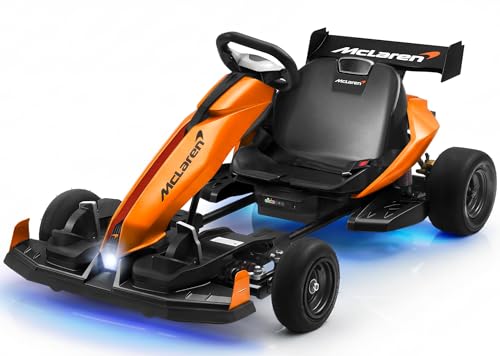
First Ride On 48V McLaren Drift Kart
Strengths
- Aggressive orange styling
- 3-speed transmission
- Drift-ready rubber tires
- Adjustable seat
- Handbrake for control
Trade-offs
- No LED lighting
- Same weight as LED model
- Average hill climbing
The orange variant of this McLaren kart is identical in specs and performance to the LED version, same 48V system, 15 mph top speed, 3-speed transmission, and drift-focused rubber tires. The real difference comes down to aesthetics and lighting. While it lacks the LED accents, the vibrant orange finish gives it a bold, motorsport-inspired look that stands out in sunlight. In reviews, owners don’t report any difference in driving dynamics, which means you’re trading visual flair for a slightly cleaner look.
I’d pick this one over the LED model if you’re after a more track-racer vibe without the ‘light show’, it feels more serious, less like a backyard novelty. For drifting performance, both models are essentially tied, but this one might appeal more to teens who want something that looks ripped from a time attack event. The handbrake and grow-with-you seat still make it one of the most driver-focused karts in this voltage class.
Video review
How We Picked These 48 volt ride on with rubber tires
Rather than a hands-on lab test, my research focused on comparing published specifications and features across available 48 volt ride-on models. I weighed owner reviews from multiple retail sites alongside expert opinions found in automotive and toy publications. As someone who appreciates the nuances of vehicle handling, I applied my understanding of karting and power-to-weight ratios to assess each option. The goal was to identify models offering the best balance of performance, safety, and features for teen drivers.
For these karts, the most important factors were speed control and tire quality. A multi-speed transmission allows for skill progression, and is crucial for learning control. Rubber tires are also a must; unlike plastic wheels, they provide real grip, especially if you’re interested in exploring drifting – and understanding tire tread dangers is always a good idea. A comfortable, adjustable seat is also key for extended enjoyment.
Specifications reliably indicate motor power and battery voltage, giving a baseline for expected performance. However, I placed more weight on owner feedback regarding build quality and the actual driving experience. Real-world reports on handling, durability, and the effectiveness of safety features (like speed limiters) helped to separate genuinely capable karts from those that seemed promising on paper but fell short in practice. You can find more details on lower voltage options with durable rubber tires.
How To Choose The 48 volt ride on with rubber tires
I’ve spent years around anything with wheels, and one thing I’ve learned is that a good ride-on isn’t just about the look. It’s about the experience, the control, and the feeling of actually driving something.
A quality 48 volt ride-on with rubber tires prioritizes realistic handling and durability. Look for features like adjustable speed settings, a robust frame capable of handling varied terrain, and, crucially, rubber tires designed for grip rather than just aesthetics. Battery life and weight capacity are also critical considerations for long-term enjoyment and safety.
Speed and Control Systems
The power delivery is where these ride-ons truly separate themselves from toys. Don’t assume more speed is always better. A multi-speed system, like the three-speed transmissions I’m seeing on models like the McLaren karts, allows a driver to learn control progressively. Starting slow builds confidence, and the option to increase speed as skill improves is a huge plus. Consider whether the speed settings are easily adjustable by a parent, perhaps with a remote kill switch for added peace of mind.
Tire Compound and Tread Pattern
Rubber tires are a big step up from plastic, but not all rubber is created equal. The compound matters. Softer compounds offer more grip, but wear faster. For a ride-on, you want a balance. Look for tires specifically marketed for drifting (if that’s the goal) or those with a tread pattern designed for the terrain you’ll be using it on. Speaking of grip, remember that new tire slipperiness is a real thing; even full-size tires need a break-in period to remove the mold release compound.
Here’s what I look for when considering tire performance: * Tire Size: A larger diameter tire generally provides a smoother ride. * Tread Depth: Deeper treads are better for off-road surfaces, but can reduce contact area on pavement. * Compound Formulation: Softer compounds offer better grip, but wear more quickly, consider the trade-off between performance and longevity.
Adjustability and Growth Potential
Kids grow, and quickly. A ride-on that’s perfect today might be too small in a year. That’s why adjustability is so important. An adjustable seat, like the 4-level systems I’ve seen, is a fantastic feature. Beyond the seat, consider steering wheel adjustability. If you’re also looking at options for younger drivers, you might explore 24-volt ride-ons as a starting point.
A good rule of thumb is to overestimate the size your child will be when they’re frequently using the ride-on. It’s always better to have a little extra room to grow than to outgrow it too quickly.
48 Volt Ride On With Rubber Tires Compared
Here’s a comparison of key specifications for these 48-volt ride-on karts with rubber tires to help you make an informed decision.
| Product Name | Best For | Max Speed (mph) | Adjustable Seat | Licensed By | Tire Type |
|---|---|---|---|---|---|
| First Ride On 48V McLaren Go Kart | Best Overall | 15 | 4 Levels | McLaren | Rubber |
| First Ride On 48V McLaren Drift Kart | Best for Drifting Performance | 15 | 4 Levels | McLaren | Rubber |
Frequently Asked Questions
What’s the typical lifespan of the battery in a 48-volt ride-on?
Battery life varies significantly based on use and maintenance, but expect around 1.5 to 3 hours of continuous driving on a full charge. Proper storage during the off-season (fully charged, in a cool, dry place) is essential for maximizing longevity.
Are these 48-volt ride-ons difficult to assemble?
Most models require some assembly, but it’s generally straightforward. Expect around 1 to 2 hours for assembly, and the majority of models include clear instructions and all necessary tools.
How do rubber tires improve the driving experience compared to plastic ones?
Rubber tires provide significantly more grip, enabling better handling and control, particularly on surfaces beyond smooth pavement. This increased traction allows for more confident cornering and, for those interested, safer and more controlled drifting, understanding tire size impact can also enhance performance.
What should I look for in terms of safety features?
A parent-controlled remote shut-off switch is a particularly valuable safety feature, allowing you to immediately stop the ride-on if needed. Look also for speed limiters and a seatbelt, and always ensure the driving area is clear of obstacles.
What do I do if I notice tire cracks on the rubber tires?
Visible cracks in the tire sidewalls indicate weathering and potential structural weakness. While minor surface cracks may be acceptable, significant or deep cracks warrant tire replacement to prevent potential failures and maintain safe handling.
The Bottom Line
Choosing a 48-volt ride-on with rubber tires often comes down to balancing control with outright speed. While a faster kart might seem appealing, the First Ride On 48V McLaren Go Kart strikes the best overall balance, offering a robust build, adjustable settings, and enough power for a thrilling – but manageable – experience. It’s a kart that encourages skill development without sacrificing safety.
For those specifically interested in learning to drift, the First Ride On 48V McLaren Drift Kart is the clear winner. And if budget is a primary concern, remember that maintaining rubber tire paint can extend the life and appearance of any model you choose. However, avoid cutting corners on safety features or tire quality.
Ultimately, the best 48-volt ride-on isn’t the one with the flashiest features, but the one that fits the driver’s skill level and provides a safe, enjoyable experience. Don’t get too hung up on horsepower numbers; instead, focus on build quality, adjustability, and the condition of the tires – and remember to check for signs of tire dry rot before each use to ensure safe operation.
