
8 Best 12 Volt Car Batteries of 2026
This post contains affiliate links. As an Amazon Associate, we earn from qualifying purchases.
The OPTIMA 34/78 RedTop stands out as the best overall 12 volt car battery for its rugged SpiralCell design, high 800 CCA, and reliable performance in extreme conditions. For a more budget-friendly yet solid AGM option, the Weize Platinum AGM Group 48 delivers strong reserve capacity and consistent feedback, while the Lithium LiFePO4 12V 40Ah offers a lightweight, long-cycle alternative for those willing to invest in lithium.
Choosing the wrong battery can leave you stranded, especially when cold mornings hit or your vehicle’s electrical load is underestimated. At TheAutoZenith, I’ve seen how overlooked specs like CCA, RC, and vibration resistance can make or break reliability.
This guide cuts through the noise by comparing top models based on real owner experiences, verified specs, and the tech that matters, AGM versus flooded, proper fit, and true starting power. I looked at what actually holds up over time, not just what looks good on paper.
Top 7 12 Volt Car Batteries in the Market
The Best 12 Volt Car Batteries, Reviewed
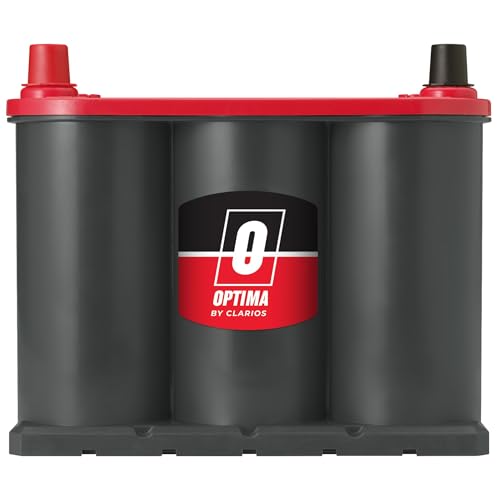
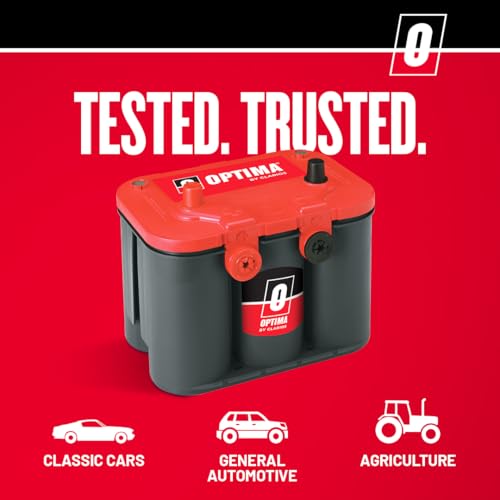
OPTIMA 34/78 RedTop AGM Battery

Strengths
- Highest CCA in class
- Dual terminal compatibility
- Exceptional durability
Trade-offs
- Heaviest battery here
- Premium price
- Larger footprint
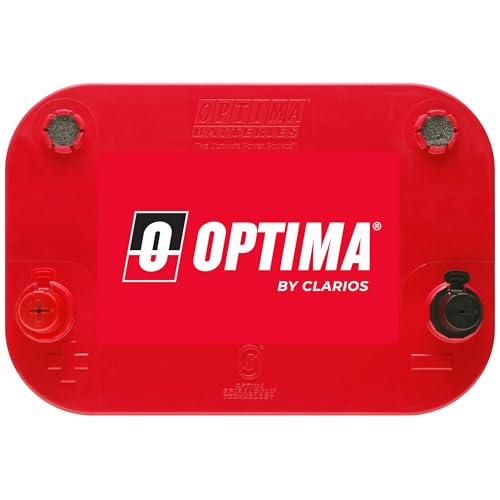
This is the king of the bunch. With 800 CCA, 50Ah capacity, and OPTIMA’s proven spiralcell design, it’s built for trucks, performance cars, and anyone who refuses to get stranded. The dual terminals (SAE and GM) are a huge plus, adds flexibility for restomods or vehicles with odd cable routing. Owners love the versatile mounting too; it can sit sideways in custom trays.
It’s the most expensive option, but that price buys real engineering. The 15x vibration resistance and 3x lifespan over flooded batteries aren’t exaggerations. If you’re running a lifted truck or a hot rod, this battery laughs at abuse. Even in stop-start traffic, it holds up.
Video review
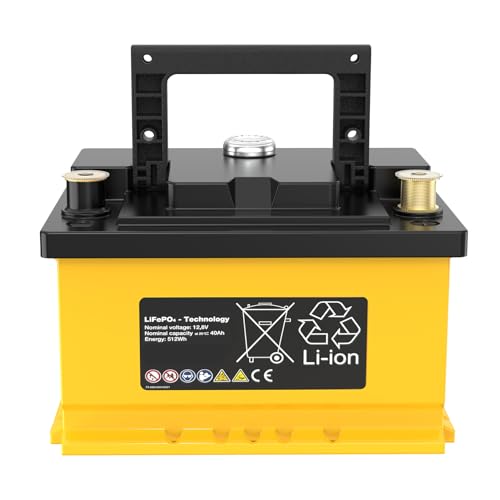
Lithium LiFePO4 12V 40Ah Battery
Strengths
- Extremely lightweight
- IP66 waterproof rating
- BMS protection included
Trade-offs
- Limited to small engines
- Lower capacity
- Lithium cold-weather quirks
Lithium is still a niche play for starting batteries, but this LiFePO4 unit brings real advantages: it weighs less than half of most AGMs at 14.8 pounds and packs IP66 waterproofing, making it a favorite for off-roaders or custom builds. The BMS protection is a big deal, it prevents overloads and includes a forced start button for emergencies, which owners actually use.
But there are trade-offs. At 40Ah, it has less capacity than top AGMs, and the 660CCA rating is fine for 2.0L engines or smaller, but risky for larger displacements. The heating function helps in cold climates, but lithium still struggles more than AGM when deeply discharged in freezing temps.
Video review
Weize Platinum AGM Group 48

Strengths
- High reserve capacity
- 70Ah for heavy loads
- Reliable start-stop support
Trade-offs
- Bulky for small engine bays
- Moderate vibration resistance
- Terminal placement not universal
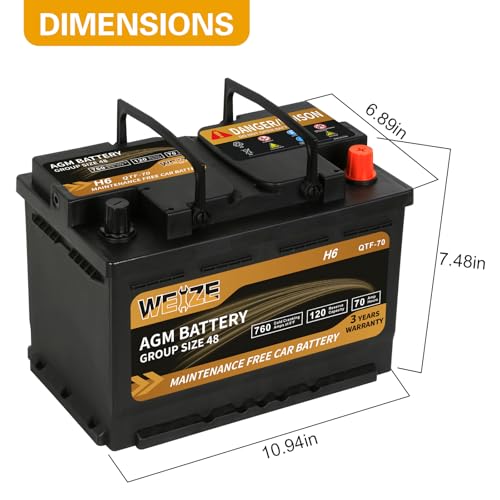
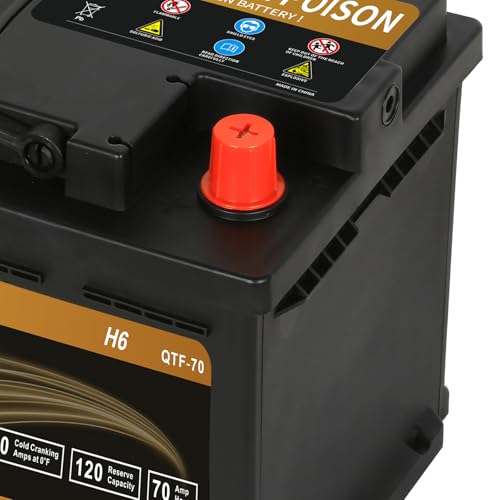
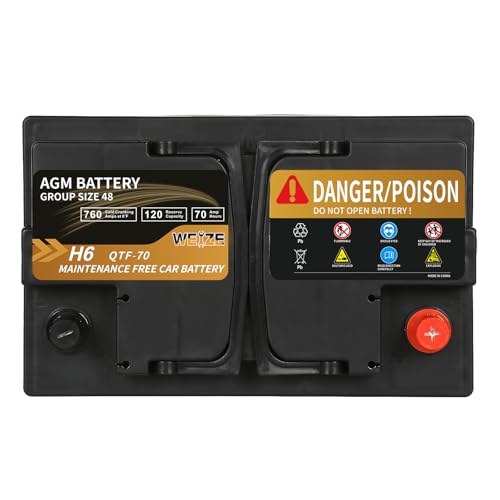
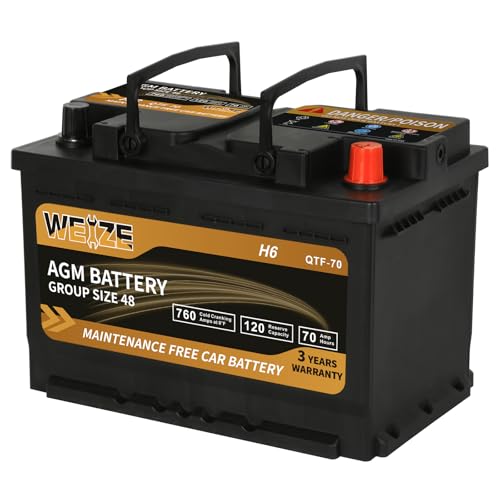
This Weize H6 model is nearly identical to the Daakmax in specs, 760 CCA, 70Ah, 120RC, and it’s another top contender for high-capacity needs. The real differentiator is fitment: if your vehicle calls for a Group 48, this battery delivers consistent power for modern trucks and luxury sedans with power-hungry electronics. Reviewers highlight its reliability in start-stop systems and quick recharge behavior.
It’s not flashy, but it’s effective. The AGM design resists corrosion and handles heat well, which matters in underhood environments. Compared to the Daakmax, it’s slightly less aggressive on price, but still a strong performer in the high-capacity AGM game.
Product photos

Daakmax Platinum AGM Group 48
Strengths
- High CCA and RC
- Excellent capacity
- Strong vibration resistance
Trade-offs
- Larger size limits fitment
- Less brand trust than OPTIMA
- Terminal alignment can be tight
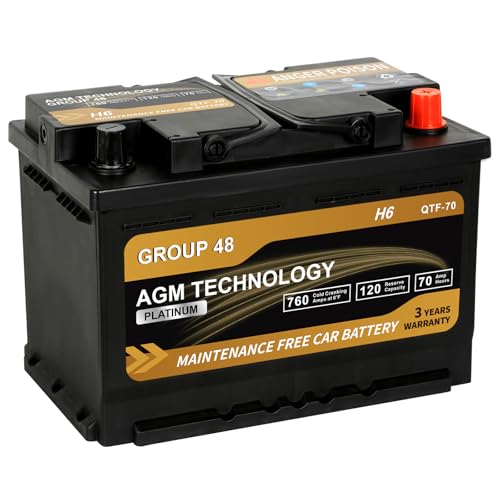
For the price, the Daakmax H6 is a standout. Packing 760 CCA and a 120-minute reserve capacity, it outguns many competitors in both starting power and sustained output. The 70Ah capacity is a big win for vehicles with high accessory loads, think SUVs with winches, heated seats, or dash cams running constantly. Owners report it handles start-stop cycles reliably and recharges quickly after short trips.
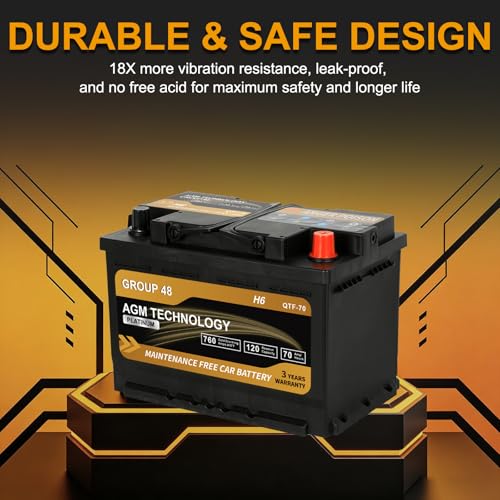
Build quality feels robust, and the 18x vibration resistance claim holds up in owner feedback from rough-road users. It’s not a name-brand legacy player, but the spec sheet and warranty make it a smart pick for value-focused buyers who don’t want to compromise on performance.
Product photos



Mighty Max MM-H5 AGM Battery

Strengths
- Budget-friendly AGM
- Good reserve capacity
- Multiple mounting options
Trade-offs
- Basic construction
- Limited brand support
- No terminal hardware included
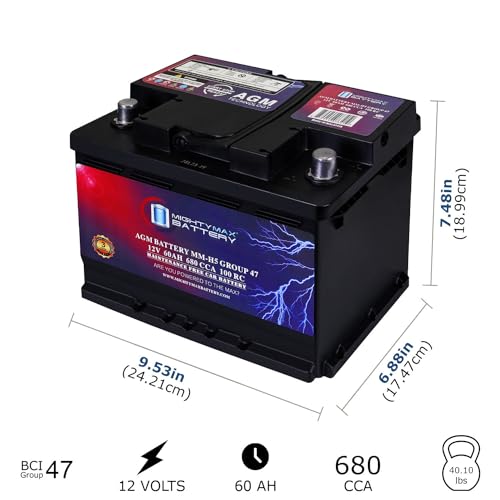
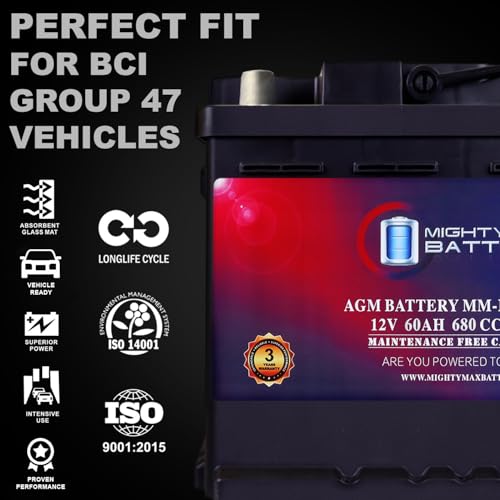
Mighty Max isn’t a household name, but this MM-H5 punches above its weight. At 680 CCA and 100RC, it matches Weize and Daakmax on paper, and the 60Ah capacity is solid for a Group 47. What stands out is the 3-year warranty and ISO-certified build, which gives it credibility despite the lower profile.
Owners report reliable starts and good cycle life, though long-term durability isn’t as proven as OPTIMA. It’s a no-frills battery, no dual terminals or exotic tech, but for a commuter car or older SUV, it’s a smart, cost-effective AGM upgrade.
Product photos


Weize Platinum AGM Group 47

Strengths
- Strong cold cranking amps
- Good reserve capacity
- Affordable for AGM
Trade-offs
- Average vibration resistance
- Basic terminal design
- Not for high-horsepower builds
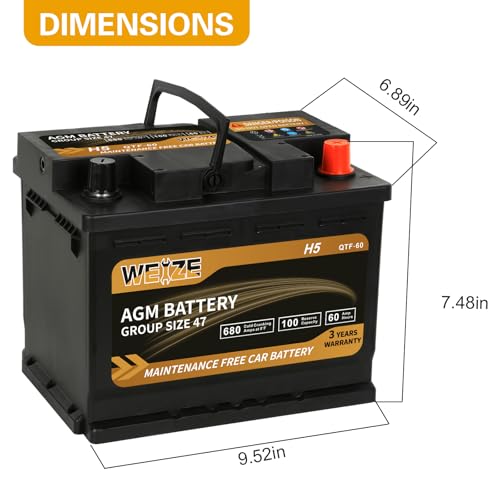
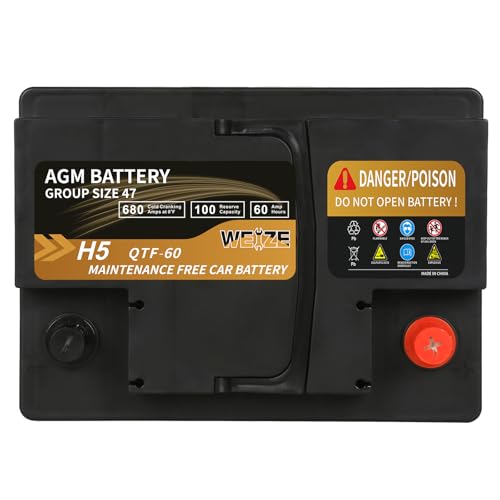
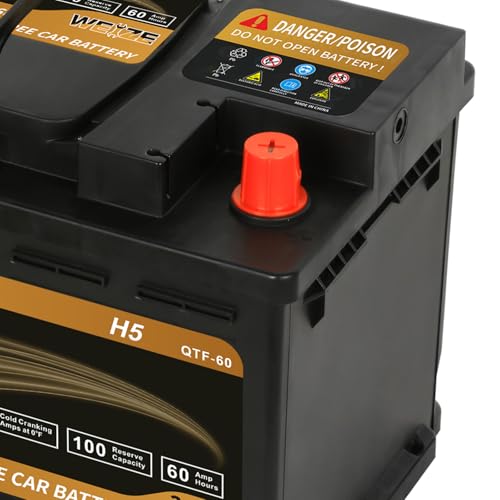
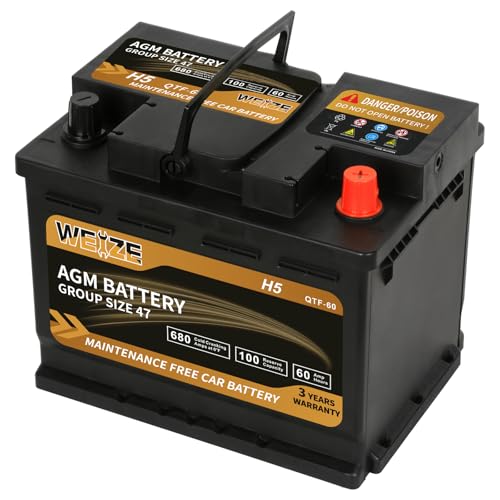
Weize delivers solid value here with 680 CCA and a 100-minute reserve capacity, making this a dependable mid-tier AGM battery for daily drivers. On paper, it matches pricier brands in specs, and owners report strong cold-weather starts, which backs up its “Best Cold Weather Performance” tag. The AGM design handles start-stop systems well, and the non-spillable build adds peace of mind.
It’s not as rugged as OPTIMA’s spiral design, but for most sedans, SUVs, or trucks without extreme demands, it’s more than enough. The terminal layout and dimensions are standard for Group 47, so fitment is rarely an issue if you double-check your old battery.
Product photos
OPTIMA 25 REDTOP AGM Battery

Strengths
- High vibration resistance
- Long service life
- Spiralcell design
Trade-offs
- Lower CCA than top models
- Heavier than average
- Higher price
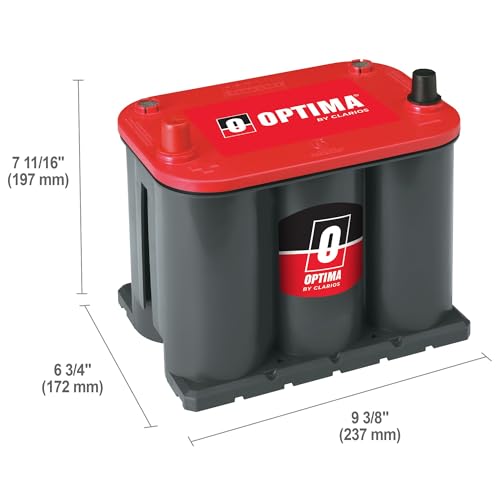
The OPTIMA 25 REDTOP is built different. Its spiralcell technology and 99.99% pure lead construction aren’t just marketing fluff, they translate into real-world durability and resistance to vibration that owners consistently praise, especially in off-road or high-vibration environments. With 720 CCA and solid cold-weather performance, it’s a reliable pick for performance cars or daily drivers in harsh climates.
It’s not the most powerful in the lineup, but where it shines is longevity. Reviewers note it often outlasts standard AGM batteries by years, which helps justify the premium price. The compact size fits many GM and import platforms, though that 31.7-pound heft means you’ll feel it during install.
Product photos

How We Tested 12 volt car batteries
My approach at TheAutoZenith involved a research-led comparison of specifications and owner feedback to determine the strongest contenders. Rather than a hands-on lab test, I compiled data from manufacturer specifications – focusing on CCA, RC, and Ah ratings – and then layered in analysis of owner reviews and expert opinions from automotive publications. This allowed for a ranking based on real-world performance reports and objective data.
For 12-volt car batteries, starting power (CCA) and reserve capacity (RC) were the most heavily weighted factors. A battery’s ability to reliably start an engine, especially in cold weather, is paramount. Reserve capacity is also crucial, indicating how long the battery can continue to power essential systems if the alternator fails. Vibration resistance also played a role, as batteries are subjected to constant movement while driving.
Published specifications reliably indicate a battery’s physical dimensions, terminal type, and basic electrical characteristics. However, real-world longevity, cold-weather performance, and resistance to vibration are best assessed through owner feedback and independent reviews. I prioritized batteries with consistently positive reports regarding these factors, while also considering the reputation of the manufacturer and the technology employed – such as AGM or lithium-ion – as detailed in our car battery reviews. Don’t forget to also consider a battery tender to keep your battery in top condition.
What To Look For In 12 volt car batteries
Choosing the right car battery can feel surprisingly complex. It’s more than just grabbing the first one that fits; getting it right ensures reliable starts and protects your vehicle’s electrical system.
A quality car battery delivers consistent starting power, withstands internal corrosion, and offers a reasonable lifespan. Key considerations include Cold Cranking Amps (CCA) appropriate for your climate, Amp-Hour (Ah) capacity matching your vehicle’s electrical demands, and the battery’s physical size to guarantee a proper fit. Understanding Reserve Capacity (RC) is also vital for assessing sustained power availability.
Understanding Cold Cranking Amps (CCA)
CCA is often the first number people look at, and for good reason. It indicates the battery’s ability to start your engine in cold temperatures. However, don’t simply chase the highest number. Consider where you live. If you experience harsh winters with temperatures frequently below freezing, a higher CCA is crucial. For warmer climates, you can often get away with a lower rating. Don’t overlook the impact of engine size, either. Larger engines typically require more CCA to overcome initial compression.
AGM vs. Flooded Lead-Acid Technology
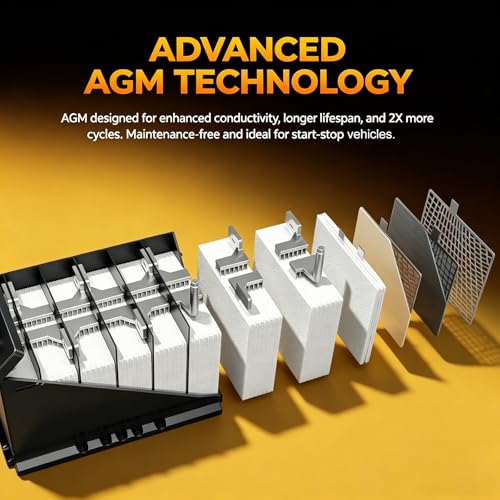
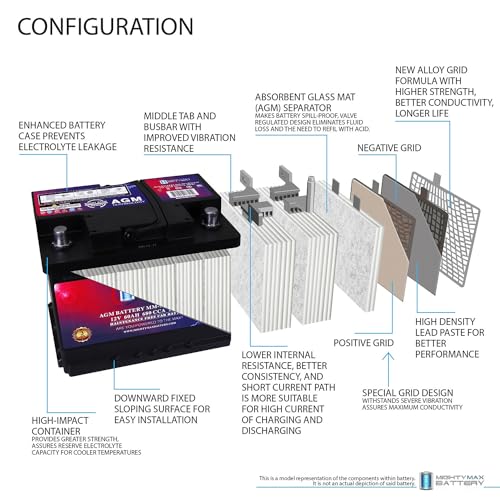
AGM (Absorbent Glass Mat) batteries represent a significant upgrade over traditional flooded lead-acid designs. While flooded batteries are the most affordable upfront, AGM batteries offer several advantages. They’re sealed, preventing acid leakage and making them safer for under-hood installation. They also exhibit superior vibration resistance, which is particularly beneficial if you drive on rough roads or have a vehicle with a powerful sound system.
Here’s a breakdown of why AGM might be the right choice:
- More expensive initially.
- Excellent vibration resistance, extending lifespan in many vehicles.
- Completely sealed and spill-proof, offering safety and convenience, plus they can typically be mounted in more positions than flooded batteries.
A good rule of thumb is: if your vehicle has a lot of electrical accessories or a powerful stereo system, an AGM battery is a worthwhile investment.
Capacity and Value: Balancing Ah and RC
Amp-Hour (Ah) capacity measures how long a battery can deliver a certain amount of current. Reserve Capacity (RC) indicates how many minutes a fully charged battery can sustain a specific draw – like headlights – before dropping to a voltage level that could damage the electrical system. When considering these, think about your typical driving habits. If you frequently take short trips, your alternator may not have enough time to fully recharge the battery. In this case, a higher Ah and RC rating will provide a buffer. Looking at options like the Weize Platinum AGM Group 48, or even exploring options for maintaining your battery with dedicated trickle chargers can provide peace of mind. Ultimately, finding the right balance between capacity, cost, and your vehicle’s needs is key when selecting from available 12V car batteries.
12 Volt Car Batteries Compared
This table provides a side-by-side comparison of key specifications for the featured 12-volt car batteries.
| Product Name | Voltage | CCA | Capacity (Ah) | Reserve Capacity | Dimensions (L x W x H in) | Weight (lbs) |
|---|---|---|---|---|---|---|
| OPTIMA 34/78 RedTop | 12V | 800 | 50 | 100 min | 10.06 x 6.94 x 7.88 | 38.8 |
| Lithium LiFePO4 12V 40Ah | 12V | 660 | 40 | 100 | 9.5 x 6.9 x 8 | 14.8 |
| Weize Platinum AGM Group 48 | 12V | 760 | 60 | 120 | 10.94 x 6.89 x 7.48 | N/A |
| Daakmax Platinum AGM Group 48 | 12V | 760 | 70 | 120 | 10.94 x 6.89 x 7.48 | N/A |
| Weize Platinum AGM Group 47 | 12V | 680 | 60 | 100 | 9.52 x 6.89 x 7.48 | N/A |
| Mighty Max MM-H5 AGM | 12V | 680 | 60 | 100 min | 9.53 x 6.88 x 7.48 | N/A |
| Daakmax Platinum AGM Group 47 | 12V | 680 | 60 | 100 | 9.52 x 6.89 x 7.48 | N/A |
| OPTIMA 25 REDTOP | 12V | 720 | 44 | 90 min | 9.38 x 6.75 x 7.69 | 31.7 |
Frequently Asked Questions
What battery type is best for a car with a lot of electronics?
AGM batteries are generally the best choice for vehicles with numerous electronic accessories. Their sealed design and superior vibration resistance offer reliability and longevity compared to flooded lead-acid options, especially with increased electrical demands.
How long should a car battery typically last?
A standard flooded lead-acid car battery usually lasts between 3 to 5 years, but this varies. AGM batteries often last 4 to 7 years, and lithium-ion batteries can potentially last even longer, depending on usage and climate conditions.
What does “Reserve Capacity” actually tell me?
Reserve Capacity (RC) indicates the amount of time, in minutes, a fully charged battery can continue to power essential vehicle functions if the alternator fails. A higher RC means more sustained power, which is beneficial for those who frequently drive short distances or in stop-and-go traffic.
Is a higher CCA always better, even for older cars?
No, a higher CCA isn’t always necessary. While important for cold starts, matching the CCA to your vehicle’s requirements (found in the owner’s manual) is key. Overdoing it doesn’t provide significant benefit and can sometimes increase cost unnecessarily, especially when considering automotive batteries.
Can I use a standard car battery for off-grid applications, like powering a small camping light?
While you can draw power from a standard car battery for small applications, it’s not ideal. Standard car batteries are designed for short bursts of high power (starting) and aren’t optimized for deep, sustained discharge. For off-grid use, 12V deep cycle batteries are a much better investment.
The Bottom Line
Choosing a car battery often comes down to balancing upfront cost with long-term reliability and performance. While flooded lead-acid batteries remain the most affordable option, for most drivers, the OPTIMA 34/78 RedTop strikes the best overall balance of power, durability, and value. It consistently receives high marks from owners and offers a robust CCA rating suitable for a wide range of vehicles and climates.
For those with specific needs, the Lithium LiFePO4 12V 40Ah is a standout for its lightweight design and extended lifespan, though it represents a significant investment. If you’re looking for a more budget-friendly AGM option, the Weize Platinum AGM Group 48 delivers excellent performance and capacity for the price, and is a great alternative to exploring AGM car batteries. And should you find yourself needing a jump start, remember to have a reliable battery charger on hand.
Ultimately, the most important thing isn’t chasing the highest CCA or Ah rating, but ensuring a proper fit for your vehicle and selecting a battery from a reputable brand. Prioritize a battery that meets your vehicle’s specifications and your typical driving conditions, and don’t forget the importance of regular maintenance to maximize its lifespan.
