
Are UTV Windshields Necessary? Learn the Critical OEM Risks
This post contains affiliate links. As an Amazon Associate, we earn from qualifying purchases.
A UTV windshield is necessary for protection from debris, wind, and weather, but its design and use come with non-negotiable OEM safety mandates that override convenience. Kolpin’s installation manuals explicitly state that open positions on full tilting windshields are for low-speed riding only, and trailering a vehicle facing forward with a tilting windshield not fully closed and tightened can allow airflow to separate the shield, resulting in “severe injury or death.”
That gap between the obvious benefit and the catastrophic, manufacturer-documented risk is where the real decision lives. A windshield isn’t just a piece of plastic or glass you bolt on; it’s a stressed component that changes the vehicle’s aerodynamics and your operational checklist.
What follows: the OEM warnings most competitors don’t quote, the hard speed limit for flip-up designs, the part-number trap for lightbar owners, and the dust problem that persists even with a rear panel. By the end, you’ll know exactly when a windshield shifts from a comfort accessory to a liability.
Key Takeaways
- OEM manuals for brands like Kolpin contain explicit, all-caps warnings that tilting windshields opened are for low-speed riding only and that improper trailering can lead to separation, accident, and death.
- If you regularly exceed 30 mph, a full fixed windshield is the only safe choice; half shields and open tilting models create a wind-tunnel effect that can destabilize the vehicle.
- Specific Polaris glass windshield kits have exact part-number compatibility (P/N 2883753 vs. P/N 2884625) based on your roof’s lightbar pocket, getting it wrong means a failed install.
- Dust intrusion with a full windshield is a near-guarantee without a sealed cab; a rear panel helps but doesn’t eliminate it, turning the cab into a dust bowl on dry trails.
- Installation is a two-person, 30-minute job requiring a 4mm hex key and torque checks, not a solo quick bolt-on.
The OEM Warning Most Owners Miss
You buy a windshield for protection. The manual that comes with it lists ways it can kill you. That’s not scare talk; it’s the verbatim language from Kolpin’s PDF instruction sheets, and ignoring it is how accessories become projectiles.
OPEN POSITIONS ON FULL TILTING WINDSHIELDS ARE DESIGNED FOR LOW-SPEED RIDING ONLY.
The clause is unambiguous. A tilting windshield, the kind that flips up at the bottom for ventilation, is not a convertible top. Open it while cruising at trail speed, and you’ve created a giant air scoop. The wind load on the hinge and mounting points wasn’t engineered for that. Stress fractures start at the clamp points you never think to check.
The second warning is even more direct.
IF VEHICLE IS TRAILERED FACING FORWARD, FULL TILTING WINDSHIELDS MUST BE IN THE CLOSED POSITION WITH TILTING T KNOBS TIGHTENED. FAILURE TO CLOSE AND SECURE THE WINDSHIELD MAY ALLOW AIRFLOW TO SEPARATE WINDSHIELD FROM VEHICLE, RESULTING IN AN ACCIDENT AND SEVERE INJURY OR DEATH.
The manual goes further: do not trailer facing rearward with any windshield installed at all. The airflow can still catch it. Your choices are remove it, or use an enclosed trailer. Most owners never read page one. They click “I Agree” and bolt it on.
These aren’t suggestions. They’re the conditions of the one-year warranty Kolpin offers. Your insurance claim after a highway incident will hinge on whether you followed them.
| OEM Mandate (Kolpin) | Correct Action | Consequence of Skipping |
|---|---|---|
| Open tilting windshield use | Low-speed riding only | High-speed wind load risks hinge failure, separation |
| Trailering forward | Closed, T-knobs tightened | Airflow separation, projectile hazard, voided warranty |
| Trailering rearward | Windshield removed | Same separation risk, denied insurance claim |
| Clean visibility | Stop and clean at next safe spot | Reduced vision, trail accident, liability |
The takeaway is simple. A windshield’s first job is safety. Its second job is not to become a hazard itself. Reading the manual isn’t optional.
Full vs. Half vs. Flip-Up: The 30 MPH Divide
The shape of your windshield dictates the shape of your ride. Get it wrong, and comfort turns into a fight against physics.
A full windshield seals the front cockpit. It blocks wind, rain, and flying debris completely. It also creates a backdraft. Air rushing over the top curls back into the cab, bringing dust with it unless you have a rear panel or a sealed cabin. That’s the trade-off: total front protection for a dusty interior on dry days. For speeds above 30 mph, it’s the only stable option.
A half windshield, sometimes called a “sport” or “mid” shield, covers about half the opening. It deflects wind over the occupants’ heads. Your torso stays in clean air, which is cooler in summer. The problem is the wind-tunnel effect. At speed, the air rushing over the top of the half shield accelerates as it drops into the cab, creating buffeting and noise. It’s fine for sub-30 mph trail work but becomes fatiguing on long road stretches.
The flip-up or tilting windshield offers versatility, closed for full protection, flipped open at the bottom for airflow. This is where the OEM’s low-speed warning applies directly. That open position is a vent, not a cruising configuration.
Where this goes sideways: Assuming a flip-up windshield is “the best of both worlds” for high-speed use. Open it at 45 mph, and you’re testing hinge engineering against a force it wasn’t rated for. The click you hear isn’t a lock engaging; it’s plastic straining.
For most riders who mix trail crawling with faster trail connections, the full fixed windshield is the default. It’s predictable. If you live in a hot climate and rarely exceed 25 mph, a half shield makes sense. The flip-up is a specialty tool for slow, technical work where ventilation is critical, think rock crawling in summer heat. Choose the shape that matches your top speed, not the one that promises flexibility.
The Installation Reality: Two People, Three Tools, 30 Minutes
The spec sheet says “30-minute install.” That’s the best-case scenario, with two people, a clean vehicle, and all the hardware present. Trying it solo adds at least twenty minutes of frustration and risk of scratching the panel.
The tools are simple: a 4mm hex socket or key, a pair of shears or wire cutters for trimming any excess material, and scissors for opening packaging. The process isn’t about force; it’s about alignment and sequence.
Before you start: Park on a flat surface, shift into park, and remove the key. Have a helper hold the windshield against the roll cage while you loosely fit the clamps. Overtightening any one clamp before the others are seated pulls the shield out of alignment, creating stress points that crack polycarbonate in cold weather.
Here’s the sequence that avoids a return call to Kolpin’s customer service line (1-877-956-5746, which the manual says to use for missing hardware, not the store).
- Unpack and verify. Lay out every clamp, screw, and rubber grommet against the parts list. One missing M8 flange nut means a trip to the hardware store.
- Clean the mounting surfaces. Wipe down the roll cage tubes where the clamps will grip. Grit between the clamp and the tube acts as an abrasive, wearing the powder coat and loosening the grip over time.
- Position with a helper. Have your helper hold the windshield in place, aligning it evenly within the roof and hood lines. You handle the clamps.
- Finger-tighten all clamps. Get every clamp snug by hand so the shield is supported but still adjustable.
- Final torque in a criss-cross pattern. Using the 4mm hex, tighten the clamps in a criss-cross pattern, like lug nuts on a wheel. Aim for firm contact, not maximum force. Polycarbonate and acrylic crack under bending stress, not under load.
- Check for contact. Ensure no part of the windshield is touching the hood or bodywork when the suspension articulates. Vibration contact wears a hole in a single season.
Skip the helper, and you’ll spend more time wrestling the shield than installing it. Skip the criss-cross torque, and you’ll see stress cracks radiating from the top clamps after the first winter. The 30-minute estimate is honest, but only if you follow the script.
The Non-Negotiable Upkeep: Fasteners and Clarity
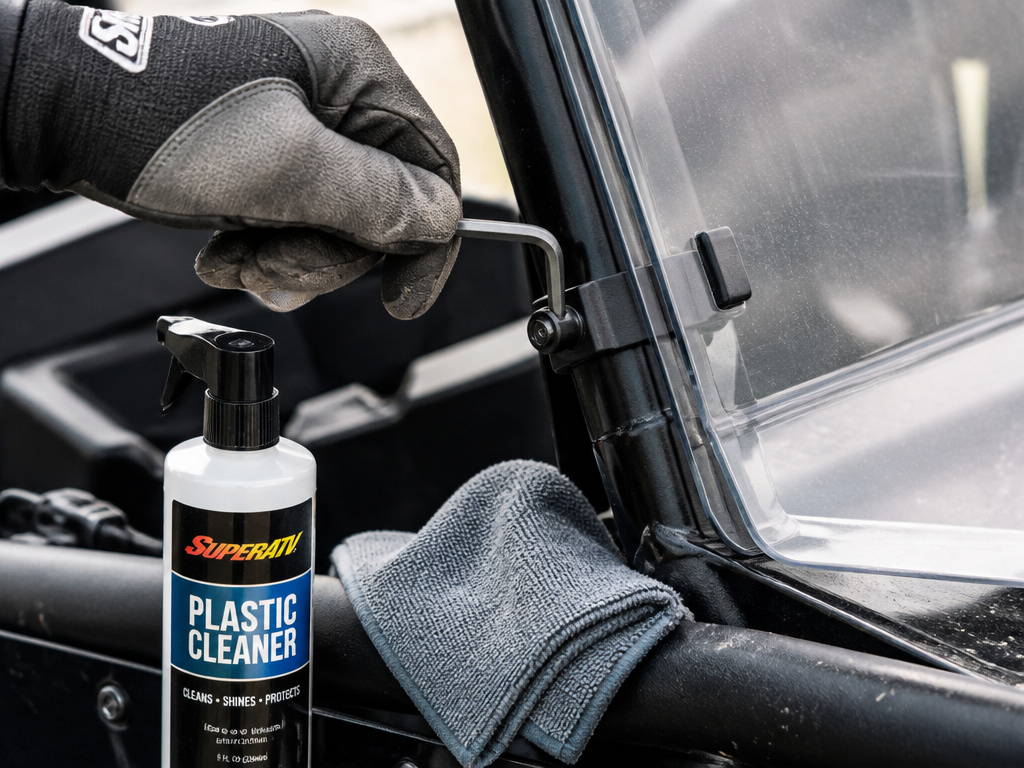
A windshield doesn’t fail all at once. It telegraphs its distress through loose fasteners and degraded clarity. Catching those signals requires a five-minute ritual before and after any significant ride.
The manual states: “PERIODICALLY CHECK FOR WEAR AND TIGHTNESS OF ALL FASTENERS. REPLACE OR RE-TORQUE FASTENERS AS NECESSARY.” “Periodically” means every 10 hours of operation or before any long trip. Vibration is a slow-acting force that works hardware loose. The front clamps take the most direct wind load and vibrate the most.
The part nobody mentions: Overtightening is as bad as undertightening. A fastener torqued past its yield point loses clamping force permanently. You feel it as a “tight” bolt that still allows movement. The fix is replacement, not more torque.
Cleanliness is a safety item, not a cosmetic one. The same Kolpin manual commands: “UTVs ARE TO ONLY BE DRIVEN WITH CLEAN WINDSHIELDS FOR DRIVING VISIBILITY. IF DIRT OR DEBRIS ACCUMULATES ON THE WINDSHIELD WHEN RIDING, STOP THE UTV AT THE NEXT SAFE LOCATION ON THE TRAIL TO CLEAR OFF THE WINDSHIELD BEFORE RESUMING RIDING.”
Mud and dust aren’t just dirty. They scratch. Wiping a dry, gritty surface with a cloth is like sanding the coating. Use water and a soft microfiber, never a dry wipe. For polycarbonate, avoid ammonia-based glass cleaners; they can haze the hard coat over time. A dedicated plastic cleaner like Plexus or a mild soap solution is the standard.
| Maintenance Item | Frequency | Wrong Method | Result |
|---|---|---|---|
| Fastener Check | Every 10 ride hours | Overtightening with hex key | Stripped threads, loss of clamp force |
| Cleaning | After every dusty ride | Dry wiping grit | Permanent scratches, hazed optics |
| Seal Inspection (if applicable) | Seasonally | Ignoring small gaps | Water leaks, increased dust intrusion |
| Storage (Winter) | Off-season | Leaving mounted, tensioned | Material fatigue from thermal cycling |
This upkeep isn’t hard. It’s a checklist. Ignore it, and the windshield that was necessary becomes the thing you’re constantly fixing.
When a Windshield Becomes a Liability
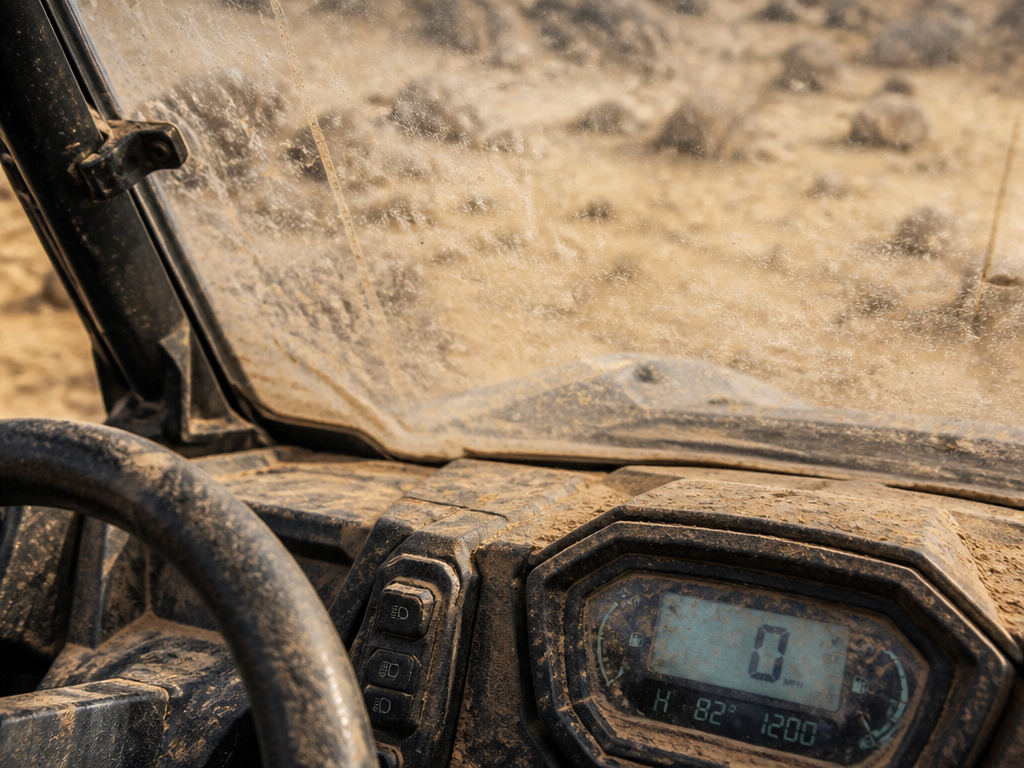
For all their benefits, windshields introduce specific problems that can outweigh their value in certain scenarios. The most cited one is dust.
Even with a full windshield and a rear panel, dust finds a way. It swirls in from the sides, gets pulled in through the footwells, and settles over everything. On a dry, dusty two-track, you’ll finish the ride coated. Some owners solve this by dropping the windshield entirely for dust-heavy seasons, accepting the wind blast for cleaner air. This is a valid, if extreme, workaround that highlights the core issue: a UTV is not a sealed cab.
Noise is another factor. A full fixed windshield can reflect engine and drivetrain noise back at the occupants, making conversations harder. A half shield avoids this but trades it for constant wind buffeting around your head.
Then there’s the compatibility trap. Not all windshields fit all roofs. The Polaris Glass Windshield Kit P/N 2883753 is not compatible with lightbar-equipped aluminum roofs. If your vehicle has that lightbar pocket, you need Kit P/N 2884625. Installing the wrong one isn’t an inconvenience; it’s an impossible fit. This level of model-specificity extends to aftermarket options too. A universal-fit windshield is often a compromise in durability and safety.
Finally, consider the outright danger in a rollover. A well-mounted windshield should stay put, but a poorly installed one or a glass unit could shatter. A polycarbonate or acrylic shield is safer here, but it underscores the need for correct installation and fastening. Your choice in UTV helmets and other safety gear should account for the presence of this large, rigid component in the cockpit.
So when is a windshield a liability? When you ride exclusively in slow, technical, dusty terrain where ventilation and visibility are paramount. When you never encounter road-speed sections or flying debris. When your vehicle’s roof configuration makes a proper, model-specific install difficult. In those narrow cases, skipping the windshield and relying on goggles and a good helmet might be the simpler, more effective path. For everyone else, especially those using their machine for work, hunting, or family riding, the protections outweigh the hassles, provided you manage them.
Frequently Asked Questions
Does a UTV windshield increase dust inside?
Yes, significantly. A full windshield creates a low-pressure area behind it that pulls dust in from the sides, rear, and footwells. Adding a rear panel helps reduce but does not eliminate this dust intrusion. On dry, dusty trails, you will get dirty.
Can you use a tilting windshield in the open position at high speed?
No. Kolpin’s OEM installation manuals explicitly state, “OPEN POSITIONS ON FULL TILTING WINDSHIELDS ARE DESIGNED FOR LOW-SPEED RIDING ONLY.” Using it open at highway or even high trail speeds puts excessive wind load on the hinges and mounts, risking failure.
Are glass or polycarbonate UTV windshields better?
Polycarbonate (often sold as “hardcoat”) is lighter, more impact-resistant, and less likely to shatter in a rollover. It scratches more easily. Glass offers superior optical clarity and scratch resistance but is heavier and poses a shatter risk. For most off-road use where impacts are likely, polycarbonate is the more durable choice.
How long does it take to install a UTV windshield?
The manufacturer’s estimated assembly time is 30 minutes. This assumes two people, the correct tools (a 4mm hex key is standard), and all hardware being present. A solo installation will take longer and is not recommended, as aligning the shield alone is difficult.
Do you need a special windshield if your UTV has a lightbar?
Often, yes. For example, the Polaris Glass Windshield Kit P/N 2883753 is not compatible with lightbar-equipped aluminum roofs. If your roof has a lightbar pocket, you need Kit P/N 2884625. Always verify exact part number compatibility for your make, model, and roof configuration before buying.
The Bottom Line
A UTV windshield is necessary for meaningful protection from the elements and debris, making it a valuable accessory for work, family use, or any riding that involves road speeds or cold weather. Its necessity, however, is conditional on respecting the hard limits printed in the OEM manual, limits about speed, trailering, and maintenance that carry real legal and safety weight.
The default choice for most riders is a full fixed windshield. It’s the only stable option above 30 mph and provides the most consistent protection. Just pair it with a rear panel and accept that dust management is part of the deal. If your world is slow, technical, and hot, a half shield or a properly used tilting model can work, but you forfeit the full guard against flying rocks and winter chill.
Ultimately, the question isn’t just “are they necessary?” It’s “are you willing to install the right one correctly, use it within its engineered limits, and maintain it like a safety device?” If your answer is yes, a windshield transforms your ride. If it’s no, you’re better off with goggles and a jacket. The middle ground, where the accessory is installed but ignored, is where the warnings in the manual become reality.
