
Are RV Surge Protectors Necessary to Prevent Costly Damage?
This post contains affiliate links. As an Amazon Associate, we earn from qualifying purchases.
An RV surge protector is absolutely necessary, but the common “surge-only” plug is not enough. You need an Electrical Management System (EMS) that guards against sustained low voltage (<102V), high voltage (>132V), open neutrals, and reverse polarity. These are the everyday campground faults that slowly cook your air conditioner compressor and fry your converter, not the rare lightning strike.
The distinction isn’t academic. A surge-only device uses sacrificial components to stop a millisecond spike. An EMS uses a relay to physically disconnect your rig from bad power that lasts for seconds or minutes. That’s the protection you actually need.
What follows is a breakdown of the two technologies, the specific failure modes they guard against, and a direct comparison of the leading units. By the end, you’ll know exactly which type to buy and why the cheaper option is a gamble with a five-figure repair bill.
Key Takeaways
- Surge-only protectors fail on the most common fault: An open neutral condition can send 180 volts to your appliances while the surge protector reads it as normal. Only an EMS with voltage monitoring catches this.
- Low voltage is a slow killer: Running your air conditioner on sustained 105V amps up the current, overheats the windings, and kills the compressor. An EMS trips at 102V after 8 seconds.
- MOVs are sacrificial: The Metal Oxide Varistors inside all surge protectors wear out with each small spike. Their total capacity is measured in joules; once expended, the unit is just a pass-through.
- Adapters are a fire risk: Using a 50A-to-30A adapter to run a large rig on a small pedestal can overheat the adapter’s contacts. Southwire’s manual explicitly warns against this for full-load use.
- Hardwired is for convenience, not safety: A hardwired EMS is more secure and out of sight, but a portable unit offers the same protection and can be moved between RVs.
The Core Difference: Surge Protector vs. Electrical Management System (EMS)
This is the decision that matters. Getting it wrong means buying a sense of security that evaporates the first time you plug into a poorly maintained campground.
A basic surge protector is a one-trick component: it contains Metal Oxide Varistors (MOVs) that act like pressure relief valves. When a voltage spike (like from nearby lightning or a pump shutting off) exceeds a threshold, the MOV instantly shunts that excess energy to ground. It’s fast, reactive, and sacrificial. Each spike degrades the MOV a little.
Surge protection is reactive, shutting down after the spike hits. Electrical management is proactive, preventing bad power from ever reaching your appliances.
An Electrical Management System (EMS) is a brain with a switch. It continuously monitors the incoming power for voltage, frequency, polarity, and ground integrity. If it detects a sustained fault, like low voltage for more than 8 seconds or a reversed hot and neutral wire, it commands an internal industrial relay to open, disconnecting your RV from the source entirely. Most quality EMS units, like the Surge Guard 34850 or Progressive Industries EMS-PT50X, also include MOV-based surge protection. So you get both: the fast reaction to spikes and the intelligent shutdown for sustained problems.
| Protection Type | Guards Against | Mechanism | Blind Spot |
|---|---|---|---|
| Basic Surge Protector | Short-duration voltage spikes (microseconds). | Sacrificial MOVs shunt energy to ground. | Sustained low/high voltage, open neutral, reverse polarity. |
| Electrical Management System (EMS) | Spikes + sustained low/high voltage, open neutral, reverse polarity, frequency shifts. | Monitoring circuit triggers a relay to cut all power. | Nothing. It is comprehensive protection. |
The open neutral is the perfect example of why you need the EMS. If the neutral wire breaks at the campground pedestal, the voltage on one leg of your 50-amp service can soar to 180V while the other drops to 60V. Your microwave and TV see 180V. A surge protector’s MOVs aren’t triggered because it’s not a “spike”, it’s a sustained wrong voltage. The MOVs do nothing, and your appliances cook. The EMS sees the imbalance and kills the power in under 10 seconds.
What Are You Actually Protecting? (The Cost of “No”)
Think of your RV’s electrical system as a network of expensive, sensitive components, not just outlets. The converter that charges your batteries, the circuit board in your refrigerator, the compressor in your air conditioner, they’re all designed for clean 120V power (or 120/240V for 50-amp).
When voltage drops, amperage rises to do the same work. That extra current creates heat. The Georgia Mountaineers RV surge protector guide notes that running an air conditioner on 105V instead of 120V can increase the current draw by over 15%. That heat slowly degrades insulation on motor windings. One weekend of brownout conditions can knock years off your AC’s life.
The financial math is brutal. Replacing a residential-style RV air conditioner compressor can hit $1,500. A new converter/charger is another $500. Fry the main power panel, and you’re looking at a multi-thousand-dollar repair with the rig in the shop for weeks. A quality EMS costs between $300 and $600. It’s the least expensive insurance policy on the rig.
Where this goes sideways: Assuming a surge protector guards against low voltage. It doesn’t. Your appliances will happily pull high amperage on low voltage until they burn out, and the protector will never make a sound.
Decoding the Specs: What Joules, MOVs, and Trip Times Really Mean
Shopping for an EMS means reading a spec sheet. Here’s what those numbers actually tell you about the unit’s capability and durability.
Joule Rating: This is the total energy absorption capacity of all the MOVs inside the unit. Think of it as the shield’s total hit points. A Surge Guard 34951 50-amp model has a 4200-joule rating from 12 MOVs. A direct lightning strike can deliver tens of thousands of joules, instantly “expending” the unit (it sacrifices itself to save your RV). Smaller, more common surges from grid switching might use up 50 joules here and there. The higher the rating, the longer the unit should last under normal use.
Voltage Trip Range & Time: This is the EMS’s intelligence. For example, the Surge Guard 34850 is programmed to disconnect power if voltage stays below 102V or above 132V for 8-10 seconds. That delay is critical, it prevents nuisance trips from momentary sags when your own air conditioner starts up. The 128-second reset delay after a fault is also key; it lets your AC’s refrigerant pressure equalize before restarting, protecting that compressor.
Other Critical Protections:
- Reverse Polarity: Catches miswired pedestals where hot and neutral are swapped.
- High Neutral Current (130%): Only on 50-amp models. Detects an overloaded neutral wire, a dangerous condition that can cause overheating inside your walls.
- Plug Temperature Trip (200°F): The unit has a sensor that will cut power if the plug itself overheats, often due to a loose connection at the pedestal, a common cause of RV electrical fires.
Portable vs. Hardwired: Convenience vs. Permanence
 Your next choice is form factor. Both offer the same core protection if they’re true EMS units.
Portable EMS (e.g., Surge Guard 34750, Progressive Industries EMS-PT30X): * Pros: Flexible. Use it on any RV. Take it with you if you sell your rig. Visibly shows status (often with an LCD) right at the pedestal. Can be stored when not in use. * Cons: Can be stolen if left unattended. One more thing to plug in and manage. Exposed to weather and physical damage.
Hardwired EMS (e.g., Surge Guard 40240, Progressive Industries EMS-HW50C): * Pros: Permanent, out-of-sight installation inside your electrical bay. No theft risk. Always there, you can’t forget to use it. Often includes a remote display inside the RV. * Cons: More complex, often professional installation required. Stays with the RV if you sell it. If it fails, you’re without protection until it’s serviced.
For most owners, a portable unit is the best starting point. It’s a lower commitment and lets you verify the protection is working with every connection. Full-timers or those in high-theft areas often move to a hardwired unit later. You can even use both in series for layered protection, though it’s usually overkill.
Essential Rules for Using Any RV Surge Protector
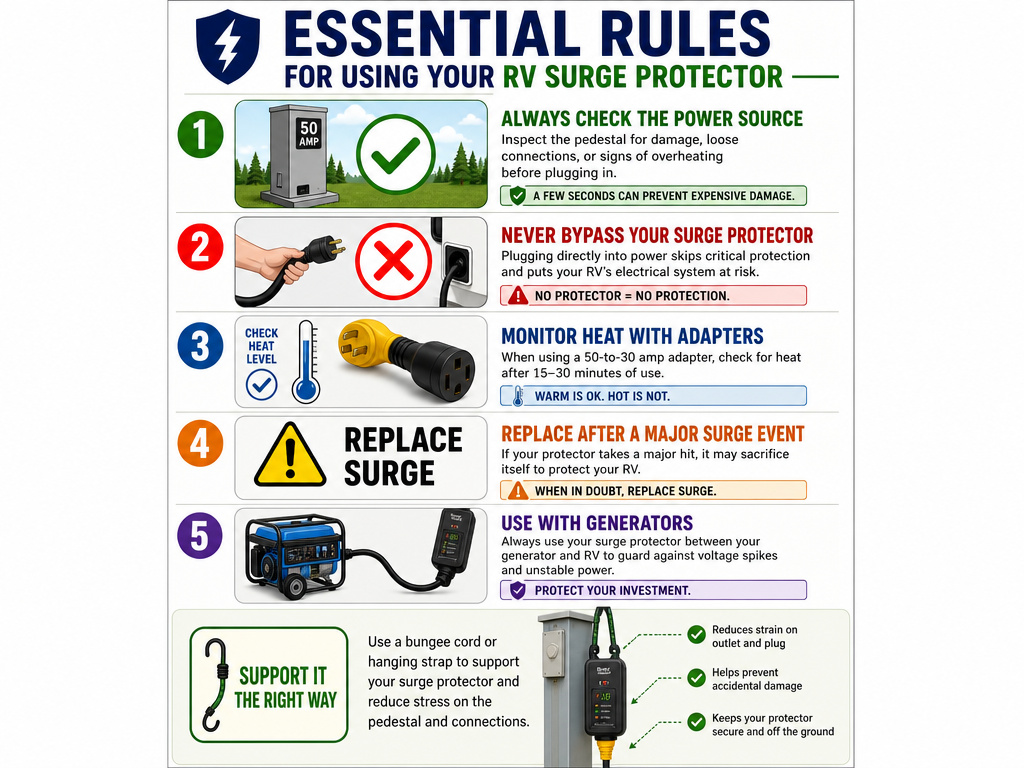 Buying the right unit is half the battle. Using it correctly is the other half. These aren’t suggestions; they’re rules that prevent fires and equipment failure.
- Test Every Pedestal, Every Time. Plug in your EMS and wait for the “all clear” signal (the caution light stops flashing after 128 seconds). Never plug your RV directly into an unknown outlet.
- Never Bypass a Fault. If the unit trips and displays “L1 Low” or “Reverse Polarity,” your only move is to find another pedestal or use your generator. Bypassing the protector to use “bad” power guarantees damage.
- Heed Adapter Warnings. Need to use a 50-amp rig on a 30-amp pedestal? Southwire’s manual for the Surge Guard 34830 states: “TRC does not recommend using [adapters] for full load applications due to the possibility of over-heating.” If you must adapt, drastically reduce your power consumption and feel the adapter for heat every hour.
- Understand the “Replace Surge” Alert. If your unit’s LCD flashes “REPLACE SURGE,” its MOVs are expended. It may still provide EMS monitoring, but its spike protection is gone. You need a new unit.
- Use it With Your Generator (If Compatible). Most modern EMS units work with inverter generators that produce clean power. Check your manual. Using it adds a layer of safety against your own generator’s potential faults.
Common mistake: Letting the EMS dangle from the pedestal plug, putting strain on the connection. Use a support stand or a simple bungee cord to take the weight off. A poor connection creates heat, and the plug temperature sensor may be your last line of defense.
Frequently Asked Questions
Can a surge protector save my RV from a direct lightning strike?
No device can guarantee protection from a direct strike. The energy is simply too massive. However, a quality EMS with a high joule rating (like 4200 joules) is considered “self-sacrificing” in such an event, it will attempt to absorb the surge and be destroyed in the process, hopefully saving your RV’s electrical system. The real strategy is to unplug during storms.
How long does an RV surge protector last?
The surge protection component (MOVs) has a finite life based on its joule rating and how many surges it absorbs. It could last 10 years or one bad storm. The EMS monitoring circuitry, however, should last indefinitely. Many units have an indicator to warn you when the surge components are spent.
Do I need a 30-amp or 50-amp surge protector?
You need an EMS rated for your RV’s service. A 30-amp RV requires a 30-amp EMS. A 50-amp RV requires a 50-amp EMS. You can use a 50-amp unit on a 30-amp pedestal with the proper adapter, but you must strictly limit your power draw to avoid overheating the adapter.
Are the cheaper “surge-only” plugs from the big box store okay?
No. Those are designed for household electronics and only protect against spikes. They offer zero protection against the low voltage, open neutral, and wiring faults that are prevalent at RV parks. They create a dangerous false sense of security.
Can I install a hardwired EMS myself?
You can if you are confident working with 120/240V AC systems, understand your RV’s power distribution, and can follow the manufacturer’s wiring diagram exactly. A mistake can be fatal or cause a fire. For most people, hiring a certified RV technician is the wise investment.
The Bottom Line
Is an RV surge protector necessary? A basic one is a placebo. A true Electrical Management System is non-negotiable. It’s the single most important piece of gear you plug into your rig, full stop. The choice isn’t between saving $300 or spending it. It’s between spending $300 on an EMS or risking a $3,000 air conditioner replacement because of a faulty campground pedestal.
Skip the surge-only plugs. Go straight for a proven EMS from Progressive Industries or Southwire Surge Guard. Get the amperage that matches your RV, use it religiously, and never bypass a fault. Your refrigerator, your air conditioner, and your wallet will thank you the first time that little box reads “L1 Low” and clicks off, saving everything behind it.
