
Are Moog Wheel Bearings Good? Owner Reports & Critical Recalls
This post contains affiliate links. As an Amazon Associate, we earn from qualifying purchases.
Moog wheel bearings are a mid-tier aftermarket option backed by a strong 5-year warranty, but their reputation is marred by a documented 2013 safety recall for defective ABS sensors and inconsistent real-world longevity, with some owners reporting failures within 5,000 miles. The brand’s quality often hinges on the specific manufacturing origin, as some lines are produced in the USA while others are sourced from China, leading to variable performance.
That warranty and the brand’s century-old chassis reputation are the main draws. The recall, however, points to a specific, serious flaw in quality control that affected Ford trucks. It wasn’t a wear issue—it was a wiring defect built into the sensor harness that could disable the anti-lock braking system.
What follows is a breakdown of that recall, the specs that matter, where forum owners say these bearings fail, and a direct comparison with brands like Timken and AC Delco. You’ll know exactly what you’re getting, and where the risks are hidden.
Key Takeaways
- A 2013 NHTSA recall targeted MOOG parts 515082 and 515083 for reversed ABS sensor wiring, a defect that could disable the ABS system.
- Owner reports on forums show extreme inconsistency: some bearings last 70,000+ miles, while others fail within a couple thousand.
- Moog’s 5-year warranty is a strong point, but it requires professional installation and receipt retention to be valid.
- Compatibility issues exist, like the need to drill out the hub flange when installing larger ARP lug studs.
- For critical applications or if OEM is an option, brands like Timken or AC Delco (often using USA-made bearings) may offer more predictable longevity.
The 2013 Safety Recall You Need to Know About
This isn’t speculation. In October 2013, ILJIN Global Co., Ltd., the manufacturer of certain MOOG-branded bearings, filed a formal defect report with the NHTSA. The recall (Campaign ID: 13E055) specifically covered MOOG Part Nos. 515082 and 515083, sold as replacement front wheel bearings for 2005–2010 Ford Heavy Duty Trucks.
The defect was in the wheel speed sensor wiring harness. The signal and VCC wires were reversed in the connector. If installed, the sensor would send incorrect data to the vehicle’s computer.
The wheel speed sensors of the wheel bearings were produced with the signal and VCC wiring reversed in the sensor wiring harness connector. As a result, the wheel speed sensor does not provide the proper signal output.
This would trigger the ABS warning light and potentially disable the anti-lock braking system entirely. Standard braking remained, but a critical safety feature was compromised. The repair involved replacing the entire defective sensor harness assembly.
| Recall Fact | Detail |
|---|---|
| NHTSA Campaign ID | 13E055 |
| MOOG Part Numbers | 515082, 515083 |
| Date Code Ranges | A13239–A13253, A13274 |
| Vehicle Application | 2005–2010 Ford Heavy Duty Trucks |
| Defect | Reversed wiring in ABS sensor harness connector |
| Risk | ABS warning light illumination, potential ABS system disablement |
The takeaway is concrete. While recalls happen to every manufacturer, this one involved a fundamental assembly error on a safety-critical component. It’s a data point that contradicts the blanket “premium quality” claim. If you’re looking at a MOOG bearing, especially for an older Ford truck, checking the part number against this list is a non-negotiable first step. You can review the full NHTSA official recall PDF for verification.
How Moog Tests and Markets Its Bearings
Moog doesn’t just sell parts; it sells engineering. The company publishes detailed test protocols to back its durability claims. For example, their endurance testing on an Audi A3 bearing simulated cornering forces at 80 km/h on a tight track.
The bearing was subjected to phased radial and axial loads—up to 8,930 N radial and 7,150 N axial—while monitoring temperature, vibration, clearance, and the torque needed to maintain 700 RPM. This kind of public-facing data is meant to inspire confidence. It frames Moog as a “problem solver,” a brand that invests in validation.
Their marketing heavily emphasizes the inclusion of all necessary installation hardware. Every bearing kit is supposed to contain new bolts, nuts, seals, and circlips. This addresses a major cause of premature replacing wheel bearings failure: reused, stretched, or damaged accessories.
Where this goes sideways: Reusing the central stretch bolt from an old hub. According to Moog’s own technical bulletin, these bolts deform permanently. Retorquing them doesn’t restore clamping force; it leads to fracture and hub separation.
The 5-year warranty is the crown jewel of this proposition. It’s a significant commitment in an industry where one-year warranties are common. However, the fine print almost always requires professional installation and proof of purchase. A DIY install, even if perfect, often voids the coverage. This warranty is a bet on their product, but it’s a bet they hedge with strict terms.
Where Moog Bearings Fall Short: Real Owner Experiences
The marketing and the warranty set an expectation. Forum reports across multiple vehicle communities reveal a starkly different reality for some buyers. The consistency is simply not there.
On a Subaru Outback forum, one owner reported a MOOG front hub failing “very quickly,” within 5,000 miles of installation, while the driver’s side unit was fine. A Jeep Liberty owner reported a failure within “a couple thousand miles.” These are not wear-out failures; these are infant mortality defects.
Conversely, on a Ford Powerstroke forum, an owner reported a MOOG bearing lasting at least 70,000 miles on a heavy-duty truck, following a Timken unit that had already done 100,000. This wild inconsistency is the core of the problem. You might get a champion bearing, or you might get one that sings its death song before the next oil change.
The “why” often points to manufacturing origin. As highlighted in a detailed YouTube teardown, some Moog bearings are made in China, while the OEM equivalent for that vehicle (like an AC Delco hub with a USA-made Timken bearing) is produced domestically. The difference in steel quality, heat treatment, and precision isn’t always visible on the outside, but it manifests as roughness in the bearing race or premature seal wear.
| Reported Experience | Vehicle | Outcome |
|---|---|---|
| Premature Failure | Subaru Outback | Failed within ~5,000 miles |
| Premature Failure | Jeep Liberty | Failed within a couple thousand miles |
| Longevity Success | Ford F-250 (6.0L) | Lasted 70,000+ miles |
| Comparative Review | Chevrolet Tahoe | Moog felt smoother than cheaper brand, but both made in China |
This pattern suggests Moog’s quality may be tiered. Their line for heavy-duty trucks, where competition from brands like TRQ wheel bearings is fierce, might use better sourcing than their economy passenger car line. It turns a simple brand question into a model-specific investigation. For another perspective on a common budget brand, see our analysis of Duralast wheel bearings.
The Critical Compatibility and Installation Warnings
Assuming you get a good unit, two major pitfalls can ruin a Moog bearing installation. Both are well-documented and catch seasoned DIYers off guard.
First is the accessory rule. Moog provides new hardware for a reason. The central axle nut or hub bolt is a torque-to-yield stretch bolt. Once used, it stretches. Reusing it will not hold the specified torque. The clamping force drops, the hub develops play, and the new bearing is destroyed within weeks. The dust seal isn’t a suggestion either. If the old one is bent, reusing it invites road salt and grit directly into the bearing grease.
Second is a specific compatibility issue with aftermarket lug studs. Enthusiasts upgrading to stronger ARP studs have found the knurl diameter (0.625 inches) is too large for the standard hole in the MOOG hub flange. The factory stud knurl is 0.560 inches.
The part nobody mentions: Installing ARP studs in a MOOG hub requires drilling the flange out to 29/64 inches (0.609 inches). If you force the larger stud in, you risk cracking the flange. It’s a deal-breaker for a track-day build.
This isn’t a quality flaw; it’s a specification mismatch. But it underscores that Moog designs for OEM replacement, not necessarily for modification. It’s a vivid example of why checking wheel bearings in the rears or any application requires more than just part number matching.
Moog vs. The Competition: When to Look Elsewhere

The bearing market has clear tiers. Moog occupies a contentious middle ground between budget brands and premium/OEM suppliers.
Moog vs. Budget Brands (e.g., Duralast, TRQ): Moog typically wins. The 5-year warranty alone dwarfs the typical 1-year coverage. The included hardware kit and generally better finishing are tangible benefits. However, as forum comparisons show, some budget bearings may feel stiffer or look similarly finished, blurring the line.
Moog vs. Timken: This is the real debate. Timken is a bearing specialist. Many OEM hubs, especially for GM and Ford trucks, use Timken bearings pressed into a hub. Timken’s reputation for consistency and longevity is superior. For a no-drama, long-life replacement on a daily driver or work truck, Timken is often the safer bet. The front wheel bearing comparison thread on Powerstroke.org is a testament to this preference among truck owners.
Moog vs. OEM (e.g., AC Delco, Motorcraft): The OEM part is engineered for your specific vehicle. It often comes with the correct hardware and a perfect fit. The cost can be higher, but as one Hummer owner discovered after two rapid Moog failures, the OEM AC Delco hub (which contained a USA-made Timken bearing) cost less and lasted. The OEM path eliminates the guesswork about manufacturing origin.
| Brand | Typical Warranty | Key Strength | Best For |
|---|---|---|---|
| Moog | 5-year (pro install often required) | Comprehensive hardware kit, strong marketing | DIYers who value the warranty and follow instructions to the letter |
| Timken | 2-3 year | Bearing manufacturing expertise, OEM supplier | Prioritizing predictable, maximum longevity over extra features |
| OEM (AC Delco, etc.) | 1-2 year | Guaranteed fit, often contains Timken/NTK bearing | Restoring exact factory specification, avoiding any compatibility issues |
| Budget Brands | 1-year | Low cost | Disposable repair on a vehicle you don’t plan to keep long |
If your research leads you to consider other aftermarket options, our guide on the best wheel bearings breaks down the top contenders across all categories.
The Bottom Line on Moog Quality
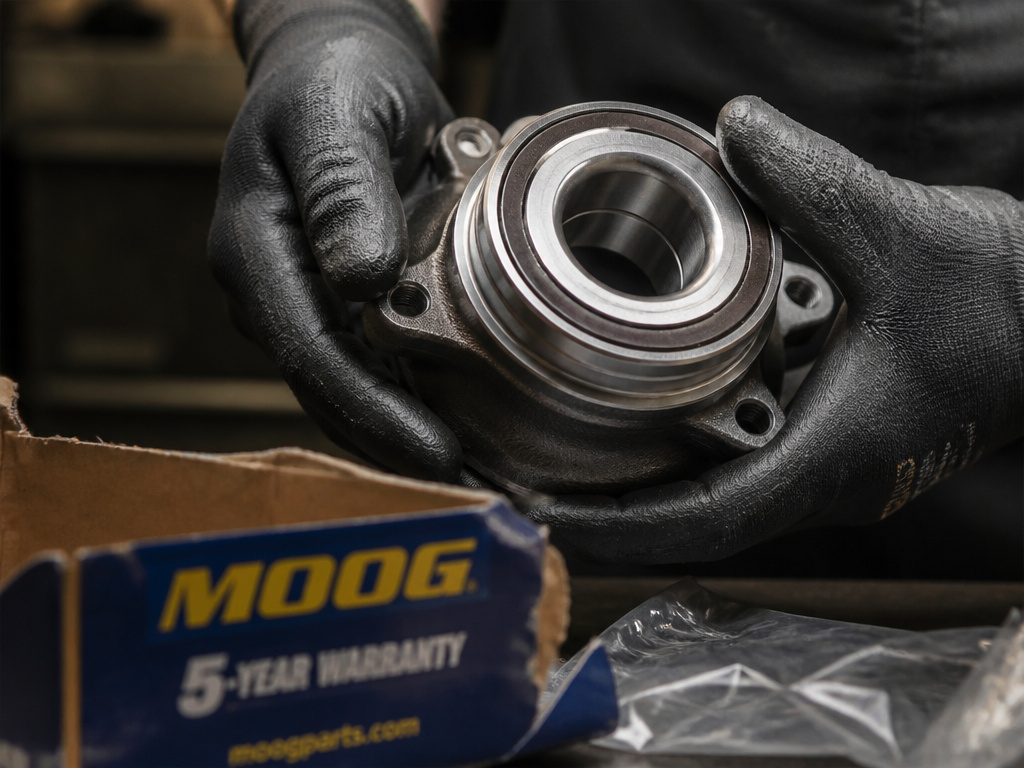
Are Moog wheel bearings good? They can be. The 5-year warranty is a legitimate advantage, and their design-for-installation approach is thoughtful. But “can be” isn’t good enough for a component that holds your wheel on.
The 2013 recall proves they are not immune to serious quality control lapses. The forum reports prove their product consistency is a lottery. For a critical, safety-related component, that’s a hard pill to swallow.
Here’s the rule: If you choose Moog, buy from a reputable source, inspect the included hardware, and follow the installation instructions like a religion. Assume the warranty will be voided by a DIY install. For heavy-duty use, or if an OEM or Timken option exists at a comparable price, lean toward those for peace of mind. The extra twenty dollars is cheap insurance against a comeback job. And always use the proper wheel bearing grease during any hub service to ensure longevity.
Frequently Asked Questions
Do all Moog wheel bearings have a 5-year warranty?
Most Moog wheel hub assemblies are covered by a 5-year warranty, but the terms are strict. It typically requires professional installation by a certified technician and proof of purchase. A do-it-yourself installation, even if done correctly, will often void this coverage. Always read the specific warranty terms on the product packaging or website before purchasing.
What are the symptoms of a failing Moog wheel bearing?
The symptoms are no different than any other failing bearing: a constant humming or grinding noise that changes with speed, a roaring sound that worsens in a turn (loading the bad bearing), and vibration in the steering wheel. In cases where the integrated ABS sensor fails, you may also get an ABS or traction control warning light on your dashboard. For a deeper look at the risks, read about driving with bad bearings.
Are Moog bearings better than Timken?
It depends on your priority. Timken is a bearing manufacturing specialist with a stellar reputation for consistency and longevity; many consider it the gold standard for replacement. Moog offers a longer warranty and focuses on making installation easier with complete hardware kits. For maximum, worry-free longevity, Timken is often the preferred choice. For a feature-focused install with strong warranty backing, Moog is a contender.
Where are Moog wheel bearings manufactured?
Moog sources its bearings from multiple global suppliers. Production occurs in both the United States and China, depending on the specific part number and application. This variation in manufacturing origin is a primary reason for the inconsistent real-world durability reports among owners. There is no single “country of origin” for the brand.
Can I use Moog bearings with aftermarket performance lug studs?
You may encounter compatibility issues. For example, popular ARP performance studs have a larger knurl diameter than the stock studs Moog hubs are designed for. This requires carefully drilling out the hub flange to the correct size (e.g., 29/64″) to prevent cracking. It’s not a simple bolt-on swap and adds complexity to the installation. For high-performance applications, verifying stud compatibility is a crucial step.
