
Are Electric Scooters Waterproof? IP Ratings & Rain Safety
This post contains affiliate links. As an Amazon Associate, we earn from qualifying purchases.
No. No mainstream electric scooter is fully “waterproof” in the way you imagine, like a submarine. They are water-resistant to varying degrees. The level of protection is defined by an IP (Ingress Protection) rating, such as IPX4 or IPX5, which promises resistance against splashes or jets of water, not submersion. Most scooters marketed for daily commuting carry an IPX4 or IPX5 rating.
That IPX4 rating is where the marketing promise and real-world road spray start to pull apart. Manufacturers will tell you it’s fine for light rain. Owners of the popular Segway Ninebot Max G30, a scooter with an IPX4 rating, reported controller corrosion, fogged displays, and rusted bearings after just months of commuting in regular rain. The rating passed the lab test. The road failed it.
What follows is a breakdown of what those rating numbers actually promise, where they fail, and how to choose a scooter that matches your real-world weather, not a marketing brochure. You’ll learn which components die first, why warranties almost never cover water damage, and the one upgrade from IPX4 to IPX5 that genuinely changes the game for commuters.
Key Takeaways
- The term is water-resistant, not waterproof. An IP rating describes resistance to specific water exposure, not total immersion.
- IPX4 is a fair-weather friend. It’s designed for splashes, not sustained spray. Real-world commuting in rain often leads to cumulative moisture damage within months.
- IPX5 is the commuter’s baseline. This rating tests against water jets, simulating the constant spray from a wet road at speed. It’s a significant, real-world upgrade.
- Warranties almost universally exclude water damage. Even with a high IP rating, proving a failure wasn’t due to “misuse” is nearly impossible for an owner.
- Water kills from the inside out. The weak points are never the battery; they’re the display, the charging port, the deck seams, and the wheel bearings.
The #1 Rule: It’s Water-Resistant, Not Waterproof
Forget the word “waterproof.” It’s a marketing ghost, a phantom promise that evaporates the first time a scooter goes back to the shop with a fried controller. The accurate, technical term, and the one used in every serious manufacturer specification like the SoFlow SO3 manual or Segway’s documentation, is water-resistant.
The difference isn’t semantic. It’s a legal and engineering line.
Water-resistant means the scooter can handle a defined type and amount of water exposure, as verified by a standardized test. Waterproof implies an absolute, unconditional barrier, which does not exist for a vehicle with vents, seams, and moving parts.
Think of it like a rain jacket versus a plastic bag sealed with tape. The jacket (water-resistant) is designed for a downpour, but eventually, if you stand under a waterfall long enough, it will wet through. The sealed bag (the impractical, non-existent “waterproof” scooter) would trap moisture from the inside anyway, from condensation or a single unseen puncture. Real scooters are rain jackets, and their quality is graded by the IP code.
The moment you see “waterproof” in an ad, your next question should be: “What’s the IP rating?” If the answer is anything less than IP67, a rating for temporary submersion, they are using the wrong word. Most commuter scooters, even good ones, top out at IPX5 or IPX6.
The IP Rating Breakdown: What IPX4, IPX5, and IPX7 Actually Mean
The IP code is governed by the international standard IEC 60529. It’s a two-digit system. The first digit (0-6) rates protection against solid objects like dust. The second digit (0-9) rates protection against water. When you see “IPX4,” the “X” simply means the dust rating wasn’t formally tested or declared.
This isn’t marketing fluff. To claim an IP rating, a manufacturer must subject samples to the exact test conditions outlined in the standard. Here’s what the common water ratings translate to in the lab, and on the road.
| IP Rating | Official Test | Real-World Translation | The “No” Zone |
|---|---|---|---|
| IPX4 | Sprayed with water from any direction for 5 minutes. | Light rain, occasional puddle splashes. | Sustained rain, road spray, puddle riding. |
| IPX5 | Sprayed with a 6.3mm water jet from 3 meters for 3 minutes. | Commuting in steady rain, riding on wet roads. | Pressure washing, submersion. |
| IPX6 | Sprayed with a 12.5mm powerful water jet for 3 minutes. | Heavy rain, very wet conditions. | Submersion, high-pressure cleaning. |
| IPX7 | Submerged in 1 meter of water for 30 minutes. | Surviving an accidental drop into a deep puddle. | Continuous submersion, high-velocity water. |
The jump from IPX4 to IPX5 is the most critical for actual riders. An IPX4 test is a gentle shower. An IPX5 test is a constant, direct spray that mimics the wheel kick-up from a wet road at 20 km/h. This is why the community reports on the Segway Ninebot Max G30 (IPX4) are filled with moisture issues, while the newer Max G2 (IPX5) is noted for holding up better in the same conditions. The lab test finally matches the commute.
Where the Water Gets In: The 4 Weak Points
The battery pack is usually the most sealed component. It has to be. The problem is everything else. Water follows the path of least resistance, which is never through the thick aluminum casing of the battery. It finds the gaps.
1. The Display & Throttle Assembly
This is the single most common failure point. It’s a complex shape with multiple layers of plastic, often sealed with a simple gasket. Moisture seeps in from the edges, condenses on the inside of the lens, and fogs the screen. From there, it drips onto the circuit board. The result is a flickering display, an unresponsive throttle, or a complete failure. No amount of exterior IP rating matters if the display’s own seal is weak.
2. The Charging Port
It’s a hole in the deck, covered by a flimsy rubber flap. That flap gets tugged open, loses elasticity, or simply doesn’t seat perfectly every time. Road spray, directed upward by the front wheel, hits it directly. Corrosion starts inside the port long before you see it, leading to intermittent charging faults.
3. Deck Seams and Screw Holes
The deck is two halves screwed together. Every screw hole is a potential micro-leak. Silicone sealant is used in assembly, but its application is not perfect. Over time, vibration works the screws slightly loose, breaking the seal. Water wicks in slowly, pooling around the controller or battery connections.
4. Wheel Bearings and the Folding Mechanism
Bearings are designed to be open to allow movement. They are not sealed against pressure. Riding through a puddle can force water past the bearing seals. Once inside, it mixes with grease, loses its lubricity, and leads to rust and a grinding noise. The folding mechanism has similar metal-on-metal joints that trap and hold water.
Common mistake: Assuming a high IP rating on the battery means the whole scooter is safe. The IP code applies to the specific enclosure tested. Your scooter is only as water-resistant as its weakest sealed interface.
Why Your Warranty Won’t Save You From Rain

This is the hardest pill to swallow. You bought a scooter with an IPX5 rating, rode it in the rain as the manual said you could, and now the display is dead. The warranty should cover it, right? Almost certainly not.
Manufacturer warranties, from Segway to Xiaomi to any major brand, explicitly exclude water damage. The wording is always something like: “This warranty does not cover damage caused by… Exposure to liquid.” They can do this because an IP rating is a test result, not a usage guarantee.
The loophole for them is the definition of “exposure.” Their manual might say “suitable for light rain,” but what constitutes “light”? A 10-minute drizzle or a 30-minute steady shower? They don’t define it. When your scooter fails, they point to the Liquid Damage Indicator (LDI).
What is an LDI? It’s a small white sticker, usually placed inside the deck or near the controller, that turns pink or red when it gets wet. It’s a forensic tool for the repair technician.
- If the LDI is white: You have a slim chance. You can argue a manufacturing defect, a bad seal from the factory.
- If the LDI is pink/red: The claim is over. They have definitive proof of water ingress. Your claim shifts from a warranty repair to a paid service quote.
Where this goes sideways: Water damage is cumulative. Your scooter might survive 100 wet commutes. On the 101st, a single droplet bridges two corroded contacts on the controller. The failure is sudden, but the cause was months of slow, incremental moisture build-up that the warranty was designed to exclude.
Your best defense is to buy a scooter whose IP rating exceeds your typical conditions. If you face daily rain, IPX5 is the bare minimum. For real peace of mind, look for a model with an IPX6 rating and a reputation for good sealing, like some of the higher-end dual-motor scooters built for all conditions.
The Real-World Choice: Picking a Scooter for Your Climate
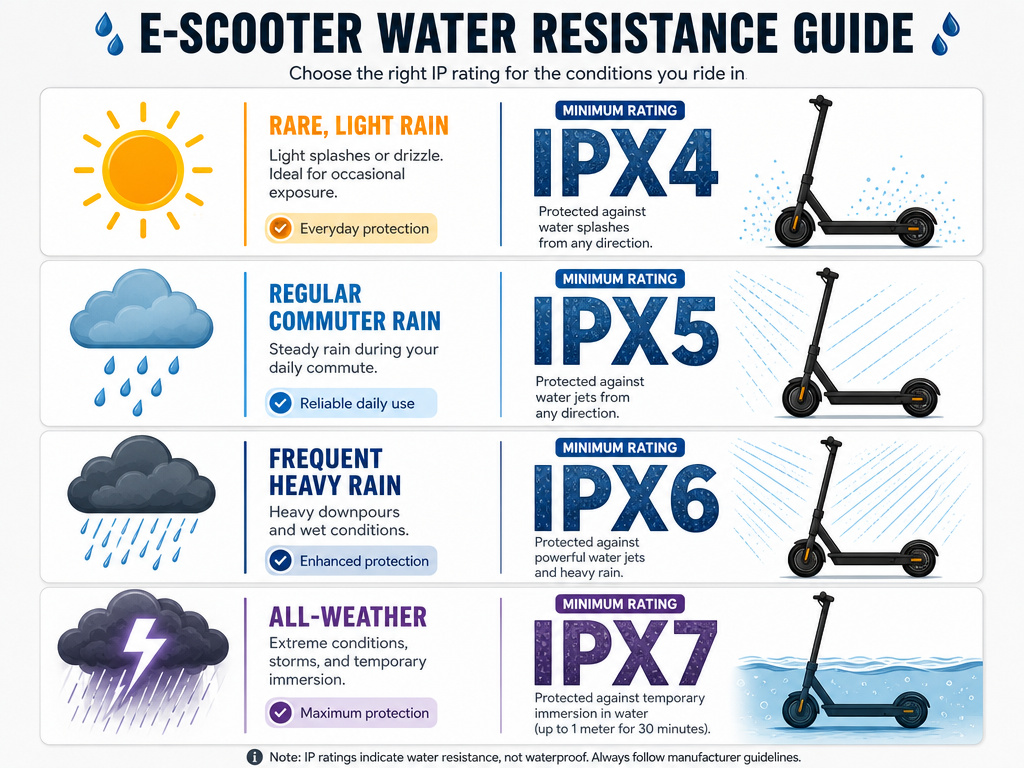
Your location dictates the spec. Don’t buy a desert scooter for a coastal city.
For Dry Climates with Rare Showers:
An IPX4 rating is technically sufficient. Your risk is low. You can prioritize other features like portability or a sleek design. Many affordable scooters and folding scooters in this category will serve you well.
For Temperate Climates with Regular Rain:
IPX5 is the new minimum. This is the rating for daily, real-world use. It matches the spray pattern of a wet commute. Models like the Segway Ninebot Max G2 built this reputation. Look for scooters that highlight this rating for commuters.
For Wet Climates or Year-Round Commuting:
Step up to IPX6. This rating is for heavy rain and consistent wet roads. You are now in the territory of higher-performance commuter scooters built for reliability. Pair this with good dust protection (the first digit, like IP6X) to keep abrasive grit out.
The “I Don’t Care About Weather” Rider:
You need a scooter built as a vehicle, not a toy. Look for models boasting IPX7 ratings on critical components (like the battery) and IPX6 on the overall system. These are often more expensive, robust machines that align with the best long-range scooters and scooters with suspension, where reliability is a core design focus.
| Your Typical Weather | Minimum IP Rating | What to Look For | Example Scooter Type |
|---|---|---|---|
| Rare, light rain | IPX4 | Affordability, portability | Basic folding scooters |
| Regular commuter rain | IPX5 | Proven reliability, daily durability | Top-rated commuter scooters |
| Frequent heavy rain | IPX6 | Robust seals, high build quality | Performance-focused commuter scooters |
| All-weather, no excuses | IPX6 (whole) & IPX7 (battery) | Premium construction, known brand reputation | High-end, long-range scooters |
If You Already Own a Scooter: Protection, Not Cure
You can’t change your scooter’s IP rating, but you can improve its chances.
1. Seal the Obvious
Apply a small bead of clear silicone sealant around the edge of the display and the charging port flap’s base. Check the deck seam for any visible gaps. This is a cosmetic, non-invasive improvement that blocks the easiest paths.
2. Adopt Wet-Ride Rituals
If you get caught in the rain, don’t just park it and walk away. Wipe the scooter down, focusing on the display, deck, and charging port. Tilt it to drain water from the deck. Let it dry indoors at room temperature for a few hours before charging.
3. Inspect and Maintain
Every few months, check the tightness of the deck screws. A loose screw is an open channel. Inspect rubber grommets and seals for cracking or deformation. Keep the charging port clean and dry.
4. Never, Ever Pressure Wash
The force from a pressure washer will defeat any IP rating short of IPX9K (for steam cleaning). It drives water past seals, into bearings, and into connectors where it can’t escape. A damp cloth is your only cleaning tool.
Bottom line: Treat your scooter like the electrical device it is. Water resistance is a buffer, not an immunity. Choose a scooter whose rated buffer matches your life, and you’ll avoid the most common, non-warrantied failure mode on the road.
Frequently Asked Questions
Can I ride my electric scooter in the rain?
You can, but you shouldn’t make a habit of it unless your scooter is rated for it. An IPX4-rated scooter is for accidental exposure to light rain. An IPX5 or IPX6-rated scooter is designed for regular riding in wet conditions. Always reduce speed, avoid large puddles, and dry the scooter thoroughly afterward.
My scooter got wet and won’t turn on. What should I do?
Do not try to turn it on. Immediately disconnect it from any charger. Wipe off all visible water. Place it in a dry, warm area (like a room, not a hot garage) and let it air dry for at least 48-72 hours. Do not use a hair dryer or heat gun, as this can drive moisture deeper or melt components. After it’s completely dry, try turning it on. If it still doesn’t work, water has likely caused a short circuit.
Are more expensive scooters more waterproof?
Not necessarily. Price doesn’t directly correlate with a higher IP rating. However, more expensive adult scooters and performance scooters often invest more in proper gaskets, conformal coating on circuit boards, and better sealing processes. Always check the official IP rating in the technical specs, not the marketing copy.
Is the battery the most waterproof part?
Usually, yes. The battery pack is the most critical and expensive component, so manufacturers typically give it the highest level of sealing, sometimes even an IPX7 rating. However, the electricity still has to leave the battery via wires and connectors that are less sealed. A waterproof battery connected to a corroded controller is still a dead scooter.
Can I make my scooter waterproof myself?
You cannot change its fundamental IP rating, which is a result of its design and factory assembly. You can improve its water resistance by applying dielectric grease to external connectors, using silicone to seal minor gaps, and adding rubber caps to vulnerable spots. These are mitigations, not solutions, and may void your warranty.
Before You Go
Electric scooters are water-resistant, not waterproof. The IP rating. IPX4, IPX5, IPX6, is your contract with the manufacturer, defining exactly what kind of wetness it’s built to handle. For daily commuting in anything more than a light drizzle, consider IPX5 your baseline. Remember, the warranty is not your friend here; water damage is almost always excluded. Your best strategy is to match the scooter’s rated protection to your actual climate, treat it with care when it’s wet, and understand that moisture is a cumulative enemy. Choose a scooter built for your reality, not just for the brochure.
