
Are Donut Tires Universal? 5 Critical Specs & Federal Rules
This post contains affiliate links. As an Amazon Associate, we earn from qualifying purchases.
No, donut tires are not universal. They must match your vehicle’s exact bolt pattern, hub bore diameter, offset, load rating, and overall diameter as specified by the OEM. The federal regulation 49 CFR 571.120 mandates these load and rim requirements for safe operation, and a mismatch in any one spec can lead to wheel detachment, brake interference, or catastrophic drivetrain damage within a few miles.
The word “universal” implies a free-for-all, but in the world of compact spares it means “doesn’t fit anything safely.” The reason is five specific numbers printed in your owner’s manual and stamped on your vehicle’s compliance label that you have to get right. Getting one wrong is how you end up with a wheel that spins but doesn’t drive, a caliper that grinds to a halt, or a differential that cooks itself before you reach the next exit.
What follows: the five technical specs that kill the universal myth, the federal rules that back them up, and the specific, physical consequences that happen when you ignore them.
Key Takeaways
- Donut spares are vehicle-specific; matching just the lug count is insufficient.
- The five critical fitment specs are Pitch Circle Diameter (bolt spacing), hub bore diameter, wheel offset, tire load rating, and overall tire diameter.
- A mismatched diameter, even by an inch, can destroy an all-wheel-drive system’s differential in under 50 miles.
- Federal regulation 49 CFR 571.120 legally ties spare tire load capacity to your vehicle’s Gross Axle Weight Rating (GAWR).
- Adhere to the “50/50 rule”: do not exceed 50 miles per hour or drive more than 50 miles on a donut spare.
The 5 Non-Universal Specs You Must Match
Thinking a donut spare will fit because it has the same number of lug holes is like thinking any five-fingered glove will fit your hand. The spacing between those fingers matters more. Here are the five measurements that decide whether a spare is a temporary solution or a roadside liability.
Pitch Circle Diameter (PCD) is the diameter of the imaginary circle formed by the centers of the wheel’s lug holes. A Toyota 5×114.3 pattern (5 holes on a 114.3mm circle) will not fit a Ford 5×10⁸ pattern, even though both wheels have five lugs. The difference is 6.3 millimeters, less than a quarter-inch, and that’s enough to prevent the lugs from seating.
Bolt Pattern is the starting point, but it’s only the count and the PCD. The hub bore is next. This is the precise hole in the center of the wheel that slides onto your vehicle’s axle hub. A wheel with a hub bore smaller than your vehicle’s hub won’t fit at all. One that’s larger will fit, but incorrectly, the wheel will be centered by the lug nuts alone, which creates a wobble. Common hub bores are not universal: Toyota/Lexus uses 60.1 mm, Honda/Acura uses 64.1 mm, and full-size Chevys use 78.1 mm. A donut spare does not have centering rings to adapt.
Wheel Offset is the distance between the wheel’s mounting surface and its centerline. If the offset is wrong, the tire can rub against the strut, brake caliper, or fender liner. A donut spare with too much positive offset will tuck in too far and can contact suspension components. One with too much negative offset will stick out and may not clear the wheel well when turning.
Load Rating is where the CFR tire selection standard gets specific. The regulation states the “sum of the maximum load ratings of the tires fitted to an axle shall be not less than the gross axle weight rating (GAWR).” Your donut spare’s load rating, the number on its sidewall, must be adequate for your vehicle’s weight on that corner. Swapping a spare from a compact car to a midsize SUV often violates this.
Overall Diameter is the final, silent killer. This is the height of the fully inflated tire. It must be within 1-3% of your other three tires’ diameter. If it’s significantly smaller (as most donuts are), it spins faster than the other wheels. On a front-wheel drive car, this confuses the ABS. On an all-wheel or four-wheel drive vehicle, it causes the differential to work constantly to compensate for the speed difference, generating extreme heat. The result is a burned-out differential or transfer case, often within the 50-mile range the spare is rated for.
| Specification | What It Is | Consequence of Mismatch |
|---|---|---|
| Pitch Circle Diameter (PCD) | Lug hole spacing | Lugs won’t thread; wheel cannot be mounted. |
| Hub Bore Diameter | Center hole size | Wheel wobble; lug nuts bear all centering force and can shear. |
| Wheel Offset | Mounting surface location | Tire rubs suspension or body; brakes overheated by caliper contact. |
| Load Rating | Weight capacity per tire | Tire overload; sidewall flex leads to blowout, especially under cornering load. |
| Overall Diameter | Tire height | Drivetrain damage (AWD/4WD), ABS faults, speedometer error. |
The Federal Rules Around That Tiny Tire
The “FOR TEMPORARY USE ONLY” stamp on the sidewall is a mandated label from Section S7 of 49 CFR 571.120.The federal government doesn’t just advise on spare tires; it regulates their load limits, labeling, and the information you must be given.
S6. Load Limits for Non-Pneumatic Spare Tires. The highest vehicle maximum load on the tire for the vehicle shall not be greater than the load rating for the non-pneumatic spare tire.
This single sentence is the legal backbone. It means the automaker must ensure the little donut in your trunk can, at a minimum, support the share of your vehicle’s weight that will rest on that corner. The regulation also dictates the placard in your door jamb and the section in your owner’s manual titled “IMPORTANT. USE OF SPARE TIRE.That section is federally required content in 10-point type, containing the cold inflation pressure and the size designation for your specific spare.
Transport Canada’s TSD No. 110 mirrors these U.S. Rules, so the same principles apply north of the border. The harmonization means a spare’s design and certification follow a consistent safety framework. The system assumes you will read that manual section. It also assumes the information there is correct, which leads to a revealing edge case.
When the Placard is Wrong: The 2019-2020 Toyota Tundra Case
In 2019, Toyota changed the spare tire on the Tundra from a P275/65R18 to a P255/70R18. The spare installed under the truck was the correct, certified P255 size. The placard on the driver’s door jamb, however, still listed the old P275 size. This mismatch triggered a formal noncompliance with FMVSS No. 110.
Toyota petitioned the NHTSA, arguing the noncompliance was “inconsequential to motor vehicle safety.” Their reasoning was that both tire sizes were designed and certified for the vehicle, the inflation pressure was correct for both, and the correct size was molded on the tire sidewall and in the manual. The NHTSA agreed and granted the petition in a Federal Register tire notice published in October 2023.
This case is the exception that proves the rule. The error was in labeling, not in fitment or function. Both tires met all federal standards. For everyone else, a mismatch between placard and spare is a red flag. It points to a potential error where the spare doesn’t meet the standard, and that’s when the risk of a blowout or failure spikes. Your first check after a flat should be the sidewall of the donut against the placard on the door. If they don’t match, your risk profile just changed.
What Happens When You Get the Specs Wrong?
 Consequences aren’t always immediate. Some show up as a vibration. Some as a smell. Some as a catastrophic failure that leaves you stranded all over again.
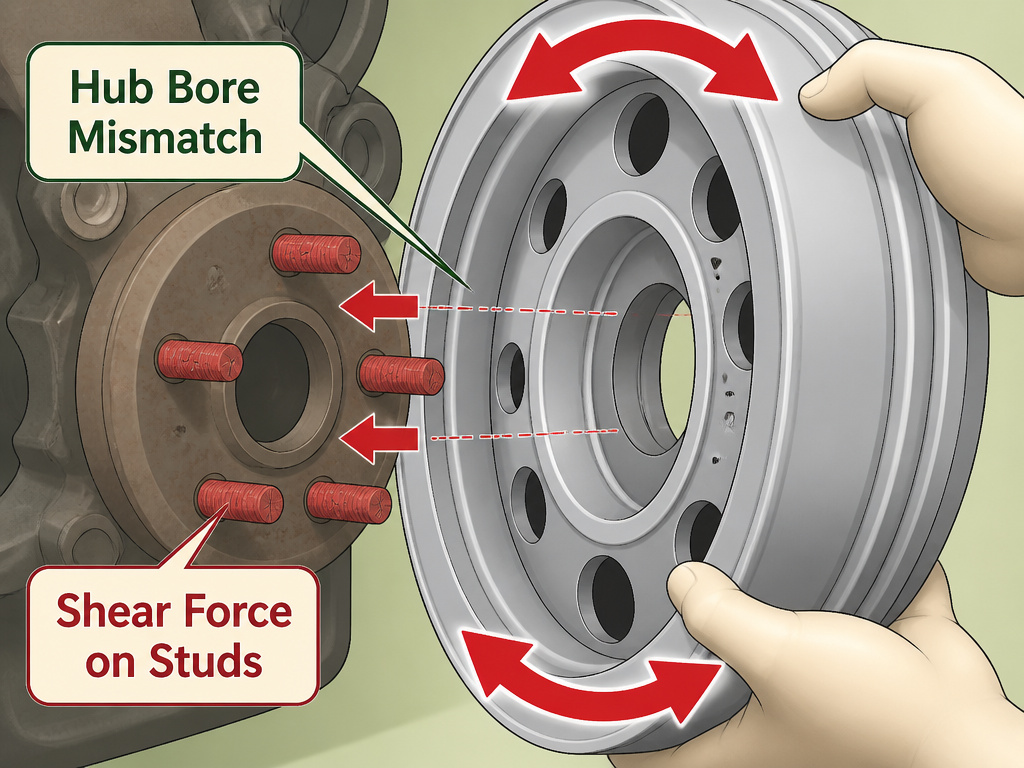
Common mistake: Forcing a wheel with the wrong hub bore. You tighten the lug nuts, and the wheel seems snug. At 30 mph, a slight shimmy starts. By 50 mph, the steering wheel oscillates in your hands. The wheel is being centered by friction, not by the hub. The lug nuts are taking shear forces they weren’t designed for. One hard pothole impact can crack a stud. The wheel doesn’t fall off at a stop; it comes loose at highway speed.
Bolt Pattern / PCD Mismatch
This usually stops you at the curb. The lugs won’t thread correctly. If you manage to cross-thread them, you’ve damaged the studs and compromised the clamping force. The wheel will work loose. This is a “won’t go on” problem. If it does go on with force, it’s a “will come off” problem.
Hub Bore Mismatch
As described above, this creates a wobble. The visual cue is an uneven gap between the wheel center and the hub. You might feel it as a vibration that starts at a specific speed. The final failure is a broken lug stud or a wheel that separates.
Offset Mismatch
The tire rubs. You’ll hear a rhythmic scraping or grinding noise when turning or going over bumps. For brake clearance, a donut with too little offset can bind against a performance caliper. The car might roll freely until you apply the brakes; then, the pad drags on the wheel. You’ll smell burning brake material before you see smoke.
Load Rating Mismatch
This failure is silent and structural. An overloaded tire heats up. The sidewall flexes excessively. At highway speed, the heat can soften the rubber and the cord belts can separate. The result is a sudden blowout. This is especially dangerous because it can happen after 20 miles of seemingly fine operation. Don’t assume a spare from your old Civic will hold up on your new Pilot.
Diameter Mismatch (The AWD Killer)
For 2WD cars, a size mismatch mainly affects the speedometer and ABS. For AWD and 4WD vehicles, it’s a death sentence for the drivetrain. The differential is designed to allow slight speed differences between wheels when turning. A permanently smaller tire makes it work non-stop. The fluid overheats, the gears overheat, and the unit seizes. The repair bill often exceeds the value of the car. The timeline? Often less than the 50-mile limit of the spare itself.
Can You Buy a Universal Donut Spare?
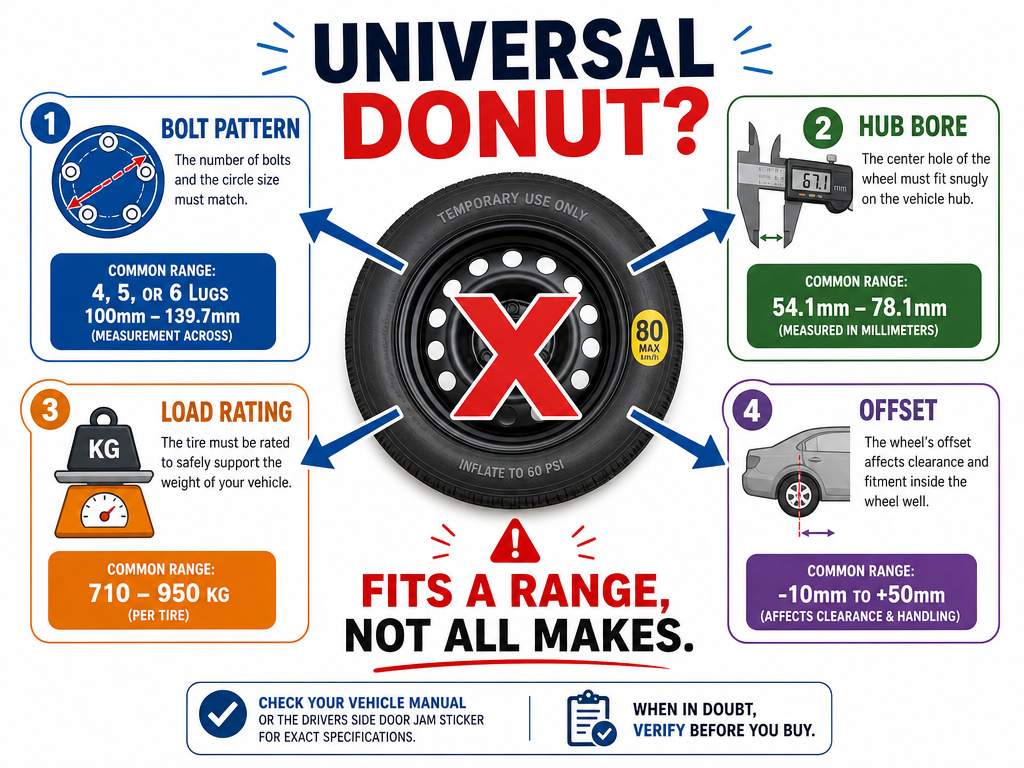 The short answer is no. The slightly longer answer is: you can buy a spare that fits a range of vehicles within a brand or platform, but it is not universally interchangeable across makes.
Aftermarket companies do sell “compact spare tires” listed for multiple vehicle applications. These are engineered to fit the most common bolt patterns and hub bores for a segment (e.g., many mid-size SUVs). However, “fits” in this context means it will physically bolt on and clear basic components. It does not guarantee the load rating is correct for your specific trim level’s weight, or that the offset is perfect.
Your only safe bet is to buy a spare designated for your exact year, make, model, and trim. The VIN is your best guide. The alternative is to have a tire professional verify all five specs against your vehicle’s requirements. This is the difference between a temporary fix and creating a new, more expensive problem.
Here’s what to do instead of hunting for a universal spare:
- Check Your Trunk First. Many used cars are missing their spare. Verify it’s there, the correct size, and properly inflated before you need it.
- Know Your Specs. Write down your vehicle’s bolt pattern, hub bore, and required load rating from the manual or door placard. Keep it in your glove box.
- Source from the Same Model. If you need a replacement spare, look for one from the same generation of your vehicle in a junkyard or online parts marketplace.
- Consider a Full-Size Spare. If you have the space, a full-size matching wheel and tire is always the safest, most flexible option. It eliminates all fitment and drivetrain concerns.
The 50/50 Rule and When to Retire Your Spare
The “50/50 rule” exists because the donut tire is a compromise. It has less tread, thinner sidewalls, and a simpler construction. The 50 mph speed limit and 50-mile distance limit are the engineering boundaries where the risk of failure begins to rise sharply.
But what if the spare is ten years old and has never been used? Age degrades rubber. A spare stored in a dark, dry trunk still suffers from oxidative cracking (dry rot) over time. You should inspect your spare tire annually, just like your old tires that are on the car. Look for: – Cracks in the sidewall (signs of dry rotted tires). – A chalky, faded appearance. – Any signs of the tire losing its round shape.
If you see cracks, the tire is compromised and could fail under load, even within the 50-mile limit. The age of the tire is often more critical than the tread depth. A 15-year-old spare with full tread is potentially more dangerous than a bald tires that’s only five years old, because the structural integrity is gone.
Your spare is part of your vehicle’s safety system. It should be treated with the same respect as your primary brakes. It’s not a get-out-of-jail-free card. It’s a calculated risk designed to get you to a repair shop. Push past its limits, or use one that doesn’t match, and the calculation fails.
Frequently Asked Questions
Can I use a donut spare on the front axle?
You can, but it’s not ideal. If your vehicle is front-wheel drive, the donut (which is usually smaller) will cause the differential to work harder. Place it on the rear if possible. If you must put it on the front of a FWD car, avoid hard acceleration and be extra cautious with braking and steering, as the handling balance will be off.
Is it illegal to drive on a donut spare past the 50-mile limit?
There is no specific law stating “50 miles,” but most states have general vehicle safety statutes requiring all tires to be in safe operating condition. A tire used beyond its manufacturer’s stated limitations is, by definition, unsafe. You could be cited for an unsafe vehicle, and more importantly, your insurance could deny a claim if an accident was caused or exacerbated by an overloaded or overused spare.
My car only came with a tire repair kit. Can I buy a donut spare?
Maybe, but it’s not simple. You need the spare, a jack, a lug wrench, and a dedicated place to store it. More critically, you need to verify your vehicle has the necessary mounting points (like a center hub) under the car. Some models designed only for a repair kit lack these provisions. Consult your dealership or a specialty parts supplier for your specific model.
How does a donut spare affect my car’s handling?
Significantly. It raises the car’s center of gravity on that corner (due to smaller diameter), reduces traction (less tread contact patch), and can induce a pull during braking. Drive smoothly, leave extra following distance, and avoid sudden maneuvers. The car will not handle normally.
Can I have a donut spare repaired if it goes flat?
No. Donut spares are not designed to be repaired. Their construction and the critical nature of their temporary role mean a puncture or damage warrants immediate replacement. A repaired donut spare has an unknown reliability factor, which defeats its purpose as a guaranteed safety stopgap.
Before You Go
Donut tires are engineered for a single vehicle, not for a category. The universal fitment myth persists because the differences are measured in millimeters and load indexes, things you can’t see from across a parking lot. Your safety hinges on those unseen specs.
Find your owner’s manual. Locate the spare tire section. Check the pressure in your spare today, before the rain starts and the light is fading. Know that the federal code and your vehicle’s engineers aligned to give you a 50-mile, 50-mph window. It’s a narrow margin, but it’s a real one, as long as the tire in your trunk is the one that belongs there.
