
Are 3 Wheel Bikes Good for Seniors? Stability vs. Handling
This post contains affiliate links. As an Amazon Associate, we earn from qualifying purchases.
Three-wheel bikes, or adult tricycles, are good for seniors who prioritize stability over speed and are willing to learn a new handling style. They eliminate the need for balance while stationary, directly addressing the fear of falling, but introduce new risks like front-wheel lock-up during braking and potential rollover in sharp turns, especially on electric models where unexpected power delivery can startle riders.
The mechanical reason tricycles handle differently lies in their rear track width and the physics of lateral weight transfer. A bicycle leans into a turn; a tricycle cannot, so the forces are resolved through the chassis. That changes everything about cornering, braking, and even where you park it.
What follows: the specific data from a recent senior survey, the engineering trade-offs you don’t see in marketing copy, and the model-by-model breakdown of what seniors actually preferred when they got to test-ride them.
Key Takeaways
- Seniors in a New England study overwhelmingly preferred the single-rider adult tricycle for its stability and comfortable seat, with the side-by-side two-seater a close second for social riding.
- Tricycle stability has a hard ceiling: corner too fast or brake the front wheel too hard, and the inside rear wheel can lift, leading to a tip-over instead of a controlled lean.
- Electric-assist models require a deliberate familiarization period; the Van Raam manual warns riders to “get used to riding with the electric support engaged” to avoid being startled by sudden power.
- The maintenance schedule is non-negotiable: the first professional service is due at 3 months or 300 km, with monthly user checks on tire pressure and brake function.
- Fit is not about height alone; inner leg length and the ability to plant your feet flat at a stop matter more for confidence than any spec on a sheet.
The Core Trade-Off: Stability vs. Cornering Dynamics
A tricycle’s primary selling point is static stability. You can stop at a red light, sit perfectly upright, and start again without putting a foot down. This isn’t a minor comfort. For a rider whose balance has declined, it determines whether they can ride at all.
A bicycle falls over when its center of gravity shifts outside the two tire contact patches. A tricycle tips over when lateral forces during a turn or on a slope overcome the stability triangle formed by its three contact points.
The size of that stability triangle is defined by the rear track width (the distance between the two rear wheels) and the height of the bike’s center of gravity. Engineers call this the Static Stability Factor (SSF). A wider track and a lower frame make a trike more resistant to tipping.
But that stable base creates a new problem: cornering dynamics. On a bicycle, you lean into a turn, shifting your center of gravity to counter the centrifugal force. On a tricycle, you must turn the handlebars without leaning. If you take a turn too fast, the force wants to tip the trike outward. The inside rear wheel can actually lift off the ground.
Where this goes sideways: Braking hard with the front wheel on a loose surface. The Van Raam Veloplus3 manual explicitly warns that the front brake (usually on the right lever) “deserves special caution, as a forceful braking could block the front wheel, which could result in a fall.”
You must unlearn the bicycle instinct to lean. You must also recalibrate your braking touch. Most riders adapt within a few short rides, but the first corner taken at bicycle speed is a genuine surprise.
What the Seniors in the Study Actually Chose
Theoretical benefits are one thing. Real-world preference is another. A 2023 study published in the journal Sustainability put specific models in front of seniors and recorded what they liked.
Researchers surveyed 178 seniors and arranged test rides for 50 participants aged 66 to 95 across several senior-living communities. The bikes provided were from Dutch manufacturer Van Raam, a leader in adaptive cycles.
The test riders ranked three models: 1. Van Raam Easy Rider (Adult Tricycle): The clear winner. This model features a low step-through frame, a supportive seat with a backrest, and a forward pedaling position. Seniors cited its feeling of security and comfort. 2. Van Raam Fun2Go (Three-Wheeled Two-Seater): The second choice. This side-by-side tandem allowed for social riding, which appealed to couples or friends. One community liked it enough to purchase one after the study. 3. Van Raam Balance Bike (Low-Step Two-Wheeler): The least preferred. Only seniors who were already confident on two-wheeled bikes chose it.
The peer-reviewed senior mobility research concluded that the single-rider tricycle was the most effective tool for keeping seniors cycling. The demand was for 30-minute rides, twice a week, on safe loops with accessible bathroom breaks, a practical, achievable goal.
The Electric Assist Question: Convenience with a Caveat
Adding a motor seems like a pure win. It counteracts a trike’s greater weight and helps with hills. For many seniors, it’s the difference between a 10-minute neighborhood loop and a 30-minute journey to the market.
The convenience, however, comes with a specific operational warning. The Van Raam manual for its electric Veloplus3 model states: “make sure that you get used to riding with the electric support engaged. Be careful when you turn on the electric support system and make sure you don’t get startled by unexpected behaviour.”
Electric power delivers torque instantly. A gentle pedal stroke on an electric trike can lurch the bike forward if you’re not braced for it. This is less about skill and more about muscle memory. The fix is simple: find an empty parking lot and spend 15 minutes starting, stopping, and turning with the assist on its lowest setting. The confidence follows.
| Consideration | Traditional Trike | Electric-Assist Trike |
|---|---|---|
| Primary Benefit | Simplicity, no battery management | Effortless hills, longer range |
| Key Caution | Managing momentum on slopes | Unexpected torque from a stop |
| Added Weight | Lighter (easier to maneuver at home) | Heavier (more stable, harder to lift) |
| Best For | Flat terrain, short errands | Varied terrain, longer recreational rides |
For a deeper look at powered options, our guide to the best three-wheel e-bikes breaks down motor types and battery considerations.
The Non-Negotiable Safety & Maintenance Schedule
A car gets serviced every 5,000 miles. A tricycle used for daily mobility needs the same disciplined care. The manufacturer’s schedule isn’t a suggestion; it’s a checklist to prevent failures that don’t just strand you, they can hurt you.
The Van Raam Veloplus3 manual lays out a strict regime: * First Service: 3 months or 300 km (whichever comes first), performed by the dealer. * Monthly User Check: Tire pressure (3 bar recommended), brake function, and light operation. * Annual Inspection: A 60-minute check of wheel true-ness, spoke tension, and steering joints.
The manual also flags components only a dealer should touch: the frame, brakes, lighting, handlebars, and front fork. Do not let a handyperson friend weld a cracked frame. The metallurgy and heat treatment matter.
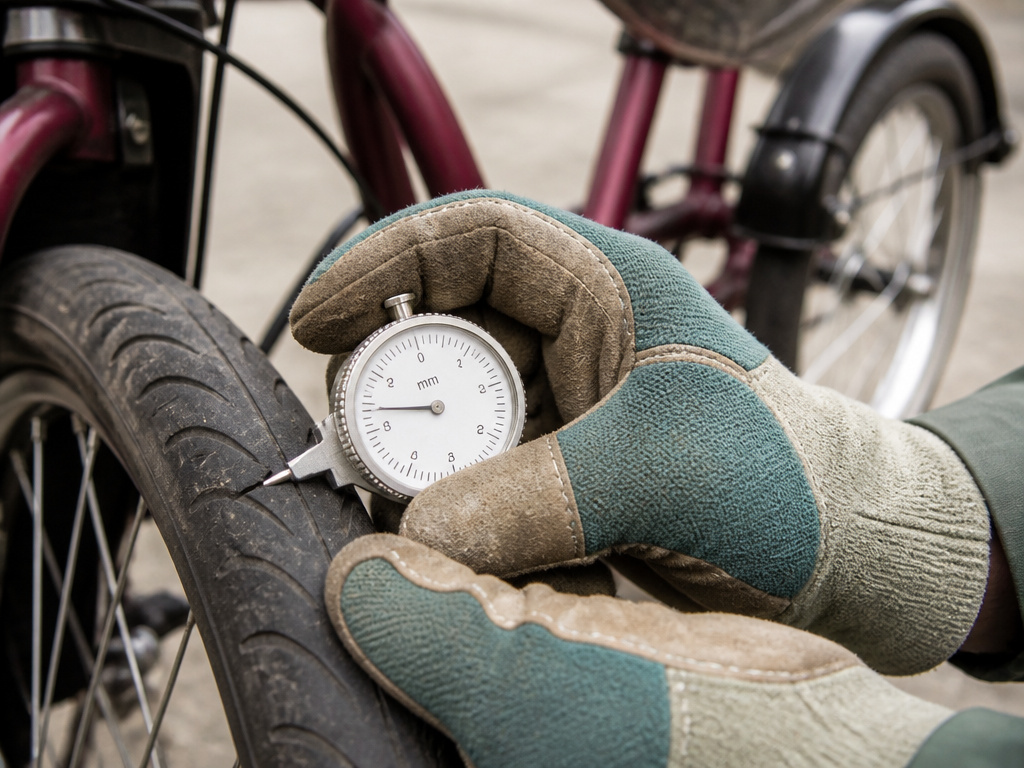
Common mistake: Ignoring tire tread depth. The manual specifies a minimum of 1 millimeter. Worn tires drastically reduce wet-weather traction and increase the risk of a front-wheel skid during braking, a primary cause of tip-overs.
This concerns the rider’s safety. A senior on a poorly maintained trike is in a more vulnerable position than a senior in a car.The NIH cycling benefits and risks review underscores that good infrastructure reduces collision risk, but rider-side maintenance is the first layer of safety.
Finding the Right Fit: It’s Not About Height
The product specs list a height range. That’s a starting point. The real metric is inner leg length, the distance from your groin to the floor, which determines if you can stand over the frame comfortably and plant your feet flat at a stop.
For the Van Raam Veloplus3, the inner leg length range is 80 to 95 cm. If you’re at the bottom of that range, the low 28 cm boarding height is a blessing. If you’re taller, you need to check that the seat post has enough extension.
A proper fitting session has three steps: 1. Mount and dismount three times. Is it a struggle, or is it fluid? 2. Pedal a short distance. Does your knee over-extend at the bottom of the stroke? 3. Come to a complete stop. Can you keep the soles of your shoes fully on the ground?
If the answer to any of these is “no,” the fit is wrong. An ill-fitting trike leads to discomfort, then disuse. Many senior-friendly bicycles and bikes for seniors over 70 now prioritize this kind of ergonomic fit over raw performance specs.
The Verdict: Who Are They Actually Good For?
So, are three-wheel bikes good for seniors? The answer is a conditional yes, for a specific person.
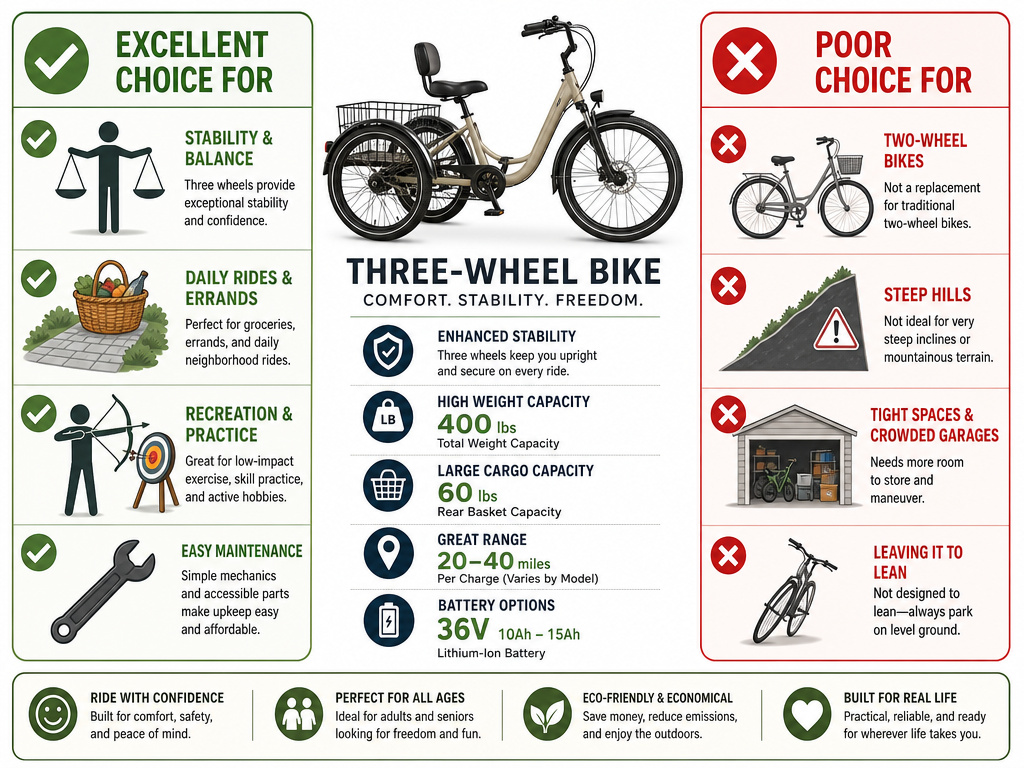
They are an excellent tool for seniors who: * Have a documented fear of falling or balance issues that rule out a two-wheeler. * Want to run local errands or enjoy recreational rides on paved paths. * Are willing to practice new braking and cornering techniques. * Have the means to adhere to the strict maintenance schedule.
They are a poor choice for seniors who: * Are comfortable on a two-wheeled step-through bike and only want light exercise. * Live in areas with steep hills and no electric assist. * Lack the storage space for a longer, wider machine. * Expect the nimble, leaning handling of a traditional bicycle.
The data points to the Van Raam Easy Rider as the benchmark. Its design, low step, supportive seat, forward pedals, directly matched what seniors in the study wanted. For those wanting company, the tandem Fun2Go model proved a viable social option.
For anyone on the fence, the study’s recommendation is the best one: find a dealer and take a test ride. Your body will tell you what the spec sheets cannot. The goal is to maintain mobility.
Frequently Asked Questions
What are the biggest risks with adult tricycles?
The two biggest risks are front-wheel lock-up during braking and rollover during sharp, fast turns. Both are counterintuitive to a lifelong bicycle rider who instinctively leans and relies on front-brake power. Electric models add a third: being startled by the instant torque from the motor, which can cause a jerky, uncontrolled start.
How much slower is a tricycle than a regular bike?
On flat, straight pavement, a fit rider on a lightweight trike might keep a similar pace. In practice, the added weight and rolling resistance of two rear wheels, plus the cautious cornering required, mean most riders average 20-30% slower than they would on a bicycle over a mixed route. The trade-off is stamina, you can ride longer without balancing fatigue.
Can I carry groceries on a trike?
Absolutely. This is a major advantage. Most adult trikes come with a rear cargo basket rated for 20 kg or more. The stable platform means a loaded basket doesn’t affect handling as drastically as it would on a two-wheeler. Just remember that the tricycle chassis design study emphasizes that the load must be centered and secured; off-center weight can subtly affect the stability triangle.
Are there any three-wheel bikes that don’t have a learning curve?
No. Every tricycle requires you to unlearn the habit of leaning into turns. The learning curve is generally short, a few hours of focused practice, but it is mandatory. Some models, like those with a variable front wheel track mechanism studied in engineering journals, can actually have a steeper curve, switching between stable and unstable modes.
What’s the difference between a trike with two front wheels vs. Two rear wheels?
The most common design for adult trikes is two wheels at the rear (a delta trike). This provides a stable, wide cargo platform and is generally easier to steer. Tadpole trikes (two front wheels) are often recumbent, offering a lower center of gravity and sportier cornering, but they can be harder to mount and have a different steering feel. For seniors, the delta configuration is the default.
The Bottom Line
Adult tricycles are a pragmatic solution, not a magical one. They exchange the dynamic balance of a bicycle for static stability, along with a new set of physical rules you must learn. The academic research is clear: when given a choice, seniors themselves vote for the tricycle’s security and comfort.
The decision comes down to honesty about your own priorities. If the primary goal is to stay active without the fear of a wobbly stop, a trike like the Van Raam Easy Rider is a validated, effective tool. Just respect its limits, maintain it religiously, and give yourself those first few afternoons in a parking lot to relearn how to turn and stop. The freedom that follows is worth the homework.
