
How Safe Are Electric Unicycles? Mastering Your Safety Margin
This post contains affiliate links. As an Amazon Associate, we earn from qualifying purchases.
Electric unicycles are safe to ride only when you actively manage multiple margins: battery charge, motor headroom, protective gear, and your own skill. They are not safe by default. A cutout or crash is rarely random; it’s the result of ignored alarms, low battery, aggressive riding, or poor conditions. The wheel’s safety systems, tilt-back, beep warnings, and app alerts, are your last line of defense, not a negotiation.
That margin is the whole game. It disappears in layers: a low battery cuts your power ceiling, a cold day slashes your range, a wet road steals your traction. When one margin shrinks, you slow down. When several vanish at once, you’re riding a different, far more dangerous machine.
What follows is not a list of obvious warnings. It’s a breakdown of the specific, manual-verified failure modes, like the 120-day battery storage limit, the 80°C controller alarm, and the wind direction that decides a crash. We’ll cover the four non-negotiable alarms, the gear that actually works, and the riding mindset that keeps you upright for the long haul.
Key Takeaways
- Battery damage is permanent and not covered by warranty. An Inmotion V11 battery left uncharged for 120-180 days can be destroyed by over-discharge. The smart chip inside logs this neglect.
- Ignore an overvoltage alarm at your peril. This specific 3-beeps-in-2-seconds warning means the wheel is seconds from a cutout. Slowing down is not optional.
- Full gear is non-negotiable. A bicycle helmet isn’t enough. You need full-face protection, wrist guards, and knee/shin guards rated for motorcycle-level impacts.
- “Margin” means riding at 70% of your wheel’s and your skill’s max. On a 50 km/h wheel, that’s 35 km/h. With a 50% battery, that’s 25 km/h. This headroom is your crash insurance.
- Water kills warranties and wheels. Most EUCs have minimal water resistance (IP55). Riding in rain or through puddles voids the warranty and can cause a short circuit or fire.
The Core Question: Safe Enough for What?
Asking if electric unicycles are safe is like asking if chainsaws are safe. In the hands of a trained, focused professional wearing chaps and steel-toed boots, yes. In the hands of someone in flip-flops trying to trim a branch over their head, no. The safety is in the operation, not the object.
An EUC is a single-track, self-balancing vehicle with immense power. Its stability comes from a gyroscope and a motor responding to your lean. This design is brilliant and inherently risky. There is no mechanical linkage between you and the wheel, only software interpreting your weight shift. If the software cannot deliver the power needed to correct your position, you fall. This is called an overlean or a cutout.
The safety of an electric unicycle is a direct function of the remaining battery charge, motor temperature, and the rider’s respect for the wheel’s programmed tilt-back and audible alarms. These are not suggestions; they are the system reporting its operational limits.
The real question isn’t about absolute safety. It’s about whether you’re willing to learn the machine’s language, its beeps, its tilt, its app warnings, and then stay well within those boundaries.
The 4 Alarms That Aren’t Suggestions
Your electric unicycle talks. It beeps, it tilts the pedals, it sends notifications to your phone. Treat these as casual suggestions and you will crash. Here’s what each one means and the specific consequence of ignoring it.
1. Tilt-Back (Pedal Dip)
What it is: The wheel physically tilts the pedals so the front is higher than the back. This makes accelerating harder and forces you to lean back to slow down.
Why it happens: The wheel does this as a speed limit protection (like on the Gosmilo X1) or when battery levels are low. It’s the system’s most polite way of saying “slow down now.”
Ignore it: If you fight the tilt and keep leaning forward, you demand more power than the wheel can give. The next step is a power cutout. You fall forward at speed.
2. Beep Sequences – Your Audible Lifeline
Different beep patterns map to specific failures. The Begode Hero manual spells these out clearly: * 3 beeps in 2 seconds: Overvoltage alarm. This is critical. It means regenerative braking is overcharging the battery, often on a downhill with a full charge. Immediate slowdown is required to avoid a cutout. * 2 short beeps: Controller overheated. The controller has hit 80°C. You must stop riding to let it cool. Continuing risks melting internal solder joints. * Rapid, constant beeping: Low battery. Power is severely limited. Pushing for more speed will cause a voltage sag and a cutout.
3. App Warnings (PWM & Voltage Sag)
The companion app shows real-time data. Two metrics are vital: * PWM (Pulse Width Modulation): This shows motor effort. At 100%, the motor has no headroom left. Riding above 80% PWM for more than a few seconds is flirting with a cutout. * Voltage Sag: Watch the battery voltage under load. A healthy battery sags slightly when you accelerate. A massive, rapid drop means the battery cannot deliver the current you’re asking for. This precedes a cutout.
4. The Physical Feel – Loss of “Push”
This is the silent alarm. When you accelerate and the wheel feels mushy or unresponsive instead of punchy, the power is already gone. You’re riding on borrowed time. This happens in cold weather (<0°C) or with a very depleted battery. The fix is immediate, gentle deceleration.
| Alarm Type | What It Signals | Immediate Action Required | Consequence of Ignoring |
|---|---|---|---|
| Tilt-Back | Speed limit or low battery | Lean back, reduce speed smoothly | Overlean and forward cutout |
| 3-Beep Pattern | Overvoltage from braking | Slow down significantly | Instant cutout, high-side fall |
| 2-Short-Beep | Controller >80°C | Stop riding, allow cooling | Permanent controller damage, fire risk |
| App PWM >90% | No motor headroom | Cease acceleration, reduce speed | Cutout from over-demand |
Gear Up or Get Hurt
A bicycle helmet and skateboard pads are insufficient. The physics of an EUC crash are closer to a motorcycle low-side at 30+ km/h. You slide and impact with substantial force.
The Non-Negotiable Kit:
- Full-Face Helmet (DOT/ECE certified): Your jaw and teeth are vulnerable in a forward fall. A full-face mountain bike or motorcycle helmet is mandatory.
- Wrist Guards: Your instinct is to catch your fall. Wrist guards prevent the most common serious injury, broken wrists and scaphoid fractures.
- Knee/Shin Guards (Motorcycle-rated): Look for hard-shell guards with D3O or similar impact foam. They should strap securely, not just slide on.
- Elbow Guards: Same principle as knee guards. They must stay in place during a slide.
- Riding Jacket (Optional but recommended): A motorcycle jacket with shoulder, elbow, and back armor turns a road-rash disaster into a manageable slide.
Where this goes sideways: Thinking “I’m just going around the block.” Most accidents happen close to home, on familiar routes, when complacency sets in. Gear up for every ride, no exceptions.
The Gosmilo manual explicitly states helmets must meet GB 24429-2009, ASTM F1492-08, CPSC, or CE EN1078 standards. This isn’t marketing. It’s a specification for impact absorption. Your $50 big-box-store helmet likely doesn’t meet any of them.
Battery & Maintenance: The Invisible Risks
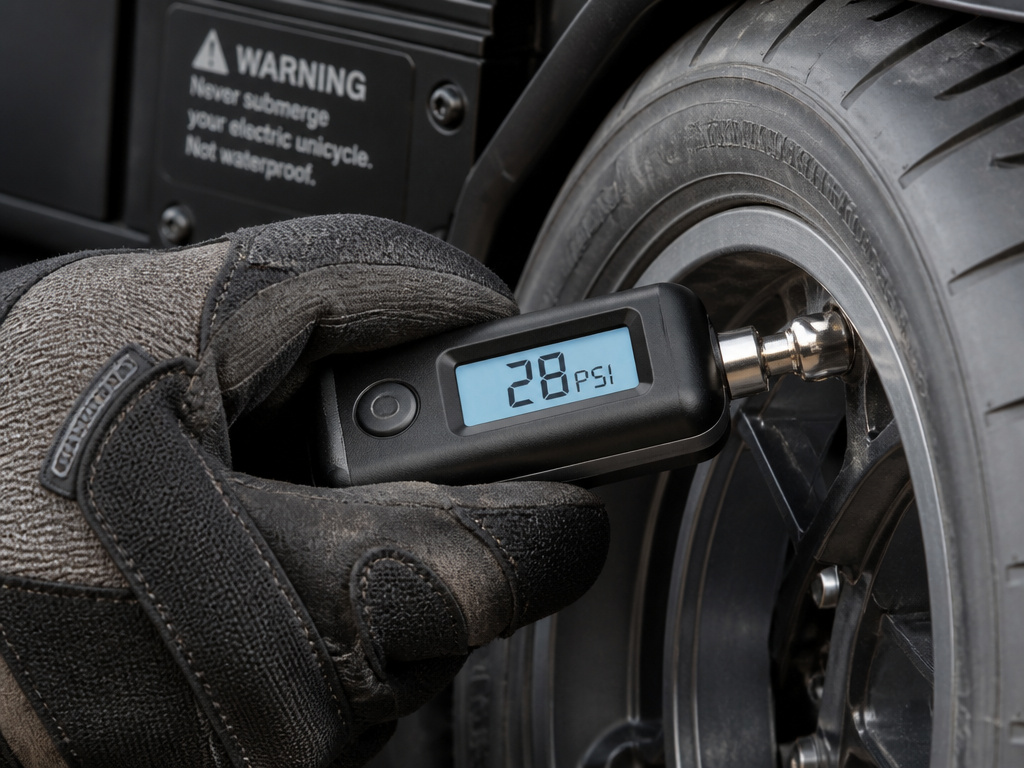
The battery pack is the heart, the most expensive component, and the biggest fire risk. Maintenance isn’t about cleaning; it’s about preventing catastrophic failure.
Storage is a timed event. Per the Inmotion V11 and KINGSONG KS-16S manuals: a fully charged battery will self-discharge to a damaging level in 120 to 180 days. The “smart chip” inside logs this over-discharge, and the resulting damage is not covered by warranty. You must recharge a stored wheel at least once a month.
Temperature is a performance throttle. Battery chemistry slows down in the cold. The KINGSONG manual notes that at -20°C, range can be half of what it is at room temperature. Conversely, storing a wheel in a car on a summer day can exceed the 50°C high-temperature limit, accelerating battery degradation and increasing fire risk.
Tire pressure is a safety setting. The Begode Hero manual recommends 1.5 to 3.2 bar (22-46 PSI), depending on rider weight and terrain. Too low, and you risk a pinch flat or rim damage. Too high, and you lose traction, especially on wet surfaces. Check it weekly.
The water resistance lie. Most wheels like the Inmotion V11 have an IP55 rating. This means they are protected from low-pressure water jets, not immersion or heavy rain. The Begode manual is blunt: “DO NOT ride in the rain or through puddles. Water damage is not covered under warranty.” A short circuit from water intrusion can lead to a fire.
Riding Mindset: Building and Keeping Margin
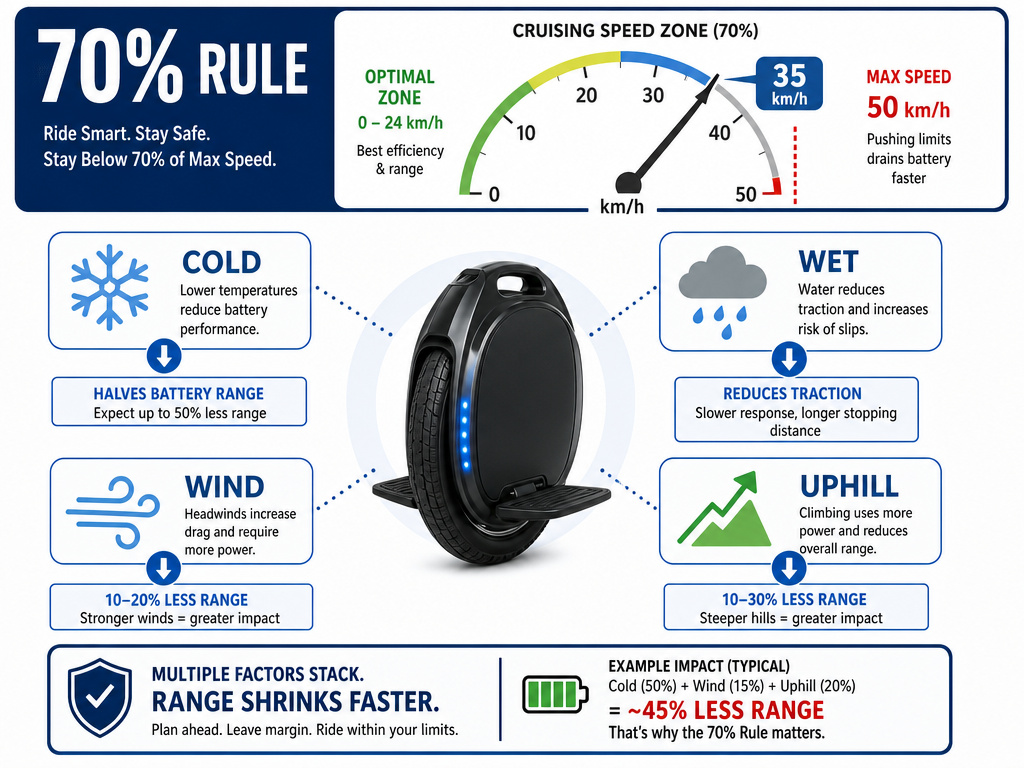
Margin is the buffer between what you’re doing and what the wheel (or you) can maximally handle. It’s your only real safety system. Here’s how to calculate it and why it matters.
The 70% Rule: This is your default setting. * Speed: If your wheel’s top speed is 50 km/h, your cruising speed should be ~35 km/h. This leaves headroom for emergency acceleration or braking. * Battery: Below 50% charge, your wheel’s maximum power output drops. Your speed and acceleration margins must shrink accordingly. At 20% battery, you are in “get home gently” mode, not “keep up with traffic” mode. * Skill: If you can just barely navigate a busy intersection, you have no margin. Avoid that intersection until it feels easy. Practice emergency braking and controlled dismounts in a parking lot until they’re automatic.
Environmental Multipliers: These shrink your margin faster than anything else. 1. Cold: Halves battery range and reduces tire grip. 2. Wet: Dramatically reduces traction. Avoid leaning, braking, or accelerating hard. 3. Wind: A strong headwind forces the motor to work much harder, consuming your power margin. 4. Uphill: Constant torque demand heats up the motor and controller, triggering temperature alarms.
The part nobody mentions: Group rides are margin-killers. The pressure to keep up with experienced riders on powerful wheels pushes beginners far beyond their safe limits. Ride alone or with riders of similar skill until your margins are instinctive.
Electric Unicycles vs. Other PEVs
Is an EUC inherently more dangerous than an electric scooter or bike? In some ways, yes, but the comparison is useful.
| Factor | Electric Unicycle (EUC) | Electric Scooter | Electric Bike |
|---|---|---|---|
| Learning Curve | Steep (10-20 hours) | Shallow (minutes) | Very shallow (if you can bike) |
| Failure Mode | Cutout (sudden power loss) | Mechanical brake failure, tire blowout | Chain derailment, brake failure |
| Stability | Unstable at low speed, stable at high speed | Very stable on two wheels | Highly stable on two wheels |
| Rider Protection | Rider is part of the balancing system | Rider is separate from steering system | Rider is separate from steering system |
| Key Safety Skill | Managing power margin and overlean | Managing speed and braking distance | Managing speed and traffic awareness |
The core difference is integration. On a scooter or bike, you can coast if power fails. On an EUC, a cutout means an immediate fall. This demands greater respect for the wheel’s power systems. However, a skilled EUC rider often has better low-speed maneuverability and obstacle clearance than a scooter rider, which can be safer in dense urban environments.
Frequently Asked Questions
Can electric unicycles catch fire?
Yes, though it’s rare. The primary risk is from physical damage to the battery pack (e.g., from a crash), water ingress causing a short, or a faulty Battery Management System (BMS). Brands like Begode have had publicized incidents. Minimize risk by avoiding crashes, never charging unattended, and storing the wheel in a cool, dry place away from combustibles.
How long does it take to learn to ride an electric unicycle?
For basic forward motion, expect 5-10 hours of practice over a week. For true traffic readiness and confidence, plan on 30-50 hours. It is not like riding a bike; it uses different muscles and reflexes. Using a fence or wall for support during the first few hours is crucial.
Do you need insurance for an electric unicycle?
Legally, it depends on your local regulations, which often lag behind the technology. Practically, yes, you should have insurance. Your homeowner’s or renter’s policy may not cover it, especially for liability if you cause an accident. Specialized personal electric vehicle (PEV) insurance is becoming more available and is highly recommended.
What is the most common injury from electric unicycles?
Broken wrists and forearm fractures are the most common, followed by shoulder injuries and facial abrasions. This is why wrist guards are as important as a helmet. The natural reaction to a forward fall is to put your hands out.
Are more expensive electric unicycles safer?
Generally, yes. Higher-end models from brands like Inmotion and Veteran often feature more robust safety systems: smarter BMS, better water resistance, higher-quality battery cells (like Samsung 50E), and more conservative power margins. They also have louder, clearer alarms. A beginner on a high-performance “torque monster” wheel is actually at greater risk if they don’t understand its limits.
Before You Go
Electric unicycle safety isn’t a checkbox. It’s a dynamic, ongoing practice of listening to your machine and being brutally honest about your own limits. The wheel gives you alarms, tilt-back, beeps, app warnings. Your job is to never argue with them.
Start with a quality wheel like the Inmotion V11 or a KINGSONG S18 that has proven safety features. Gear up with motorcycle-level protection every single time. Internalize the 70% rule for speed and battery. And understand that the 120-day clock is ticking the moment you park it for the season.
The freedom and thrill are real. So are the stakes. Manage your margin, and you’ll manage the risk.
