
What’s the Difference Between a Road Bike and Hybrid Bike?
This post contains affiliate links. As an Amazon Associate, we earn from qualifying purchases.
The difference between a road bike and a hybrid bike comes down to three non-negotiable things: riding position, tire size, and speed. A road bike’s aggressive geometry and narrow high-pressure tires are built to cut wind and transfer every ounce of energy forward. A hybrid’s upright position and wider tires prioritize comfort and stability over multiple surfaces.
The answer “one is fast, one is comfortable” is a cliché. The real decision is how your body feels after mile fifteen, how many flats you get in a month, and whether you can lift the bike onto a car rack without throwing your back out. The geometry numbers, the tire specs, and the weight are the underlying mechanics; the back pain, the commute time, and the repair bills are the consequences.
The rest walks the choice through those mechanics: frame angles, named components, and the compromises that come with each. You’ll finish knowing exactly which bike leaves you smiling at the end of your regular route.
Key Takeaways
- A road bike’s 70–74° seat tube angle puts your hips forward for a powerful pedal stroke. A hybrid’s slacker 72–75° angle keeps you upright and comfortable at the expense of raw power.
- Tire pressure is the loudest difference. Road tires run 80–130 PSI; hybrid tires run 50–70 PSI. That’s the direct line between a smooth, fast ride and a soft, bump-absorbing one.
- A hybrid’s flat handlebars give you immediate, upright control. Road bike drop bars offer three hand positions for long-distance endurance but demand a flexible back and core strength.
- The Polygon Strattos S5 with a Shimano 105 groupset and the Polygon Heist 7 with a Shimano Deore 1×11 setup illustrate the parts-binning reality: road parts are light and fast, hybrid parts are durable and simple.
- Choosing wrong means buying twice. A road bike on a gravel path rattles fillings loose; a hybrid in a road group ride gets dropped by mile five.
The Difference Starts With a Single Question
What kind of riding hurts you? A road bike’s geometry is engineered to hurt you a little now so you can go a lot faster later. A hybrid’s geometry is engineered to avoid that hurt entirely, trading speed for all-day comfort.
The frame angles tell the story. Road bikes have a steeper seat tube, typically between 70 and 74 degrees. This angle rotates your pelvis forward, aligning your hips over the pedals for a more direct power transfer. It’s efficient. It’s also the reason your lower back and hamstrings will talk to you after the first twenty miles if you’re not conditioned for it.
Hybrids use a slacker angle, between 72 and 75 degrees. This lets you sit more upright, like in a chair. Your weight settles onto your sit bones, your back stays straight, and your neck isn’t craned upward. You sacrifice pedaling efficiency—some power gets lost as your legs push down at a less optimal angle—but you gain the ability to look around comfortably in traffic or on a trail.
Common mistake: Buying a bike based on the “look” of the frame alone. The seat tube angle is invisible until you ride it, and that single degree of difference decides whether you can ride for an hour or for four.
The top tube length and handlebar reach complete the picture. A road bike’s longer top tube stretches you out into an aerodynamic tuck. A hybrid’s shorter top tube brings the handlebars closer, keeping your torso upright. This isn’t a minor preference. It’s the fundamental trade-off between slicing through air and sitting up to see over a car’s hood.
Handlebar Showdown: Drop Bars vs. Flat Bars
Your hands are the direct interface. A road bike’s drop bars and a hybrid’s flat bars dictate not just your posture, but your control, your braking reaction time, and how many hours you can stay in the saddle.
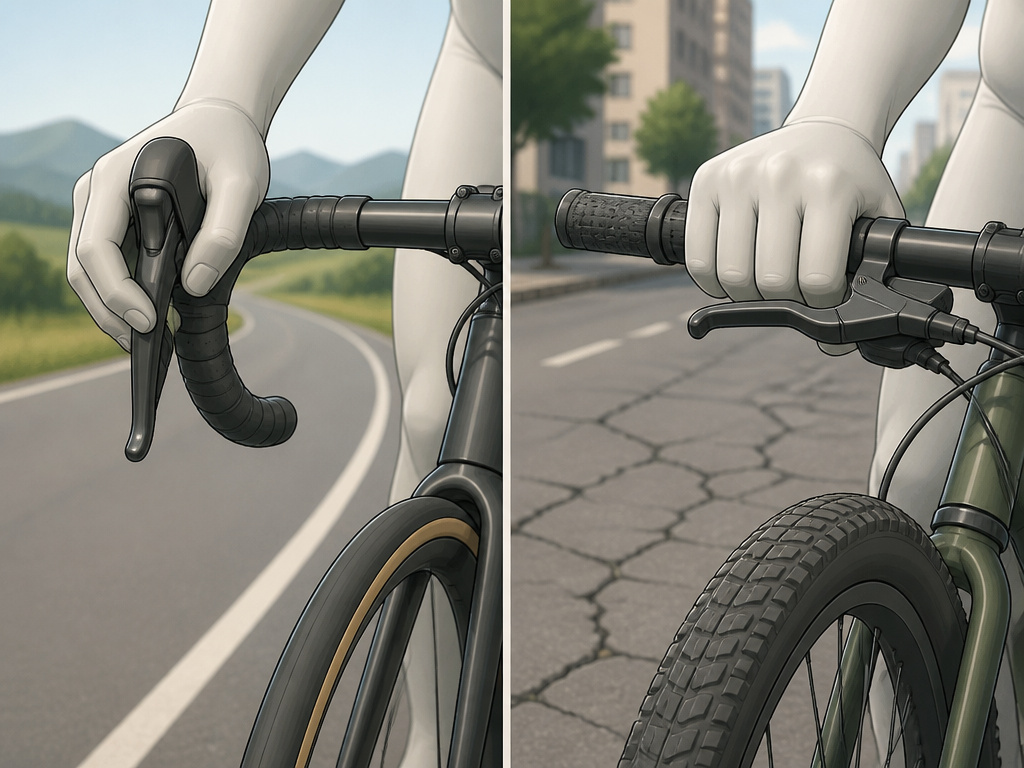
Drop bars offer three distinct hand positions: the hoods, the drops, and the tops. On a long ride, you shift between them to relieve pressure and fight fatigue. The hoods are the default—your fingers rest on the brake levers, ready to stop. The drops are for descending or fighting a headwind, getting you lower and more aerodynamic. The tops are for climbing or a relaxed cruise. This versatility is why road bikes rule endurance events.
The catch is muscle memory. Shifting your hands changes your center of gravity and your relationship with the brakes. New riders often panic-grab for the wrong spot. The learning curve is real, and it takes a few rides before moving your hands feels automatic instead of risky.
Flat bars are simple. Your hands are always in the same place, shoulder-width apart, with the brake levers and shifters always under your thumbs. The control is immediate and intuitive, like riding a bike from childhood. This makes hybrids brilliant for city commuting where you need to brake, signal, and maneuver quickly. You’re upright, you can see everything, and you’re not fighting your posture to look over your shoulder.
The trade-off is wind resistance. That upright posture is a sail. On a flat bar hybrid, you’re pushing a much larger frontal area through the air. The energy cost adds up fast, especially over distances longer than ten miles.
| Hand Position | Best For | The Trade-Off |
|---|---|---|
| Drop Bars (Road) | Long-distance endurance, speed, headwinds | Demands core strength, flexible back; braking requires hand movement |
| Flat Bars (Hybrid) | City commuting, traffic, casual cruising, light trails | High wind resistance limits speed; only one hand position causes fatigue on very long rides |
The choice here isn’t about good or bad. It’s about matching the tool to the task you actually do. If your ride involves constant stops and starts, flat bars win. If your ride is about covering ground without stopping, drop bars win.
The Real-World Numbers That Decide Your Speed
Tires and gearing are where the rubber meets the road—literally. The spec sheets for a Polygon Strattos S5 road bike and a Polygon Heist 7 hybrid show the engineering priorities in hard numbers.
Road bike tires are narrow and run at high pressure. Think 25mm or 28mm wide, inflated to between 80 and 130 PSI. This creates a small, hard contact patch that rolls with minimal deformation. Less energy is lost to the tire flexing, so more of your pedal stroke goes into forward motion. The ride is firm, fast, and transmits every pebble through the frame. You feel the road.
Hybrid tires are wider and softer. They range from 28mm to 38mm wide, running 50 to 70 PSI. The larger air volume and lower pressure allow the tire to conform to bumps and absorb vibrations. The ride is plush and stable, perfect for broken pavement or hard-packed dirt. The trade-off is rolling resistance. That compliant tire wall absorbs some of your pedaling energy as heat, which is why a hybrid always feels slower than a road bike on the same smooth asphalt.
A Shimano 105 R7000 groupset on a road bike like the Strattos S5 uses a close-ratio cassette (like an 11-28t) paired with 50/34t chainrings. This gives you small, precise gear jumps to maintain an optimal cadence at high speed. It’s a racer’s setup.
Gearing follows the same logic. A road bike’s drivetrain, like the Shimano 105 R7000 groupset on a bike like the Strattos S5, is built for maintaining high speed. It typically uses a close-ratio cassette (like an 11-28t) paired with 50/34t chainrings. This gives you small, precise gear jumps to keep your pedaling rhythm perfectly efficient at 20+ MPH. It’s a racer’s setup.
A hybrid like the Polygon Heist 7 uses a Shimano Deore M5100 1×11-speed groupset. The single front chainring simplifies shifting, and the wide-range cassette is geared for climbing steep hills or accelerating from a stop with a load. It’s a utilitarian setup designed for reliability and a broad range of usable gears, not for preserving a specific cadence at race pace.
Weight, Brakes, and the Invisible Maintenance Schedule
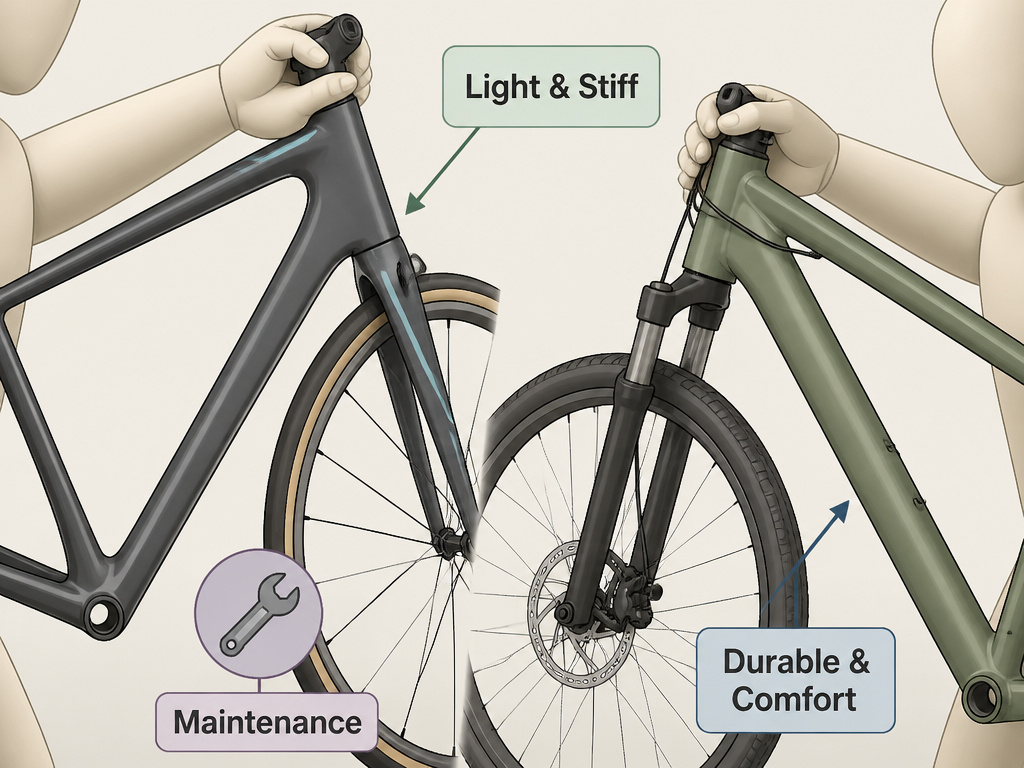
Lift a road bike. Now lift a hybrid. The four to eight pound difference is immediately obvious in your hands and on every hill. A road bike frame is built to be light and stiff, often from aluminum or carbon fiber. Every gram saved is a watt you don’t have to expend later. A hybrid frame prioritizes durability and comfort, using thicker tubing and more material, which adds weight.
Brakes are another dividing line. Most modern bikes in both categories now use disc brakes for superior stopping power in all conditions. However, the edge case matters: many older road bikes and budget hybrids still use rim brakes. They’re lighter and simpler but fade badly in wet weather. When you’re looking at a used bike or an entry-level model, the brake type is a critical safety check.
The maintenance schedule is the invisible cost. Road bikes, with their lightweight, high-performance parts, need more attentive care. The narrow, high-pressure tires are more prone to pinch flats if you hit a pothole. The delicate derailleurs need precise adjustment. The clean, efficient drivetrain gunks up quickly and needs frequent cleaning and lubrication.
Hybrids are built to be tougher. The wider tires resist pinch flats. The components, like the Shimano Deore groupset, are designed to withstand dirt and grit with less frequent adjustment. They don’t perform at the same peak, but they hold their acceptable performance longer with less fuss. For a commuter who rides rain or shine, this robustness is a feature, not a bug.
Where this goes sideways: Assuming a hybrid is just a cheap road bike. The components are not interchangeable in spirit or often in fact. Putting a road groupset on a hybrid frame still leaves you fighting an upright geometry, and the bike will handle poorly at speed.
The Final Verdict: Which Bike Actually Fits Your Life?
This isn’t a theoretical choice. It’s about matching a machine to the roads, paths, and distances you actually travel. Your body and your schedule will vote every time you ride.
If your typical ride is a 50-mile Saturday morning loop on country roads where you want to keep up with a group, a road bike is your only rational choice. The speed difference isn’t marginal; it’s categorical. A fit rider on a road bike will average 3-5 MPH faster than the same rider on a hybrid over that distance. The road bike’s geometry and tires are doing exactly what they were designed to do.
If your regular route is a 5-mile commute through city streets with stoplights, potholes, and the need to carry a laptop, a hybrid is the smarter tool. The upright position gives you better visibility and control in traffic. The wider tires shrug off urban debris. The mounts for fenders and a rack turn it into practical transportation. A road bike would be faster on the open segments, but the hybrid is faster and safer door-to-door because it’s built for the whole journey, not just the uninterrupted parts.
For the rider stuck in the middle—someone who wants one bike for weekend fitness rides on pavement and the occasional gentle gravel path—the compromise isn’t a hybrid. Look at an endurance road bike or a gravel bike. These categories borrow the road bike’s efficient geometry but relax it slightly and clear wider tires. They split the difference better than a hybrid tries to.
Before you spend anything, answer this: what does a successful ride look like to you? Is it a faster time, a longer distance, or simply arriving comfortable and dry? The bike that delivers that feeling is the right one. Everything else is just spec-sheet noise.
Frequently Asked Questions
Can I put road bike tires on a hybrid bike?
Sometimes, but it’s rarely a good idea. A hybrid frame has clearance for wider tires, but switching to narrow, high-pressure road tires won’t change the bike’s upright geometry or added weight. You might roll slightly faster, but you’ll lose the hybrid’s comfort and puncture resistance, and the handling can become twitchy. It’s a modification that usually disappoints.
Are hybrid bikes good for long distances?
They are comfortable for long distances, but not fast. The upright position is easier on your back and neck, allowing you to ride for hours without the fatigue of a road bike’s aggressive tuck. However, the increased wind resistance and rolling resistance mean you’ll cover those hours more slowly and with greater effort than on a road bike built for the task.
Is a road bike harder to ride than a hybrid?
For the first few rides, yes. The learning curve involves getting used to the lower, more forward position, handling the bike with drop bars, and reaching the brake levers from multiple hand positions. A hybrid’s flat bars and upright stance are instantly familiar. After the initial adaptation period, a road bike becomes second nature, but that initial period is real.
Can I use a hybrid bike for exercise?
Absolutely. A hybrid is an excellent fitness tool, especially for building base endurance, burning calories, and low-impact cardio. It will get you fit. The limitation is that as your fitness improves, the bike itself becomes the limiting factor for speed and high-intensity training. For general health and weight loss, it’s more than capable.
Which bike requires less maintenance?
Hybrid bikes generally require less frequent, less meticulous maintenance. Their sturdier components and wider tires are more forgiving of dirt and minor impacts. Road bikes, with their precision parts and narrow-tolerance systems, require more regular cleaning, adjustment, and care to perform at their peak. For a rider who just wants to ride without becoming a part-time mechanic, the hybrid has an edge.
The Bottom Line
Forget what the bike looks like in the shop. The difference between a road bike and a hybrid bike is measured in the strain in your lower back after thirty miles, the number on your bike computer at the end of your regular loop, and how often you find yourself reaching for a hex wrench.
The road bike asks more of your body and rewards you with speed. The hybrid asks less and rewards you with comfort and versatility. One is a scalpel, the other is a utility knife. You need to know what you’re cutting before you choose the blade.
Pick the bike that fits the riding you will actually do this month, not the riding you imagine doing someday. The right bike gets used. The wrong one gathers dust in the garage.
