
How to Prevent a Stolen Bicycle: Essential Security Guide
This post contains affiliate links. As an Amazon Associate, we earn from qualifying purchases.
Prevent bicycle theft by using a high-quality, keyed U-lock costing at least $40 to secure both the frame and a wheel to a solid, permanent metal object. Immediately register the bike’s serial number for free with Bike Index or Project 529, and avoid overnight public parking.
This is the physical mechanism that stops a thief: a U-lock forces them to use a loud, conspicuous grinder, buying time and increasing risk. Registration creates a digital tether so a recovered bike can prove it’s yours.
What follows is the rest of the picture: the exact lock hierarchy that matters, why city data says cameras and foot traffic are not shields, the single best place to park overnight, and what to do the moment you discover your bike is gone.
Key Takeaways
- A cable lock is not a lock. It’s a suggestion a thief can cut in under 10 seconds with handheld shears.
- Register your bike the day you buy it. The serial number is the only permanent ID; a photo and receipt are just supporting documents.
- Thieves operate in plain sight. A busy café patio is a target-rich environment, not a deterrent.
- “Secure” parking like a garage or bike room still requires a U-lock inside it. Shared spaces are not safe spaces.
- If it’s stolen, file a police report online immediately and list it on Bike Index. Recovery rates are near 50%, but only if the bike is identifiable.
The Locking Hierarchy: Cable, Chain, U-Lock, or Folding?
The difference between a stolen bike and a secure one is the tool a thief must bring. Choose the lock that demands the loudest, most difficult tool.
Cable locks fail a basic physics test. A $20 pair of bolt cutters applies thousands of pounds of force through two hardened steel blades. The cable’s individual woven strands snap in sequence, not all at once. A thief can cut through in seconds, often unnoticed in a crowd.
Cable locks are for convenience, not security. Use one only to secure a helmet or a quick-release seatpost to your already-U-locked frame. Never as the primary lock.
Chain locks bridge the gap, but only if they are heavy-duty, hardened steel links with a matching padlock. A quality one weighs several pounds and costs as much as a good U-lock. They are versatile for wrapping around odd-shaped objects but are vulnerable to bolt cutters unless specifically rated against them.
U-locks are the default for a reason. The hardened steel shackle resists bolt cutters and requires a loud, spark-throwing angle grinder or a heavy-duty jack to break. The security comes from the material and the limited space to attack it. Look for a Sold Secure rating—an independent UK testing body whose gold/silver/bronze certifications are the only numbers that matter.
Folding locks like those from Abus or Litelok offer a U-lock’s security with more flexibility. The linked steel plates resist cutting tools well, but the pivot points can be a target. They are an excellent choice for irregular racks.
| Lock Type | Thief’s Tool | Time to Defeat | Best For |
|---|---|---|---|
| Cable Lock | Handheld shears | 5–10 seconds | Securing accessories only |
| Cheap Chain | Bolt cutters | 15–30 seconds | Low-risk, short stops |
| Sold Secure U-Lock | Angle grinder | 60+ seconds (noisy) | Daily urban locking |
| Folding Lock | Angle grinder / Leverage | 60+ seconds | Irregular parking spots |
The Milwaukee Bike Theft Reduction Initiative puts a specific price on this: a U-lock worth less than $40 likely skimps on steel quality. Bike East Bay echoes this, noting security is usually proportional to price. Your first lock should be a keyed U-lock from Kryptonite, Abus, or OnGuard. Combination locks are weaker and easier to fiddle open.
Common mistake: Locking only the frame. A thief will happily leave your frame and walk off with a $200 wheel. Always secure the frame and one wheel to the immovable object. For quick-release wheels, either take the front wheel with you or lock it to the frame and the rack.
Choose the Anchor, Not Just the Lock
A U-lock is only as strong as what you attach it to. A thief doesn’t defeat the lock; they defeat the anchor.
City data reveals the traps. The Milwaukee initiative notes that many thefts happen under crowd cover, and security footage is rarely useful for recovery. A busy street is a smokescreen, not a shield. They also warn that signposts can be unbolted, and some are already loose. Never trust a wooden railing—it can be sawn. Bike East Bay is blunt: avoid chainlink fences and trees.
The rule is solid, permanent, and metal. A bike rack cemented into the ground is ideal. Give the object a hard shake before you lock. If it moves, find another. This is where a heavy chain or long-shackle U-lock gives you options when the only anchor is a thick tree or a structural beam.
For daily commuters, consider a BikeLink locker. In the Bay Area, these electronic lockers at BART stations cost 5 cents per hour and require a $20 card. It’s a metal box, which beats any public rack.
Register Before You Ride (Not After)
A lock is a delaying tactic. Registration is the recovery system. Over half of stolen bikes are recovered by police, but without a registered serial number, they sit in an impound warehouse, unclaimed.
Bike Index and Project 529 are free, independent databases used by police and shops nationwide. Seattle.gov calls them “proven effective.” Registration takes five minutes: find the serial number under the bottom bracket, take two photos, and submit. Do this the day you buy the bike.
I learned this the hard way with a vintage road bike I’d owned for years. When it was stolen, I realized I had never written down the serial number. I had photos, I had receipts, but without that number, the police had nothing to match against their recoveries. It’s still gone.
This registration creates a public, searchable record. If a shop or a potential buyer checks the number, a “stolen” flag appears. It makes your bike harder to sell, which is the point.
Helmet and light laws in your area are separate, but compliance makes you a less obvious target. A rider with a bicycle helmet and working bike lights looks lawful and prepared—thieves often target bikes that appear neglected.
The Home and Work Garage Fallacy
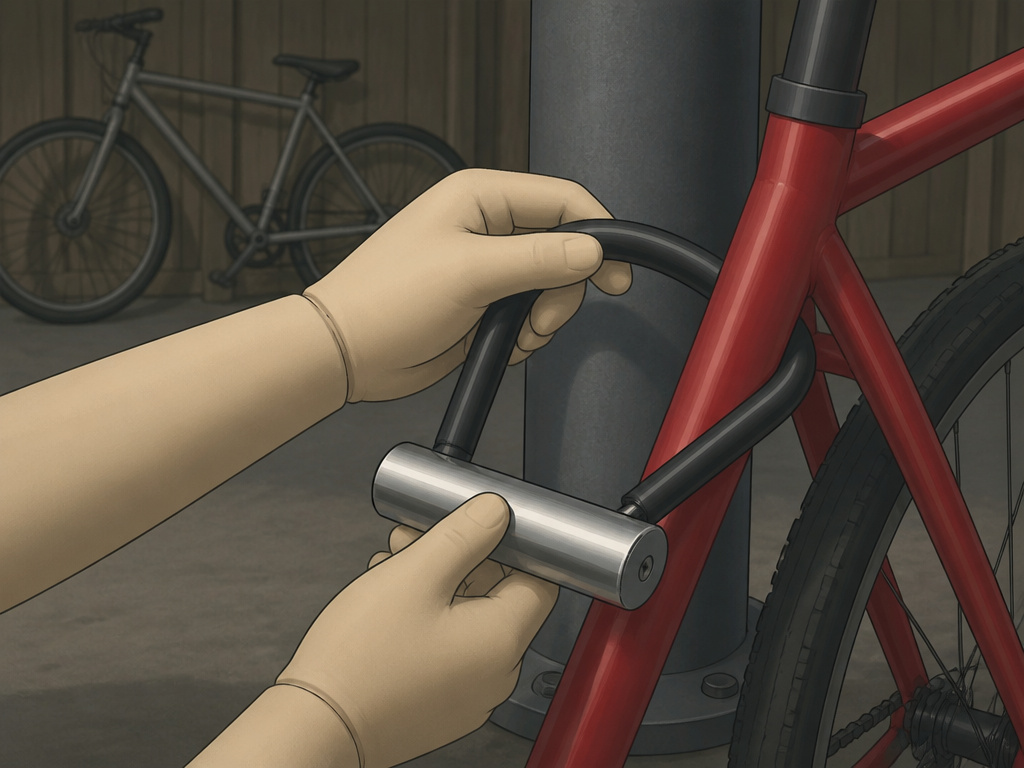
Your garage or apartment bike room feels safe. It is not. These are high-value targets because bikes are often left unlocked inside. The Milwaukee initiative explicitly warns to secure bikes even in “secure” locations.
At home, lock the bike to a grounded metal pipe or a dedicated anchor bolt in the wall. Never leave it leaning against a wall in an unlocked shed. At work, use your U-lock inside the company bike cage. Shared access means shared risk.
For overnight parking, the single worst thing you can do is leave a bike locked on a public street. Bike East Bay’s data shows about 20% of BART station thefts happen overnight. If you must store a bike outside, use a BikeLink locker or a private, locked courtyard.
When the Lock is Cut: The Recovery Protocol
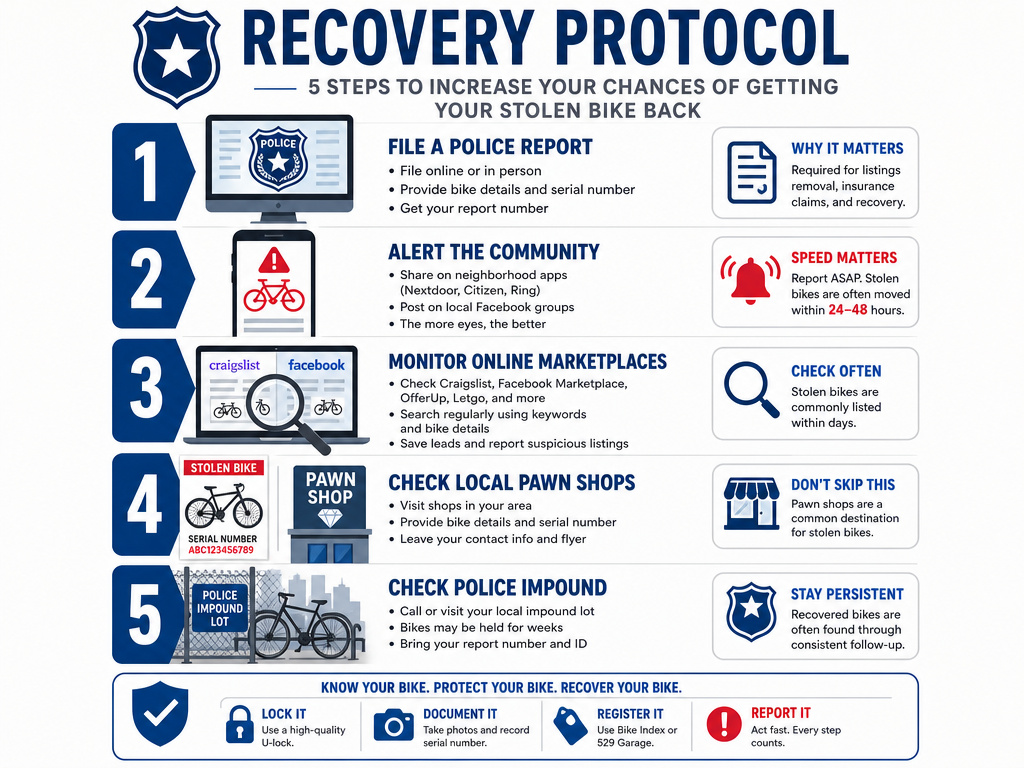
You walk out and the bike is gone. The lock is in pieces on the ground. This is when most people freeze.
Do not freeze. Follow this sequence:
- File a police report online, immediately. This generates a case number, which is required for insurance and for pawn shops to legally return your bike. Do not call 911; use the non-emergency line or online portal.
- Flag the bike as stolen on Bike Index or Project 529. This pushes an alert to their network and auto-posts to social media. The community looks for it.
- Search locally. Check Craigslist, Facebook Marketplace, and OfferUp. Thieves often list bikes quickly within the same city. Set up alerts.
- Visit pawn shops and bike shops with a flyer that includes the serial number and case number. Pawn shops are legally required to check serial numbers against police reports.
- Check police and transit agency impounds. Bikes recovered from a thief or left on a bus end up here.
The Portland.gov guide states nearly half of stolen bikes are recovered. Your job is to be the owner who can prove it.
The Bottom Line
Preventing bike theft isn’t about a single magic lock. It’s a system: a Sold Secure-rated U-lock on a solid rack, a free Bike Index registration done today, and the discipline to never trust a cable or a “secure” room. For daily commuters, a BikeLink card is a better investment than a second cable.
Assume every thief has bolt cutters. Make them need an angle grinder. That’s the line you’re defending.
Frequently Asked Questions
What is the single most important thing I can do to prevent bike theft?
Use a high-quality U-lock, not a cable. Bike East Bay data shows over 80% of bikes stolen from transit stations were secured with only a cable, which can be cut in seconds. A U-lock forces a thief to use a loud, slow grinder.
Is it worth registering my bike if I already have photos and a receipt?
Yes, absolutely. The serial number is the only unique, permanent identifier. Photos and receipts prove you owned a bike. The serial number proves you owned this specific bike. Police recoveries are matched against serial number databases.
Are combination locks or keyed locks better for a U-lock?
Keyed locks are stronger. The tumbler mechanism in a good key lock is more pick-resistant. Combination locks can be decoded or shimmed open more quietly and quickly. Opt for a key.
I have to lock my bike outside overnight. What should I do?
If you must, use a BikeLink locker or room (5¢/hour) if available in your city. If not, use two U-locks (frame + back wheel, frame + front wheel) on the most solid, well-lit rack you can find. Never leave it more than one night.
My bike was stolen months ago. Is it too late to register it?
Register it now as stolen. While the trail is colder, the serial number is still in the database forever. If it surfaces at a pawn shop or is recovered in a police raid, you can still get it back.
