
Why You Should Wear a Helmet When Riding a Bike: Key Facts
This post contains affiliate links. As an Amazon Associate, we earn from qualifying purchases.
Wearing a bicycle helmet reduces your odds of any head injury by 62 percent, and your odds of a serious head injury requiring hospitalization by 71 percent, according to a study of 1,256 hospitalized cyclists. A helmet also cuts your chance of needing cranial neurosurgery by 64 percent. The protection comes from the helmet’s crushable polystyrene liner absorbing linear impact energy and, in modern designs, a separate layer managing rotational forces that cause concussions.
The difference between a 62% odds reduction and 100% guaranteed safety is where the real conversation about helmets starts. Those numbers come from real-world hospital data where crashes still happen, they measure injury severity, not crash prevention. A helmet doesn’t make you invincible. It changes the medical outcome from a likely skull fracture or brain bleed to a concussion or a bad headache. That’s the practical, physical trade-off.
What follows is a breakdown of the peer-reviewed evidence, a look at how helmets actually work on a mechanical level, and the surprising realities that most buying guides skip: why a more expensive helmet isn’t necessarily safer, the one age group where the data shows no benefit, and the single impact that can render a helmet useless.
Key Takeaways
- A 62% reduction in head injury odds is the documented effect, but it’s not a force field, serious injuries still happen.
- MIPS technology (Multi-directional Impact Protection System) in helmets like the Giro Angon MIPS cuts rotational forces linked to concussions by nearly 20%, but doesn’t affect linear impact protection.
- Price has no correlation with protection in impact tests; a £10 helmet can outperform a £135 model.
- A single impact crushes the foam liner permanently; a helmet with internal damage offers drastically reduced protection on the next hit.
- The EN 1078 standard is the European certification baseline, but helmets meeting the stricter Snell Memorial Foundation standard provide measurably better protection.
The 62% Head Injury Reduction. What the Numbers Actually Mean
When a study reports that helmets reduce the odds of a head injury by 62 percent, it’s easy to picture a force field. The reality is messier. That figure comes from a 2024 study in Acta Neurochirurgica that tracked 1,256 cyclists admitted to a trauma center. Researchers compared injury severity between those who were and weren’t wearing a helmet at the time of their crash.
The critical finding was the difference between any head injury and a serious head injury. While the overall reduction was 62%, the reduction for serious head injuries, those severe enough to be coded 3 or higher on the Abbreviated Injury Scale (AIS), was 71%. This distinction matters because the AIS scale translates directly to clinical outcomes. An AIS 3 injury often means a complicated concussion with prolonged loss of consciousness or a skull fracture. An AIS 4 or 5 involves brain bleeds like subdural hematomas. The helmet’s effect was strongest against these high-severity outcomes.
A helmet that has sustained an impact should be returned to the manufacturer for inspection or be destroyed and replaced. The crushable polystyrene liner is damaged internally during an impact, and a compromised liner provides less protection during future impacts.
This isn’t theoretical. The study also tracked who needed neurosurgery. Only 6% of helmeted cyclists required a procedure, versus 14% of unhelmeted cyclists, a 64% odds reduction. Procedures ranged from inserting intracranial pressure monitors to evacuating acute subdural hematomas. The helmet doesn’t stop the crash. It changes the aftermath from an operating room to, in many cases, an observation ward.
TL;DR: The 62% figure is an odds reduction, not a guarantee. Its real value is in dramatically lowering the severity of the injury you do receive, shifting the outcome away from surgery.
How a Helmet Actually Works: The Physical Mechanism
A bicycle helmet is a sacrificial structure. Its job is to break so your skull doesn’t have to. The outer shell, usually polycarbonate, is there to spread a point impact over a larger area and to slide along pavement. The real work is done by the expanded polystyrene (EPS) foam liner underneath.
Upon impact, the EPS foam crushes in a controlled, plastic deformation. This process converts the kinetic energy of your moving head into the work of crushing the foam, which slows the deceleration over a few milliseconds. The key metric here is Peak Linear Acceleration (PLA), measured in g-forces. Standards like EN 1078 set a pass/fail threshold (e.g., not exceeding 250-300 g). The foam’s density and thickness are engineered to keep the PLA below this threshold for a given impact energy.
But your head doesn’t just accelerate in a straight line. In a real-world oblique impact, hitting the pavement at an angle, it also rotates violently. This rotational kinematics is now understood to be a primary driver of concussions and diffuse brain injuries. Rotational forces are measured as Peak Rotational Velocity (PRV) and Peak Rotational Acceleration (PRA). A related metric, the Brain Injury Criterion (BrIC), predicts the risk of diffuse axonal injury based on these rotational motions.
This is why modern helmet design has evolved. It’s no longer just about managing g-forces. The latest generation of helmets, including most high-end models from Giro, Specialized, and Lazer, integrate systems to manage these rotational forces, which traditional EPS foam alone cannot address effectively.
Helmet Technology: MIPS and What It Does
If you’ve shopped for a helmet recently, you’ve seen MIPS, the Multi-directional Impact Protection System. It’s a low-friction liner suspended inside the helmet. The concept is simple: during an oblique impact, the outer shell can slide relative to your head, reducing the rotational forces transferred to your brain.
The data backs it up. A 2024 biomechanical study in the Annals of Biomedical Engineering tested 30 popular helmets. Comparing identical models with and without MIPS, like the Giro Angon MIPS versus the standard Giro Angon, showed the technology reduced Peak Rotational Velocity by 19% and Peak Rotational Acceleration by 27.6%. The Brain Injury Criterion (BrIC), a key predictor of concussion risk, dropped by 18.5%.
Where this goes sideways: Assuming MIPS makes a helmet “safer” in all ways. The same study found MIPS had no statistically significant effect on Peak Linear Acceleration (PLA). It manages rotation, not linear force. You still need proper foam density and coverage.
This nuance is crucial when choosing a helmet. MIPS addresses a specific failure mode (rotational brain injury) that older standards ignored. Ten of the top eleven best-performing helmets in that study had MIPS. But it’s an addition, not a replacement for fundamental design. A cheap, poorly fitting helmet with MIPS is still a poor helmet.
Other technologies exist, like Koroyd’s welded-tube energy absorption or Bontrager’s WaveCel crumple structure. The principle is similar: add a mechanism to manage non-linear forces. But MIPS is currently the most studied and widely adopted system, featured in everything from basic mountain bike helmets to premium road bike helmets.
The Price vs. Protection Myth (and What Actually Matters)
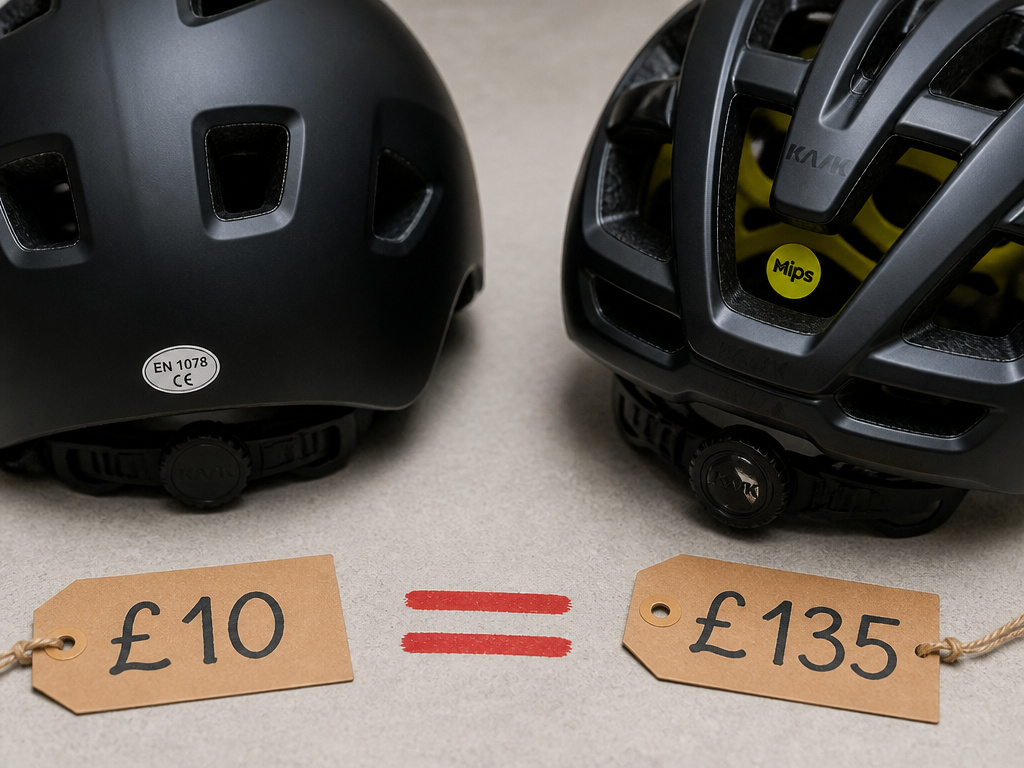 You can spend £10 or £135 on a helmet. Your brain won’t know the difference. That same Annals of Biomedical Engineering study found no significant correlation between helmet price and protection across 30 models. The exposure-adjusted risk of injury varied by a factor of 2.25 between the best and worst helmet, but price wasn’t a predictor.
| Factor | Effect on Protection | Evidence |
|---|---|---|
| Presence of MIPS | Reduces rotational risk significantly. No effect on linear protection. | Direct comparison of 3 helmet models with/without MIPS. |
| Helmet Mass | Heavier helmets associated with higher linear risk (PLA). | Ordinary Least Squares (OLS) model showed mass predicted higher PLA. |
| Retail Price (£9.99–£135) | No significant influence on overall, linear, or rotational injury risk. | Statistical analysis showed p-values of 0.755 (overall), 0.263 (linear), 0.799 (rotational). |
What does this mean for you? Don’t buy protection; buy fit, comfort, and features. A £10 Btwin 100 City helmet that passes EN 1078 meets the same baseline linear acceleration standard as a £135 Specialized S-Works Prevail. The more expensive helmet will be lighter, better ventilated, and likely include MIPS or similar tech for rotational protection. But the core job, keeping g-forces below a critical threshold in a straight-on impact, is covered by both.
The real investment is in a helmet you’ll wear consistently. An uncomfortable helmet left in the garage provides zero percent protection. This is where the nuances of helmet selection guide advice matter: prioritize a snug, level fit over a brand name.
The Critical Importance of Fit and a Single-Impact Lifespan
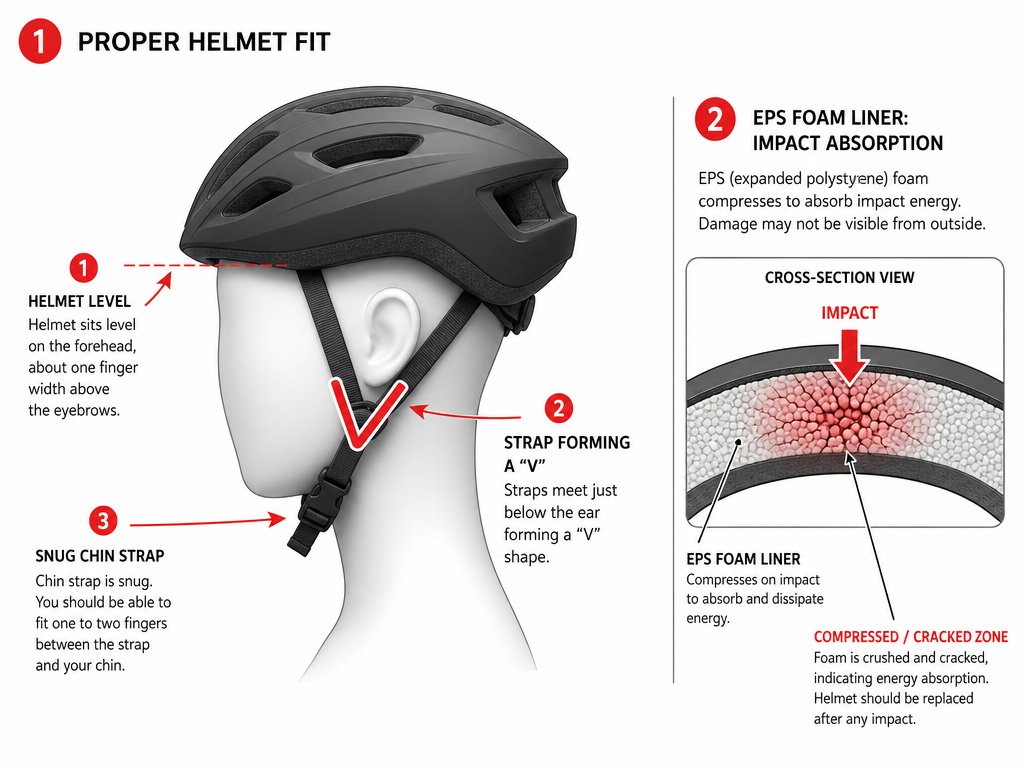 A helmet works only if it stays in place. The oldest documented failure mode in the CDC injury control recommendations from 1993 was helmet slippage. Early designs would roll off the head during an angled impact. Modern retention systems, the dial-fit wheel and chin strap, solve this, but only if you use them correctly.
The strap should form a “V” under your ears, and the buckle should be snug enough that you can only fit one finger between the strap and your chin. The helmet should sit level on your head, not tilted back to expose your forehead. When you shake your head side-to-side, the helmet should move with your skin, not slide over it.
Common mistake: Tightening the chin strap but leaving the helmet loose on the crown. The helmet cants back on impact, exposing the frontal lobe to direct contact. The resulting injury switches from a diffuse concussion to a focal contusion.
Then there’s the helmet’s lifespan. It’s not about years; it’s about impacts. The expanded polystyrene (EPS) liner crushes permanently. Even a drop from handlebar height onto concrete can create a compromised zone. You won’t see the damage from the outside. The CDC guidance is blunt: after any impact, the helmet should be inspected by the manufacturer or destroyed.
The foam also degrades with UV exposure and sweat. The general five-year replacement rule is based on material science estimates of this degradation, not on a magical expiry date. If your helmet’s foam feels crumbly or the interior padding is falling apart, it’s time for a new one, regardless of price or how it looks.
When Helmets Are Less Effective: Age, Shell Type, and Edge Cases
No safety device is perfect. The data reveals specific scenarios where a helmet’s protection drops, or where design choices introduce new risks.
The 2024 Acta Neurochirurgica study found a significantly reduced odds ratio for serious head injury in all age groups except for those aged 70 and older. The statistical significance disappeared here. Why? Older riders often have different crash dynamics (lower-speed falls), and age-related factors like osteoporotic bone may change injury patterns. It doesn’t mean helmets are useless for seniors, but the overwhelming benefit seen in younger cohorts wasn’t statistically detectable in this smaller sample.
Shell design also matters. The same CDC report noted that early soft-shell or no-shell helmets tended to catch on rough concrete, decelerating the head violently and increasing neck injury risk. Conversely, hard-shell helmets slid more easily. Modern “micro-shell” or in-mold construction helmets use a thin, hard shell bonded to the foam to achieve this slide without the weight of 1980s-style hard shells.
Finally, there’s the issue of over-reliance. A helmet is a last line of defense. It doesn’t replace safe riding practices, good bike lights for visibility, or avoiding risky traffic situations. The best helmet in the world is irrelevant if you’re struck by a car at high speed. Your primary strategy must be crash avoidance.
Frequently Asked Questions
Do bicycle helmets really prevent concussions?
Yes, but not all concussions and not equally. Helmets are highly effective at reducing linear forces that cause skull fractures and severe traumatic brain injuries. For concussions caused by rotational forces, modern helmets with technologies like MIPS provide measurable, though not complete, protection. A MIPS helmet was shown to reduce a key concussion risk metric (BrIC) by 18.5% compared to the same helmet without it.
How long is a bicycle helmet good for?
The industry standard is to replace a helmet every five years, due to UV degradation of materials and foam. However, the more critical rule is to replace it immediately after any impact, even if no damage is visible. The crushable EPS liner compresses once and loses its protective capability. Also replace it if the interior padding deteriorates or the straps become frayed.
What’s the difference between a $50 helmet and a $200 helmet?
Primarily weight, ventilation, aesthetics, and additional technology like MIPS. Both must meet the same minimum safety standards (like CPSC or EN 1078). The $200 helmet will be lighter, have more vents, and likely include rotational protection systems. However, impact tests show no correlation between price and the level of protection against linear or rotational forces, a cheap helmet can score as well as an expensive one.
Are there helmets that don’t work?
Yes. Any helmet that is old, damaged, doesn’t fit, or fails to meet current certification standards offers compromised protection. Specifically, helmets made before the mid-1990s often had inadequate retention systems and poor coverage. Also, the Hövding airbag helmet, while innovative, was temporarily suspended from sale by Swedish authorities due to incomplete testing and safety concerns, highlighting that novel designs require rigorous, third-party validation.
Do I need a different helmet for road cycling vs. Mountain biking?
Yes, because the risk profiles differ. A road bike helmet prioritizes aerodynamics, light weight, and ventilation for sustained effort. A mountain bike helmet often has extended rear coverage to protect against falls onto rocks or roots, a visor to block sun and debris, and a more robust retention system for rough terrain. Some mountain bike helmets are even full-face for downhill racing. Match the helmet to the discipline’s common impacts.
Before You Go
The numbers are clear: a helmet slashes your risk of a serious head injury by about two-thirds. That’s not a marketing claim. It’s trauma center data from thousands of real crashes. The mechanism isn’t magic, it’s a foam liner crushing itself to slow your head down, and in better models, a sliding layer to deflect twisting forces.
But the helmet is a tool, not a talisman. Its effectiveness hinges on a proper fit, on replacing it after a single hit, and on understanding that a £10 certified model provides the same baseline impact management as one costing ten times more. Look for a Snell certification if you want the highest standard, or a MIPS version if you’re concerned with concussion mitigation. For most riders, a well-fitting, comfortable helmet from a reputable brand that you’ll actually wear every time is the single best choice.
