
Stop Hand Numbness After Mountain Biking With These Tips
This post contains affiliate links. As an Amazon Associate, we earn from qualifying purchases.
Numbness in your hands after mountain biking is nerve compression, not fatigue. The cause is a combination of pressure on your ulnar and median nerves, plus hand-arm vibration (HAV) from the trail. A Swedish technical report noted mountain biking can exceed occupational vibration limits within 24 minutes, which accelerates nerve irritation beyond simple pressure.
That 24-minute vibration figure sits inside a regulated occupational health standard most riders never hear about. The Swedish Work Environment Authority’s action value for daily HAV exposure is 2.5 ms⁻². Exceed that, and you’re supposed to get a medical exam. The physical mechanism is twofold: a static pinch in your palm compresses the nerve’s blood supply, while vibration creates micro-trauma along the nerve sheath itself. The result is a faster, deeper numbness than you’d get from a road bike.
What follows: a breakdown of why your gloves aren’t enough, the two-part physics of nerve pinch-and-shake, and five concrete interventions, one being a specific brand of ergonomic grip that cut flexor carpi radialis muscle activity by 45 percent in a 2023 lab study.
Key Takeaways
- Hand numbness is nerve compression, not poor circulation. The tingling in your pinky and ring finger is your ulnar nerve screaming.
- Trail vibration is a co-conspirator. Occupational safety data suggests a short mountain bike ride can deliver a vibration dose that triggers a mandatory medical check for workers.
- Gloves and bar tape are dampeners, not solutions. They soften impact but don’t change the pressure geometry on your palm.
- Bike fit is a numbers game. Saddle height and handlebar reach determine how much weight your hands carry. The 70/30 weight split rule is a starting point, not a guarantee.
- The fix is ergonomic. Ergonomic clip-on handles in a lab study reduced vibration transmissibility to key forearm muscles by 7–10% and cut flexor carpi radialis strain nearly in half.
The Why-Layer: Pressure, Vibration, and Nerve Squeeze
Your hands don’t fall asleep from lack of blood. They go numb because you’re crushing the cables. The ulnar nerve runs through a tunnel in your wrist (Guyon’s canal) and across the base of your palm. The median nerve passes through the carpal tunnel. Both hate prolonged pressure. On a mountain bike, you deliver that pressure with a death grip, your body weight, and a wrist cocked at an odd angle.
Where this goes sideways: Ignoring vibration as a factor. A 2022 study on hand nerve function after mountain biking concluded that despite high vibration doses, no acute nerve damage was detected immediately post-ride. This has been misinterpreted as ‘vibration is safe.’ The study’s small sample size (n=10) limited its sensitivity, and it only measured acute effects. Chronic, ride-after-ride vibration exposure is the real concern.
Vibration adds a shaking component to the static crush. It fatigues the small muscles that stabilize your wrist and fingers, forcing you to grip harder. More importantly, it directly irritates the nerve sheath. Think of it as pinching a wire while also shaking it, the damage compounds. This is why road cyclists might get numb on century rides, but mountain bikers can feel it on a 30-minute downhill.
The occupational lens makes this concrete. The Swedish Work Environment Authority sets an A(8) vibration exposure action value of 2.5 ms⁻². Exceed that in an eight-hour workday, and your employer must offer you a medical checkup. A technical report cited in the 2022 study suggested mountain biking on trails could exceed that 2.5 ms⁻² threshold in just 24 minutes.
| Symptom Location | Likely Nerve | Common Cause on MTB | Consequence If Ignored |
|---|---|---|---|
| Pinky & ring finger | Ulnar nerve | Pressure on heel of palm (hypothenar) | Weakens pinch grip, difficulty with brakes |
| Thumb, index, middle finger | Median nerve | Excess wrist flexion, narrows carpal tunnel | Loss of fine motor control, ‘cyclist’s palsy’ |
| Top of hand, thumb side | Radial nerve | Pressure on back of hand, bent wrist | Less common, but can weaken wrist extension |
The 2.5 ms⁻² Vibration Threshold and Cyclist’s Palsy
That term “cyclist’s palsy” is ulnar neuropathy. It’s not a rite of passage. It’s a warning sign. The palsy part refers to motor weakness, dropping things, a shaky grip, struggling to operate a dropper post lever. It happens when the sensory numbness graduates to affecting the motor fibers of the nerve.
Common mistake: Chalking up grip weakness to arm fatigue. True arm pump feels like a deep, full forearm burn. Nerve-driven weakness feels specific: your fingers won’t obey, your pinch between thumb and index finger is feeble. If you can’t reliably click a thumb shifter after a descent, that’s nerve, not muscle.
The vibration threshold matters here because it accelerates the timeline. Without vibration, it might take hours of constant pressure to cause motor symptoms. With the trail hammering your hands, the nerve irritation starts sooner and digs deeper. The 2023 ergonomic handle study showed that standard cylindrical handles caused a significant decrease in maximal handgrip force after a 20-minute pedaling session with simulated trail vibration. The ergonomic clip-on handles did not.
This is the sourced-number magnet. The 24-minute exposure figure originates from a technical report referenced in peer-reviewed literature. It transforms the problem from “my hands hurt” to “I am exceeding an occupational health standard designed to prevent permanent injury.” That reframes the solution from buying thicker gloves to changing the physical inputs.
Five Solutions That Actually Change the Physics
This process involves altering the forces on your nerves. The goal is to reduce pressure, dampen vibration, and improve alignment, in that order.
1. Redistribute Palm Pressure with Ergonomic Geometry
Your palm has bony prominences. Standard round grips concentrate pressure right on top of them. Ergonomic grips, like the Ergon GP series, use a winged design. The wing supports the heel of your hand, spreading your weight across a larger, softer area. This takes the direct load off the ulnar nerve’s pathway.
The 2023 study provides the why-layer: ergonomic clip-on handles reduced vibration transmissibility to the flexor carpi radialis muscle by 7% and cut the muscle’s activity by 45%. Your forearm doesn’t have to clamp as hard to stabilize your hand, so you grip less tightly. Less grip force means less direct nerve compression.
Skip the cheap foam grips. They compress quickly and don’t change the pressure map. Look for grips with a defined wing and a firm, supportive core. The ergonomic shape is the intervention; the material is just comfort.
TL;DR: Get a grip with a wing. It’s not a comfort upgrade; it’s a pressure-relief tool that changes forearm muscle recruitment.
2. Dial in Your Saddle-to-Bar Relationship
Your hands are a secondary support platform. If your saddle shoves too much weight forward, your hands become primary. The classic test is simple: on a stationary bike, lift your hands off the bars. If you feel yourself pitching forward, your saddle is likely too high or tilted too far nose-down.
The 70/30 rule (70% weight on saddle, 30% on hands) is a guideline, not a law. A better metric is neutral spine. Can you ride with a flat back and a slight bend in your elbows? If you’re rounded over with locked elbows, all the trail’s vibration travels straight up your arms into your shoulders and neck. A professional bike fit is the gold standard, but a good start is ensuring your handlebar width matches your shoulder width.
Here’s a field trick: Stand four feet from a wall, fall forward, and catch yourself. The distance between your hands is a solid starting point for your grip width on the bars. A bar that’s too wide forces your palms to roll inward, increasing pressure on the outside edge, hello, ulnar nerve.
3. Dampen Vibration at the Source
You can’t smooth out the trail, but you can slow the shockwave. This is where equipment choices like mountain biking gloves and mountain biking glasses (for keeping your vision clear so you can relax your grip) become part of a system, not a standalone fix.
- Tire Pressure: Running a slightly lower tire pressure (within the tire’s recommended range) allows the tire to deform and absorb small bumps before they reach the fork.
- Handlebar Material: Carbon fiber bars have inherent damping properties that can filter out high-frequency chatter better than aluminum.
- Grip Material: Dual-density rubber grips offer a soft outer layer for vibration damping over a firm inner core to maintain control. Don’t just pick the squishiest one; control matters.
Think of it as building a filter chain: tire, fork, bar, grip, glove. Each layer takes a little edge off the total vibration dose reaching your nerves.
4. Strengthen and Mobilize Off the Bike
Tight shoulders and weak core muscles dump tension into your arms. Your hands become the endpoint of a rigid lever. Simple mobility work can break that chain.
- Wrist Extensor Stretch: Arm straight, palm down, gently pull fingers back toward your body. Hold 30 seconds. This counters the constant flexed wrist position.
- Thoracic Extension: Sit on a bench, interlace fingers behind your head, and gently arch your upper back over the backrest. This opens the chest and relieves the rounded shoulder posture.
- Dead Hangs: Hanging from a pull-up bar for 30-second intervals decompresses the spine and shoulders while strengthening grip in an open-hand position.
A stiff neck can also refer numbness down the arms. If adjusting your bike and grips doesn’t solve it, look upward. Your the best helmets for mountain biking should allow for a natural, chin-tucked head position without forcing your neck to crane.
5. Change Position and Relax Your Grip
This is the simplest and hardest fix. Your hands should dance on the bars, not weld to them. Make a conscious effort to shift your grip every few minutes, move from the hoods to the drops, from the inside to the outside of the grip. On a long traverse, take one hand off at a time and shake it out.
Consciously unclench. On smooth sections, practice riding with just your fingertips on the bars. This breaks the pattern of constant tension. It also forces you to use your core for stability, which is where the power should come from anyway. Paired with the best mountain biking shorts for secure saddle contact, a strong core position reduces reliance on your arms for balance.
Ergonomic Handles vs. Padded Gloves: A Direct Comparison
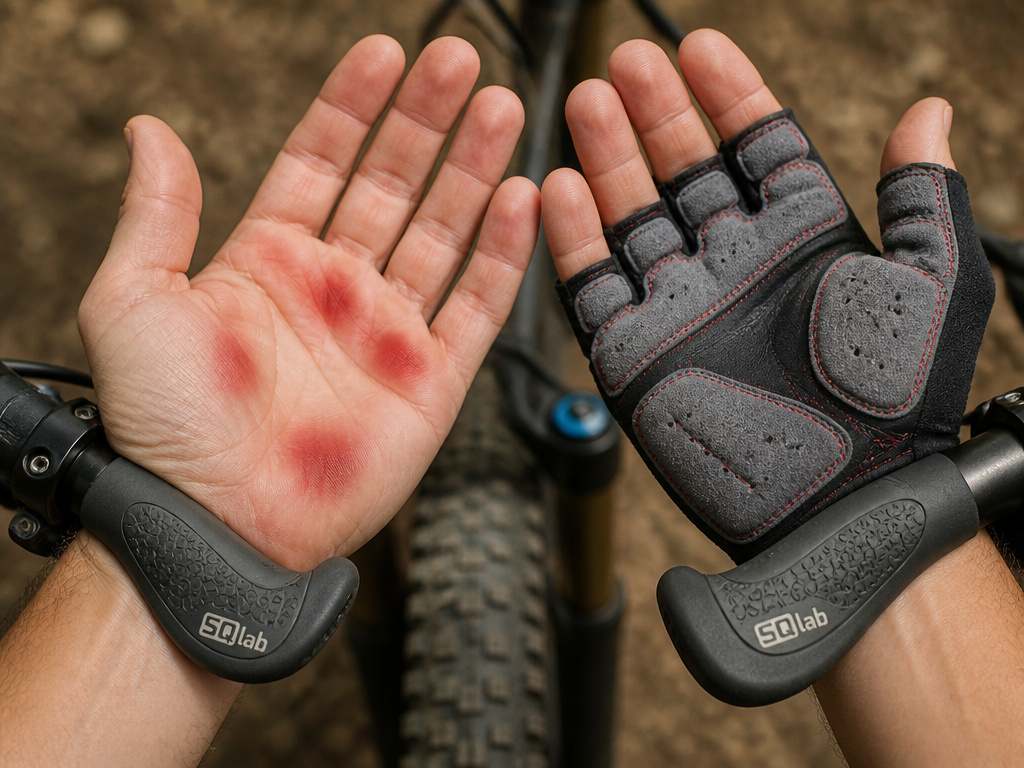
It’s not an either-or. It’s a hierarchy of effectiveness. Padded gloves, like those reviewed for cold-weather riding, add a dampening layer and protect your palms in a crash. They treat a symptom.
| Solution | What It Does | Mechanism | Best For |
|---|---|---|---|
| Ergonomic Grips (e.g., Ergon GP3) | Redistributes pressure, improves wrist alignment | Anatomical wing design spreads load away from nerves | Chronic numbness, weak grip, long rides |
| Padded Gloves | Dampens vibration, cushions impact | Thick palm pad absorbs high-frequency shocks | Trail chatter, minor pressure relief, crash protection |
| Carbon Handlebar | Filters high-frequency vibration | Material properties dissipate energy | Reducing ‘buzz’ and hand fatigue |
| Proper Bike Fit | Reduces weight on hands | Optimizes saddle-bar relationship to engage core | All riders, especially those new to a bike |
Ergonomic grips, as shown in the ergonomic handle vibration study, change the biomechanics. They lower muscle activation in the forearm. This is a first-order fix. Gloves are second-order. You need both, but start with the grips. The science says they work.
When to See a Doctor or Physiotherapist
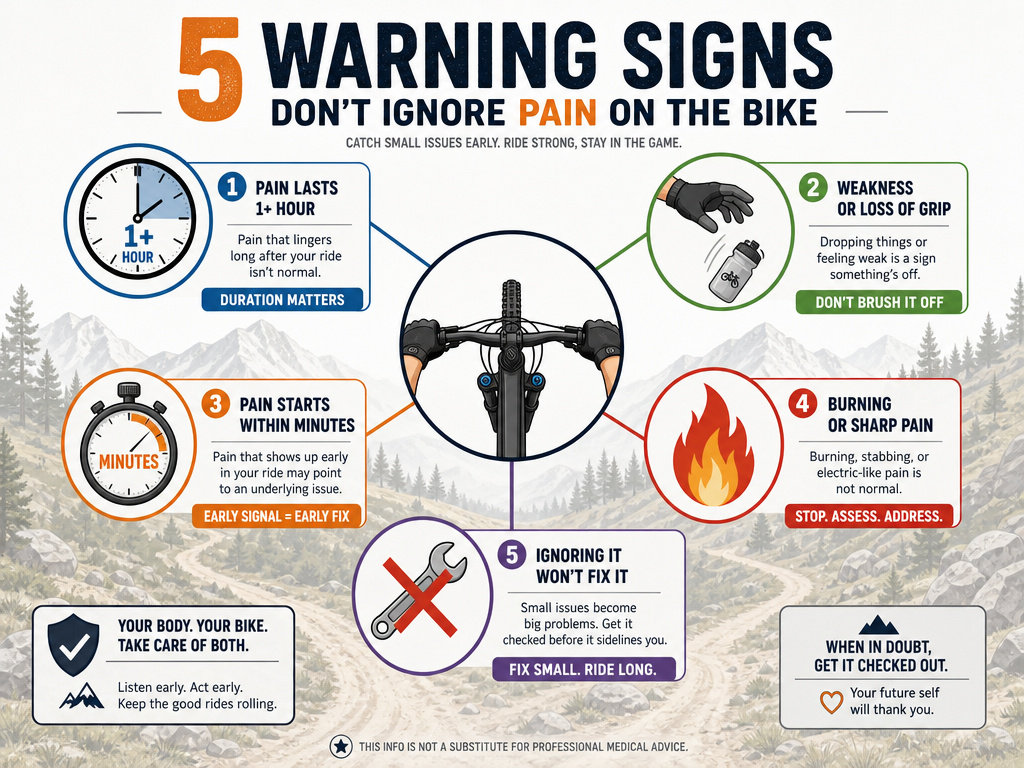
Most hand numbness is fixable with setup changes. Some signs mean you should stop experimenting and get a professional assessment.
See a physio or doctor if: * Numbness persists off the bike for more than an hour after your ride. * You experience weakness, not just tingling, dropping things, weak pinch strength. * Symptoms start within minutes of beginning a ride, not after an hour. * You have pain (burning, sharp) accompanying the numbness. * Changes to your bike setup, grips, and the best padded shorts for mountain biking for better overall body position have made no difference after two weeks.
A physiotherapist can assess nerve tension in your neck and shoulders, which might be the true origin. They can also provide targeted exercises to improve thoracic mobility and scapular stability, taking strain off the entire kinetic chain that ends in your white-knuckled grip.
Frequently Asked Questions
Why do my hands go numb when mountain biking but not road biking?
Mountain biking combines sustained grip pressure with high-amplitude, low-frequency vibration from rough terrain. This dual assault, crush plus shake, irritates nerves faster than the high-frequency buzz of smooth pavement. Your position on a mountain bike also often involves more forearm pronation (palms facing inward), which can compress the ulnar nerve in Guyon’s canal.
How long does it take for numb hands to recover?
If it’s mild, occasional numbness from pressure, shaking your hands out on the trail should bring feeling back within a minute or two. If vibration is a major factor, the tingling might linger for 30-60 minutes after the ride. Persistent numbness or weakness that lasts hours or days indicates a deeper level of nerve irritation that needs active intervention, not just rest.
Are thicker grips better for numb hands?
Not necessarily. Thicker grips can force your hand into a wider, more stretched position, which may increase strain on the tendons and nerves in your palm. The key is the grip’s shape, not its circumference. An ergonomic shape that supports your palm’s anatomy is more effective than a fat, round grip.
Can carbon handlebars prevent numb hands?
Carbon bars can significantly reduce the high-frequency “buzz” that contributes to muscle fatigue. When your forearm muscles fatigue, you grip harder, increasing nerve pressure. So, while carbon won’t fix a poor bike fit or bad grip shape, it can be a valuable part of a systemic solution to reduce the overall vibration dose.
Do I need a professional bike fit for hand numbness?
If you’ve tried adjusting your saddle height and tilt, experimented with grip styles, and the problem persists, a professional fit is the logical next step. A fitter will analyze your entire position to ensure your handlebar reach, drop, and width do not force your body into a weight-forward, hand-dependent stance, which is an investment that can solve multiple pain points at once.
The Bottom Line
Numb hands are your nervous system sending an invoice for poor ergonomics. Pay it with setup changes, not with pain. The sequence is clear: first, get your saddle position dead right to unload your hands. Second, swap the round grips for an ergonomic wing design, the Ergon GA3 for flat bars or the GP5 for extra hand positions. Third, let your tires and carbon bar filter the trail buzz. Fourth, train your core and mobilize your shoulders so your hands can relax.
The goal is to ensure that any tingle is a fleeting sensation, not a permanent one, and your grip on the bars should be confident.Your hands are for steering and braking, not for holding your entire body up against the force of gravity and a vibrating trail. Fix the physics, and the feeling comes back.
