
How to Check Motorcycle Tire Pressure: Cold PSI & TPMS Guide
This post contains affiliate links. As an Amazon Associate, we earn from qualifying purchases.
You check motorcycle tire pressure with an accurate, manual pressure gauge when the tires are cold, ideally before the first ride of the day or after the bike has sat for at least three hours. The recommended PSI or kPa is in your owner’s manual or on a frame label, not the tire sidewall’s maximum. Ignore the TPMS dashboard reading for adjustment, it shows warm pressure.
That cold spec is non-negotiable because tire pressure rises predictably as the rubber heats from friction and flex. A 30 PSI cold tire can read 34 PSI or higher on a TPMS screen after a ride. The Triumph Speed Twin 1200 manual states it explicitly: do not use the tire pressure display on the instruments to set pressure. Use a manual gauge on cold tires only.
What follows is the step-by-step sequence to avoid the TPMS trap, how to read the manufacturer’s pressure chart, what to do when you load the bike, and why the gauge you pick decides everything.
Key Takeaways
- Use a dial or digital pressure gauge, not a dashboard TPMS display, to set cold tire pressure. The TPMS sensor reads warm, expanded air.
- Check pressure only after the bike has sat for three hours post-ride. The Indian Motorcycle TSB states tires remain warm for at least that long, and adjusting warm pressure guarantees under-inflation.
- Your correct PSI is in the owner’s manual or frame sticker, not the max PSI on the tire sidewall. The manual lists separate pressures for solo rider and rider-plus-passenger.
- Tires lose about 1-2 PSI per month normally. Check weekly to stay ahead of slow leaks.
- Replace the valve stem cap every time you check. Michelin calls it a core part of the seal, and a missing cap lets grit jam the valve core.
The Right Gauge & Cold Check Sequence
A dashboard tire pressure monitoring system is a warning light, not a setting tool. The air inside a tire expands as it heats from road friction and flexing. Your TPMS reads that expanded, warm pressure in real time. The Triumph manual for the Speed Twin 1200 puts it bluntly: “Only adjust tyre pressures when the tyres are cold using an accurate pressure gauge. Do not use the tyre pressure display on the instruments.”
Your first tool is a standalone, dial-type or digital tire pressure gauge. The pencil-style stick gauges are notoriously inconsistent. A quality dial gauge with a 1-2 PSI resolution and a flexible hose is the default for a reason.
The second tool is patience. A “cold” tire means ambient temperature. The federal bulletin from Indian Motorcycle notes tires stay warm for at least three hours after riding. If you check sooner, you are measuring warm pressure. Adjusting to the manual’s cold spec at that moment guarantees under-inflation as the tire cools.
Here is the sequence, timed. 1. Park the motorcycle on level ground. The bike must be upright, not on the side stand. 2. Unscrew the valve stem cap. Set it somewhere you will not lose it. 3. Press the gauge fitting squarely onto the valve stem. You will hear a short hiss. Hold it firm for two seconds. 4. Read the gauge. A dial needle will settle; a digital readout will flash and hold. 5. Compare that reading to the cold spec from your manual. 6. If you need to add air, use a portable air compressor with a precise regulator. Add in short bursts, checking with your gauge between bursts. 7. If you over-inflate, depress the valve core pin briefly with your gauge or a tool to bleed air. Re-check. 8. Screw the valve cap back on tightly. This seals against dirt and moisture.
Common mistake: Topping up tires right after a ride using the TPMS reading as a guide. The tires are warm, so you set them to, say, 36 PSI. Three hours later, they cool and settle at 33 PSI. You are now 3 PSI under the cold spec, which the Motorcycle Safety Foundation links to irregular wear and overheating risk.
Skip the gas station air hose unless it has a reliable, built-in gauge you trust. Those are often calibrated for car tires and can be off by 5 PSI.
Interpreting Your Motorcycle’s Tire Specs
Motorcycle manufacturers publish tire pressure specs for a reason. The number balances load capacity, handling feel, tread contact patch, and wear. It is not a suggestion.
You find the spec in two places. First, your motorcycle’s owner’s manual under “Tire Pressures” or “Specifications.” Second, a metal or vinyl label on the frame, swingarm, or chain guard. This label lists the bike’s exact pressures for front and rear tires.
The tire’s own sidewall shows a maximum pressure, the most air the tire structure can safely hold when cold. That is a safety limit, not a recommendation. Running at the max PSI creates a narrow, overinflated contact patch. The bike feels nervous and skittish, and the center of the tread wears out fast.
Manufacturers usually give two numbers: one for solo riding, one for riding with a passenger and/or cargo. The added weight needs higher pressure in the rear tire to maintain the designed shape and prevent excessive sidewall flex. The Motorcycle Safety Foundation’s example chart in their official motorcycle tire maintenance PDF shows this: solo rider uses 36 PSI front and rear; rider and passenger uses 36 PSI front, 40 PSI rear.
| Load Scenario | Front Tire Pressure (PSI/kPa) | Rear Tire Pressure (PSI/kPa) |
|---|---|---|
| Solo Rider | 36 / 248 | 36 / 248 |
| Rider + Passenger | 36 / 248 | 40 / 276 |
If your manual only lists one number, it is likely the solo-rider spec. When you add weight, increase the rear pressure by 4-6 PSI. Check the bike’s load limit in the manual, exceeding it stresses the tire carcass regardless of pressure.
When Your Bike Has a Tire Pressure Monitoring System (TPMS)
A TPMS is a wireless sensor inside the wheel that transmits pressure data to your dash. It is excellent for catching a sudden puncture on the road. It is terrible for setting pressure.
The sensor reads the actual air pressure inside the warm tire. The Indian Motorcycle technical bulletin confirms this: “Riding warms the tires and increases tire air pressure.” Your TPMS display might show 38 PSI after a freeway run, while the cold target is 36 PSI.
The rule is simple: use the TPMS as a monitor, not a gauge. If the warning light comes on, pull over when safe and check with your manual gauge. Do not add air until you verify with your gauge that the tire is cold and under target.
Where this goes sideways: Assuming a steady TPMS reading means your pressure is fine. A tire can lose 1 PSI a month and still read within the system’s normal range on a warm day. You miss the slow leak until the tread wears unevenly or the handling goes soft.
Some advanced motorcycle TPMS units let you set cold-pressure alerts. That is helpful, but the principle holds. The sensor tells you the current state; the manual gauge and cold spec tell you the correct state.
Weekly Inspection & Tread Depth Check
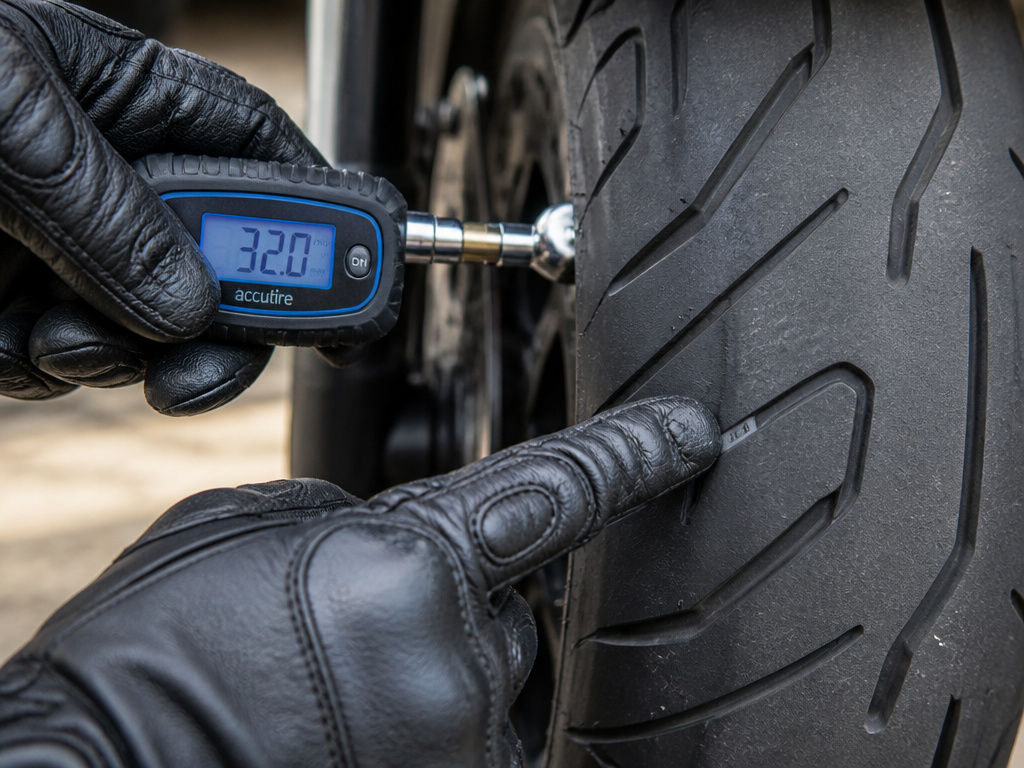 Pressure is half the equation. The other half is tread condition.
The Motorcycle Safety Foundation recommends checking cold inflation pressures at least once a week and before long trips. That frequency catches slow leaks before they become roadside problems.
While you are at the tire with your gauge, do a visual inspection. Look for cuts, cracks, embedded nails, or uneven wear patterns. Run your hand around the tread to feel for bulges or deformities.
Tread depth matters more on a motorcycle than a car. Motorcycles lean, and the tread edges provide cornering grip. Tires have small wear bars molded into the tread grooves. When the tread wears down to the level of these bars, they become visible as smooth strips across the groove. That indicates 1/32 of an inch of tread remaining.
Some tire makers, like Michelin, recommend replacement at 2/32 or 3/32 inches, before the wear bars are fully exposed. The Triumph Trident manual sets a hard minimum: 0.08 inches (2 mm) for speeds under 80 mph for both tires. For higher speeds, the spec tightens.
| Speed | Minimum Tread Depth (Front) | Minimum Tread Depth (Rear) |
|---|---|---|
| Under 80 mph (130 km/h) | 0.08 in (2 mm) | 0.08 in (2 mm) |
| Over 80 mph (130 km/h) | 0.08 in (2 mm) | 0.12 in (3 mm) |
A penny test works in a pinch. Insert a penny into the tread with Lincoln’s head upside down. If you can see the top of his head, you are at or below 2/32 inch. Time for new motorcycle tires.
What About Off-Road or Mixed Use?
Off-road tire pressure is a different game. Lower pressure increases the tire’s contact patch for better traction on soft dirt, sand, or mud. A tubeless adventure tire might run as low as 15 PSI off-road.
The critical rule here is reinflation before hitting pavement. Running street sections at off-road pressure creates dangerous understeer, excessive flex, and heat buildup. Carry a compact inflator and know your bike’s standard cold road PSI.
If you get a puncture off-road, a quality tire repair kit with sticky-string plugs can be a trailside save. The MSF notes repairs should be considered temporary, with speeds kept below 50 mph for the first 24 hours. Never repair a sidewall puncture.
The Tools You Actually Need
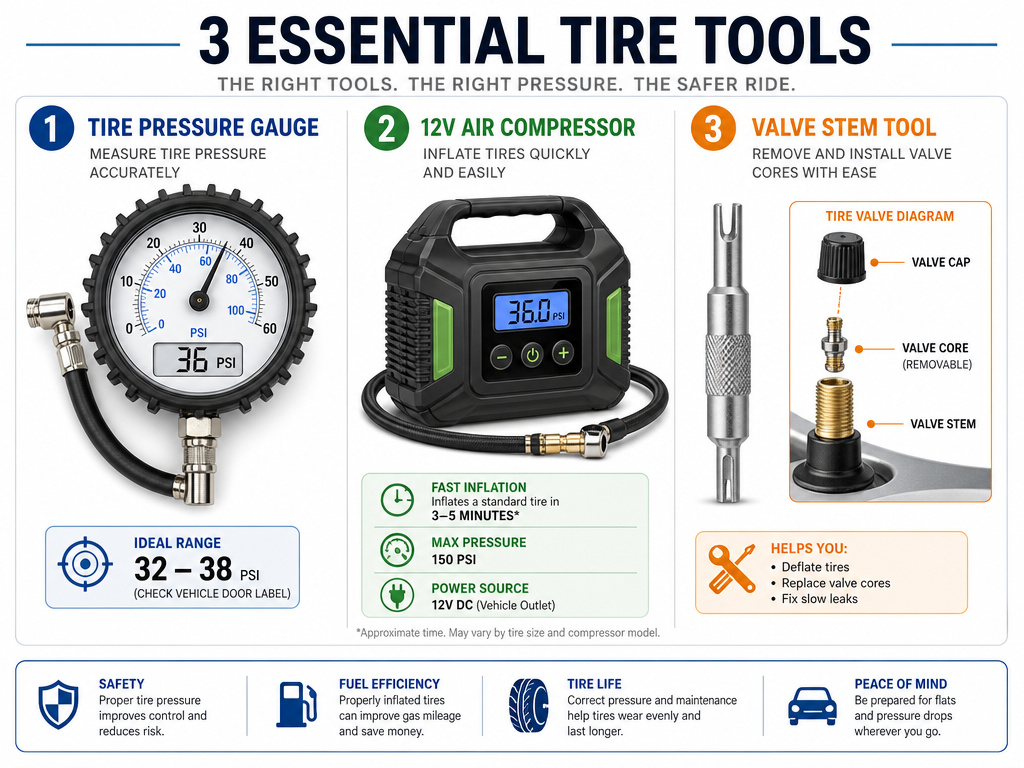 You do not need a garage full of equipment. Three tools handle 99% of pressure checks.
- A dial tire pressure gauge with a 1-2 PSI resolution. This is your truth-teller.
- A portable 12V air compressor with a built-in accurate gauge. The compressor’s gauge is for rough filling; your handheld gauge is for final verification.
- A valve stem tool is optional but cheap insurance. It lets you tighten a leaky valve core.
For anything beyond air pressure, like mounting a new tire, you enter professional tool territory. A tire changing machine or a set of tire irons requires skill to avoid pinching the tube or damaging the rim. Most riders are better off letting a shop handle mounting and tire balancing.
Frequently Asked Questions
How often should I check motorcycle tire pressure?
Check at least once a week when the tires are cold. Tires naturally lose 1-2 PSI per month. Before any long trip, check again. Daily riders might check every few days. The Motorcycle Safety Foundation tire guide recommends weekly as a minimum.
Can I use the pressure listed on the tire sidewall?
No. The sidewall shows the maximum safe inflation pressure for the tire when cold. It is a safety limit, not the recommended operating pressure. Your correct PSI is in the motorcycle’s owner’s manual or on the frame sticker. Using the max PSI leads to a harsh ride and accelerated center tread wear.
Why is cold tire pressure so important?
Cold pressure is the baseline measurement before heat from riding expands the air inside the tire. All manufacturer handling, wear, and safety specifications are based on this cold number. If you set pressure when the tire is warm, you will be under-inflated once it cools, which can cause overheating and failure.
My TPMS says 36 PSI, but my manual gauge says 33 PSI. Which is right?
Your manual gauge is right if the tire is cold. The TPMS reads the warm, expanded air pressure inside the tire after riding. Always trust your standalone gauge and the cold spec from the manual. Adjust pressure to match the manual gauge reading.
What happens if my tire pressure is too low?
Under-inflation causes excessive sidewall flex. The tire overheats, which can lead to a blowout. It also causes uneven tread wear, poor fuel economy, and sluggish, heavy handling. The NHTSA motorcycle technical service bulletin explicitly links under-inflation to tire failure.
What happens if my tire pressure is too high?
Over-inflation reduces the tire’s contact patch with the road. The bike feels twitchy and loses grip, especially when cornering. The center of the tread wears out much faster. You also feel every bump in the road.
Before You Go
Get a good gauge. Learn your bike’s cold PSI specs for solo and two-up riding. Check pressure weekly, always when the tires are cold. Ignore the dashboard TPMS for setting pressure, it is a monitor, not a measurement tool.
That is the whole process. It takes five minutes and prevents 90% of tire-related problems. Your tires are the only thing between you and the road. Give them the right amount of air.
