
How Often Should You Change Motorcycle Oil: The Full Guide
This post contains affiliate links. As an Amazon Associate, we earn from qualifying purchases.
Change motorcycle oil based on two rules: follow the stricter of your owner’s manual’s mileage or time intervals, then cut those numbers in half if your riding meets any severe-use definition. A Ducati Panigale demands a change every 12 months regardless of miles; a Yamaha XSR700 calls for 4,000 miles or 6 months, whichever comes first. Ignoring the time rule kills engines just as dead as ignoring mileage.
That “whichever comes first” clause is where people’s engines die. An owner who rides 2,000 gentle miles a year might see the calendar hit 12 months long before the odometer ticks over. In that year, moisture from temperature swings condenses inside the crankcase, the oil’s additive package depletes, and acidity builds. The engine looks clean on paper but is corroding from the inside.
What follows: the exact mileage and time numbers pulled from current OEM service manuals, the severe-use criteria they actually list (not the generic ones), and the two oil specs that matter more than brand. You will also see why the “synthetic lasts longer” promise is a trap if you only read half the bottle.
Key Takeaways
- Your manual has two numbers: a mileage (e.g., 4,000 mi) and a time (e.g., 6 months). The time limit applies even if you never ride.
- Severe use isn’t just racing. It’s short trips, dusty roads, frequent cold starts, or high humidity. These conditions demand oil changes at half the normal interval.
- Synthetic oil allows longer mileage intervals in some modern engines but does not override the manual’s time-based limit.
- The JASO MA2 and API SN certifications on the bottle are non-negotiable for most modern motorcycles; using the wrong spec can glaze a wet clutch or clog a catalytic converter.
- Changing the oil filter every single time is cheaper than the engine repair skipping it causes.
The Two Clocks: Mileage vs. Time
Your motorcycle’s oil change schedule runs on two independent clocks. The odometer counts revolutions. The calendar counts chemical decay.
The Mileage Service OIL must be performed every 12,000 km/7,500 mi for Multistrada 1100/1200 Model Year 2010-2014 model versions and every 15,000 km/9,000 mi for Multistrada 950/Multistrada 1200 DVT/Multistrada 1260 DVT model versions. – Ducati Scheduled Maintenance for Multistrada.
That’s the mileage rule. Now the time rule, from the same Ducati document: “The Time Service must be performed every 12 months.” For a Multistrada 1260, you change oil at 15,000 km (9,320 mi) or at 12 months, whichever hits first. A garage queen hits the year mark with 800 miles on it. The oil still gets changed.
Why? Condensation. A cold engine started and shut down before full warm-up collects water in the oil. That water never evaporates. Over months, it promotes sludge and acid formation. The oil’s anti-wear additives also oxidize and lose potency sitting in the sump. Time degrades oil even without use.
Check your manual. The numbers vary wildly. A Yamaha XSR700 manual says every 4,000 miles or 6 months. A Bajaj Pulsar NS400 mandates every 10,000 km. A Ducati Panigale V4 requires oil service every 12 months, full stop. Find your bike’s specific line in the schedule.
Decoding Your Manual’s Interval Table
Owner’s manuals bury the schedule in a multi-column chart. It looks like accounting. Here is how to read it.
| Model (Source) | Mileage Interval | Time Interval | Severe Use Advice |
|---|---|---|---|
| Yamaha XSR700 (OEM Manual) | 4,000 mi (6,400 km) | 6 months | Replace air filter more frequently in rain or dust. |
| Bajaj Pulsar NS400 (OEM Manual) | 10,000 km (6,214 mi) | – | Use BS VI compliant oil for catalytic converter life. |
| Ducati Multistrada 1260 DVT (OEM Schedule) | 15,000 km (9,320 mi) | 12 months | Reduce intervals for dusty, muddy, or high-speed use. |
| Kawasaki Ninja ZX-10R (Technical Advisory) | See manual chart | 12 months | More frequent service in severe conditions (dusty, wet, muddy). |
The “Severe Use” column is critical. It is not a suggestion. It is the manufacturer telling you the published interval assumes ideal conditions. Your reality is likely not ideal.
Where this goes sideways: Assuming your 3-mile commute counts as normal use. A cold engine that never reaches full operating temperature for 10 minutes accumulates fuel dilution and water. That is severe use. Your manual’s normal interval does not apply.
What Qualifies as Severe Use?
Manufacturers are specific. “Severe conditions” in a Kawasaki Ninja ZX-10R advisory includes dusty, wet, or muddy roads, high-speed operation, and frequent starting and stopping. That describes most recreational riding.
The technical definition breaks into three categories:
- Short-Trip Riding: Any ride where the oil temperature does not stabilize at its full operating range for at least 15-20 minutes. This prevents moisture evaporation and leads to sludge.
- Dirty Environments: Riding on gravel, construction zones, or behind other vehicles kicks abrasive particulates into the airbox. The oil filters some, but fine silica dust accelerates wear.
- High-Performance Operation: Track days, sustained high RPMs, aggressive acceleration. This shears the oil’s viscosity modifiers and burns off volatile additives faster.
If any of those match your typical month, you are on the severe schedule. That means halving the mileage interval from your manual’s “normal” column. A Yamaha XSR700’s 4,000-mile interval becomes 2,000 miles. The time interval, however, does not change. You still change at 6 months even if you only rode 1,000 miles.
Common mistake: Using synthetic oil to stretch the severe-use interval. Synthetic handles heat and stress better, but it cannot counteract fuel dilution or water contamination from short trips. The contamination clock still runs.
The fix is simple. Admit your riding is severe. Change the oil at the shorter interval. The cost of two extra oil changes a year is less than the cost of a single top-end rebuild.
The Oil Specs That Actually Matter
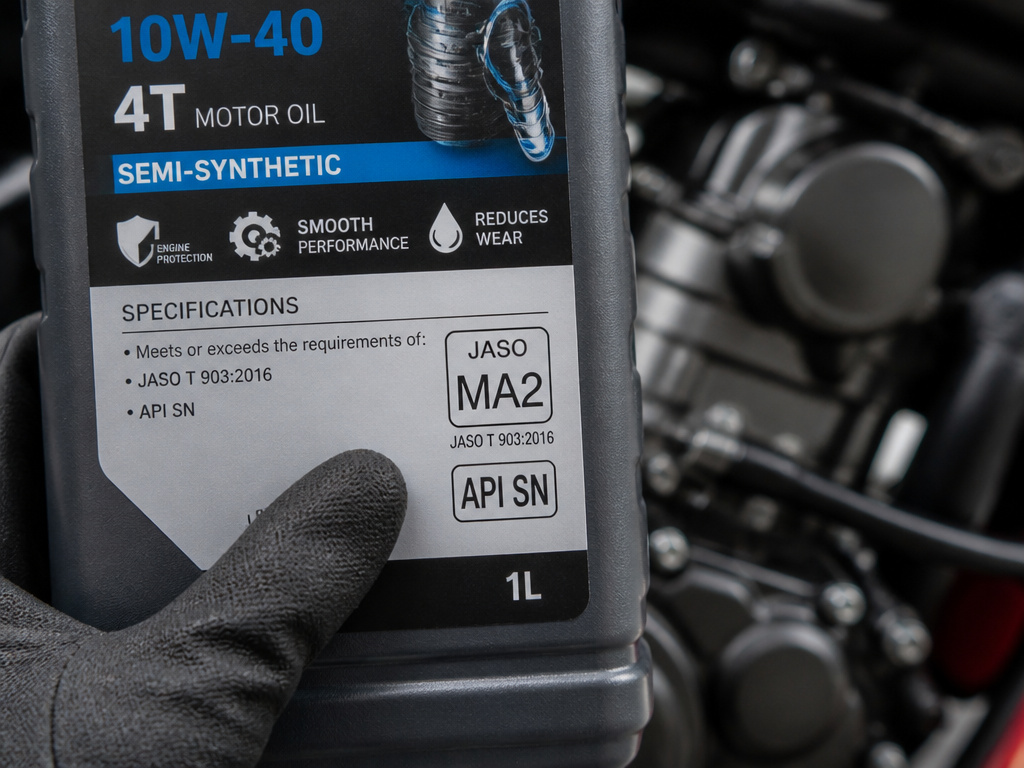 You see shelves of bottles. The brand matters less than two codes stamped on the back: JASO MA2 and API SN.
JASO MA2 is a Japanese standard for motorcycle-specific oil. It certifies the oil is safe for wet clutches. Car oil often contains friction modifiers that cause a motorcycle’s clutch to slip. A JASO MA2 oil guarantees it won’t.
API SN is an American Petroleum Institute rating for gasoline engine oil. It deals with deposit control, oxidation stability, and catalyst compatibility. A Bajaj Pulsar NS400 manual explicitly states: “Use BS VI compliant engine oil for BS VI vehicles to prolong catalytic converter life.” API SN (or newer SP) oils are designed for this.
| Oil Specification | Primary Purpose | Risk If Ignored |
|---|---|---|
| JASO MA2 | Wet clutch compatibility. | Clutch slippage, burned plates, loss of power transfer. |
| API SN/SP | Emission system protection, deposit control. | Clogged catalytic converter, lost performance, expensive replacement. |
| SAE 10W-40 | Viscosity grade (thickness at hot/cold temps). | Poor cold starting, inadequate hot lubrication, increased wear. |
Your manual lists a viscosity (like 10W-40) and these certifications. Stray outside them at your engine’s peril. A great synthetic motorcycle oil that lacks JASO MA2 can ruin your clutch in 500 miles. An oil that doesn’t meet the API spec can foul oxygen sensors.
The one-step check: Before pouring, confirm the bottle’s “Specifications” fine print includes both JASO MA2 and the API rating your manual lists. If it doesn’t, put it back.
Synthetic vs. Conventional: The Interval Myth
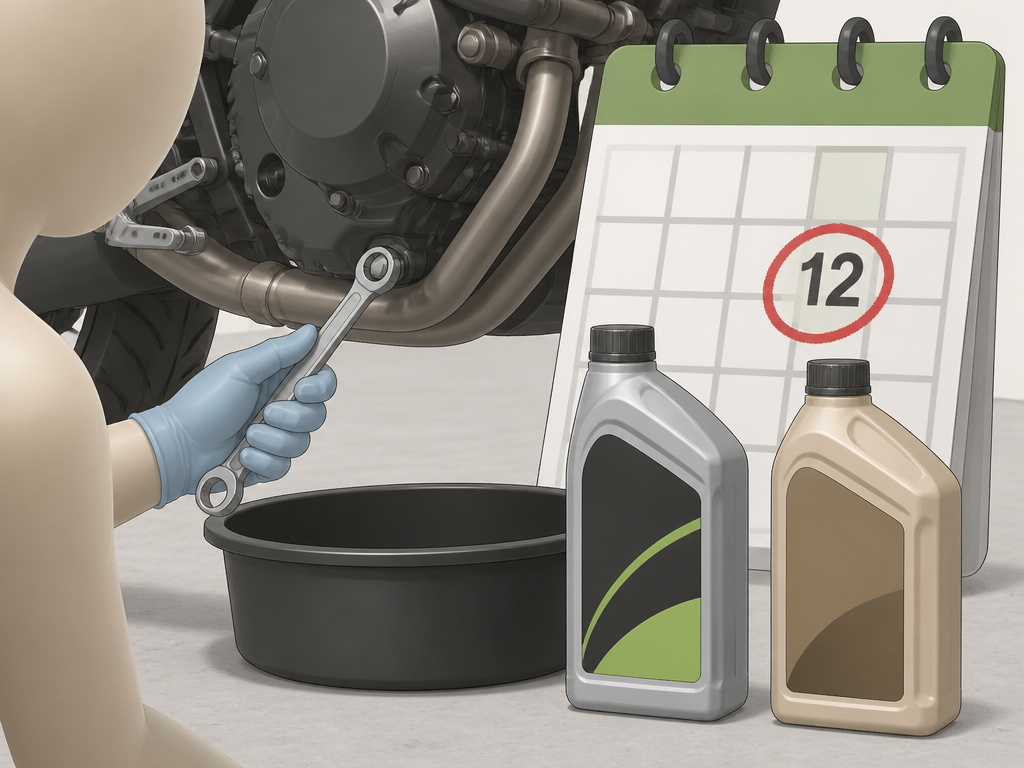 Synthetic oil is more stable at high temperatures and flows better when cold. It does allow some manufacturers to recommend longer mileage intervals. However, it does not magically suspend the time-based interval or severe-use penalties.
The myth goes: “I run full synthetic, so I can go two years or 10,000 miles.” That is a good way to need new crankshaft bearings. The oil’s base stock may last, but the additive package that neutralizes acids and suspends contaminants still depletes. Condensation still happens.
Where this goes sideways: A rider using a premium synthetic oil in a bike with a 12-month time service. They ride 2,000 miles in 18 months and think the oil is fine. That oil has been neutralizing combustion acids for a year and a half. Its Total Base Number (TBN) is shot. It now accelerates corrosion.
Follow the manual, not the marketing. If your manual says “synthetic recommended” and lists a 15,000 km interval, trust that. If it says “change every 6 months,” the calendar overrules the oil’s pedigree.
Step-by-Step: Executing the Oil Change Correctly
Changing oil is straightforward. Missing these four steps is not.
- Warm the engine for five minutes. Cold oil holds suspended particles in suspension. Warm oil drains faster and carries more contaminants out with it. The Yamaha XSR700 manual explicitly states: “Change (warm engine before draining).”
- Replace the oil filter every single time. A new motorcycle oil filter is cheap. A used filter holds about a quart of dirty oil, diluting your fresh fill instantly. It also has a bypass valve that opens when clogged, sending unfiltered oil through your engine.
- Torque the drain plug. The Indian Scout manual specifies 15 ft-lbs (20 Nm). Over-tightening strips the aluminum case threads. Under-tightening leads to a leak and sudden oil loss. Use a torque wrench.
- Refill to the middle of the sight glass or dipstick range. Overfilling can cause aeration and loss of lubrication. Underfilling starves the oil pump. Start with less than the stated capacity, check, then add slowly.
The part nobody mentions: After the change, start the engine and let it idle for a minute. Then shut it off and wait two minutes. Recheck the oil level. The new filter soaks up oil, dropping the level in the sump. Top up to the correct level only after this second check.
The Cost of Getting It Wrong
Pushing an interval has a price tag. It’s not abstract.
- Short-Trip Sludge: A bike used for 2-mile commutes over two years without a time-based change develops mayonnaise-like sludge in the valve cover. That restricts oil flow to the top end. Cam and follower wear accelerates. Repair: top-end disassembly and cleaning, new camshafts if scored.
- Acid Erosion: Used oil becomes acidic. That acid etches microscopic pits into soft bearing materials like lead-copper alloys. Over time, the bearing clearance opens up. You hear a deep knocking at startup. Repair: crankshaft removal and rebuild, new bearings.
- Clogged Pickup: Sludge settles in the oil pan and can clog the oil pump pickup screen. Oil pressure drops. The warning light might not come on until damage is done. Repair: oil pan removal, full inspection, possible new oil pump.
These repairs start in the thousands. An oil change costs fifty. The math is simple, yet people ignore the calendar and gamble.
Frequently Asked Questions
Does synthetic oil really let me go longer between changes?
It can extend the mileage interval if your manufacturer’s schedule already accounts for it. It does not override the time interval. Oil still absorbs moisture and depletes additives over months, synthetic or not. Always follow the stricter limit in your manual.
What if my motorcycle doesn’t have an owner’s manual?
Download a PDF from the manufacturer’s website. Sites like ManualsLib also archive them. Do not guess. A Ducati Panigale V4 and a Honda CRF250L have completely different requirements. Guessing is how engines seize.
I only ride a few hundred miles a year. Do I still need to change it annually?
Yes, absolutely. This is the most common oil-change failure. Time degrades oil through condensation and additive oxidation. Your engine needs fresh oil annually to prevent internal corrosion, even if the mileage is near zero.
Can I use car oil in my motorcycle in a pinch?
Only if it explicitly states JASO MA or MA2 compliance on the bottle. Most car oils contain friction modifiers that will cause your wet clutch to slip. Using non-compliant oil risks an expensive clutch replacement.
How do I know if my riding is “severe use”?
If most of your trips are under 10 miles, you ride in stop-and-go traffic, you frequent dusty or muddy roads, or you ride in very hot or cold climates, you qualify. When in doubt, err on the side of severe. More frequent changes are always safer.
The Bottom Line
Stop looking for one universal number. Your answer is in your bike’s manual, under two columns: mileage and time. Whichever deadline comes first is your next oil change date. Then, honestly assess if your riding matches the manual’s definition of severe use—most riders’ do. If it does, cut that mileage number in half.
The right engine oil for motorcycles with the correct JASO MA2 and API SN specs matters, but the right interval matters more. A thousand-dollar synthetic in the sump for 24 months is just corrosive soup. A thirty-dollar conventional changed every six months is clean protection.
Your engine doesn’t count miles or months. It counts revolutions under lubrication. Give it fresh oil on the schedule it was designed for, and it will return the favor for a long, long time.
