
The Real Difference Between a Crew Cab and an Extended Cab
This post contains affiliate links. As an Amazon Associate, we earn from qualifying purchases.
A crew cab has four full-size, front-hinged doors and near-equal seating space front and rear, built for passenger comfort. An extended cab has smaller, often rear-hinged rear doors and a cramped second row, trading rear-seat space for a longer wheelbase that often accommodates a longer truck bed. The difference is one of priority: passengers or payload.
That priority manifests in two tangible, measurable things: door hinge placement and rear legroom in inches. A crew cab’s doors open like a sedan’s. An extended cab’s rear doors are usually smaller and swing opposite the front doors, a design that shrinks the cab’s structural footprint. That saved length gets added to the bed or kept off the truck’s overall length.
What follows is a breakdown of how that trade-off plays out across cab styles, including which bed lengths get locked out, why the most powerful trims are often crew-cab only, and how to read a spec sheet to see the choice you’re actually making.
Key Takeaways
- Extended cab rear doors are typically rear-hinged (“suicide doors”) and cannot be opened independently of the front doors, complicating access.
- Crew cabs often force a shorter bed. On many models, choosing a crew cab eliminates the option for the longest 8-foot bed.
- High-performance or luxury trims (like GMC Denali or Toyota TRD Pro) are frequently crew-cab exclusives, linking top-tier features to the passenger-focused cab.
- Wheelbase is the hidden spec. A crew cab’s longer wheelbase improves ride quality but reduces maneuverability; an extended cab’s shorter wheelbase aids turning.
- Your payload and towing ratings are set by the cab configuration you choose, as the cab structure and wheelbase are integral to the truck’s chassis design.
The Core Difference: Door Design & Seating
Forget interior volume for a second. The fastest way to spot the difference is to walk up to the truck and look at the doors. A crew cab has four conventional, front-hinged doors, each roughly the same size. An extended cab has two full-size front doors and two smaller rear doors. On most models, those rear doors are rear-hinged, they swing toward the back of the truck, and the front door must be opened first.
The rear-hinged “suicide door” on an extended cab isn’t just a styling quirk. It allows the B-pillar to be moved forward, shrinking the cab’s rear structure and freeing up chassis length for other uses, like a longer bed.
This isn’t about aesthetics. The door design dictates the entire cabin’s architecture. The crew cab’s layout requires a longer section of frame between the front and rear axles, the wheelbase. The extended cab’s compact rear saves inches there. Those saved inches are the whole game. They either shorten the truck’s overall length for easier parking, or they allow a longer bed to be fitted without creating a behemoth.
Inside, the door choice defines the rear seat. A crew cab’s rear bench is a proper seat, with legroom measured in the double digits for adults. An extended cab’s rear bench is smaller, with legroom often in the single digits. It’s suitable for occasional use, children, or extra storage. The seat bottoms often fold up to create a flat, enclosed storage area, acknowledging its primary role isn’t always passenger hauling.
| Feature | Crew Cab | Extended Cab |
|---|---|---|
| Rear Door Design | Full-size, front-hinged | Smaller, typically rear-hinged (“suicide doors”) |
| Rear Seat Legroom | Adult-sized (often 34+ inches) | Cramped (often < 30 inches) |
| Primary Passenger Role | Full-time passengers | Occasional passengers / storage |
| Common Alternate Names | SuperCrew (Ford), Double Cab (Toyota) | SuperCab (Ford), Access Cab (Toyota), King Cab (Nissan) |
The Ford F-150 makes the contrast clear. The F-150 SuperCrew (crew cab) offers a cavernous rear seat. The F-150 SuperCab (extended cab) has rear-hinged doors and a rear seat best used for gear. Your choice here directly impacts your next one: bed length.
How Cab Choice Dictates Bed Length (and Vice Versa)
The cab and bed are locked in a zero-sum game on a fixed frame. A longer cab eats into the space available for the bed, and manufacturers have strict rules about which combinations they allow. This is where the “passengers or payload” trade-off gets real.
Crew cabs prioritize the cabin, so they are often paired with shorter beds. For many full-size trucks, choosing a crew cab means you cannot get the maximum 8-foot bed. The Chevrolet Silverado 1500 crew cab, for instance, is not offered with an 8-foot bed. You typically get a 5.5-foot short bed or a 6.5-foot standard bed. Extended cabs, with their shorter cabin length, are the usual gateway to those longer 8-foot beds, especially in a regular cab configuration.
Common mistake: Assuming you can get any bed with any cab. The longest beds are almost always reserved for regular or extended cabs, not crew cabs.
This constraint is a matter of overall vehicle length and wheelbase. A crew cab with an 8-foot bed would require a wheelbase so long it would become unwieldy on streets and impossible to park. Manufacturers match the cab to a bed length that keeps the total package manageable. Here’s how it shakes out for some popular models:
| Truck Model | Extended Cab Config | Crew Cab Config |
|---|---|---|
| Ford F-150 | SuperCab: 5.5′, 6.5′, or 8′ bed | SuperCrew: 5.5′ or 6.5′ bed (No 8′) |
| Toyota Tacoma | Access Cab: 6′ bed only | Double Cab: 5′ or 6′ bed |
| Nissan Frontier | King Cab: 6’1″ bed | Crew Cab: 5′ bed (Long Bed SV: 6’1″) |
| Chevy Colorado | Extended Cab: 6’2″ bed | Crew Cab: 5’2″ or 6’2″ bed |
Notice the pattern. The Toyota Tacoma Access Cab (extended) gets only the six-foot bed. The Tacoma Double Cab (crew) can be had with the five-foot bed, which is standard, or the six-foot box, but the off-road focused TRD Pro trim is only built as a Double Cab with the short box. This links cab choice directly to capability and trim level.
Cab Configuration, Wheelbase, and Driving Dynamics
The wheelbase, the distance between the front and rear axles, isn’t a minor spec. It’s the chassis foundation set by your cab choice, and it changes how the truck drives, rides, and handles payload.
A crew cab has a longer wheelbase. This generally translates to a smoother, more stable ride as the truck is less prone to pitching over bumps. It also increases the turning radius, making it feel less nimble in tight spaces like parking lots or job sites. The longer wheelbase also positively affects towing stability, as it provides a longer lever between the axles to manage trailer sway.
An extended cab has a shorter wheelbase. This makes the truck feel more maneuverable and easier to park. However, the shorter distance between axles can lead to a slightly choppier ride, especially when the bed is empty. The shorter wheelbase can also limit tow rating in some configurations, as the distance from the hitch point to the rear axle is critical for control.
The numbers are stark. A 2022 Ford F-150 SuperCrew with a 6.5-foot bed has a 157.2-inch wheelbase. The same truck as a SuperCab with the same 6.5-foot bed has a 145.4-inch wheelbase, nearly a full foot shorter. That foot of frame is the difference in cabin space you sit in.
Your cab choice silently commits you to a wheelbase, which in turn influences ride comfort, handling, and payload capacity. The truck’s suspension and frame are tuned for the weight distribution of each specific cab/bed combo.
Trim Levels and Feature Availability by Cab Style
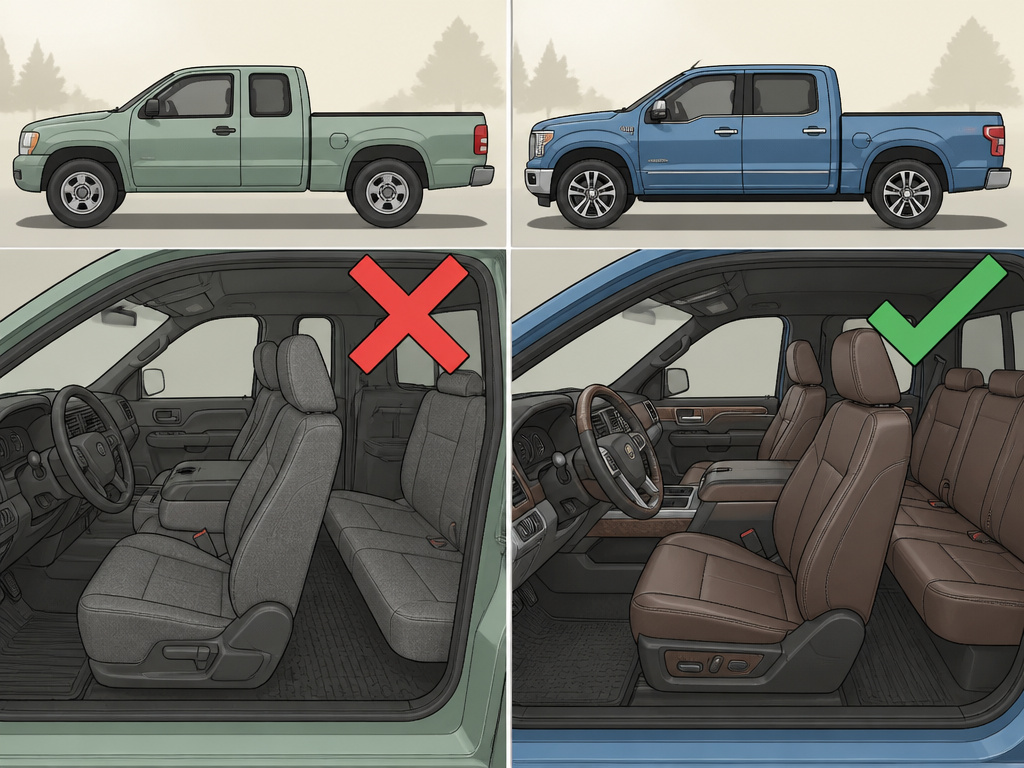
Your dream trim package might not be available with your preferred cab. Manufacturers often restrict high-end luxury or performance packages to crew cab models. This isn’t arbitrary marketing; it’s a demographic bet.
Luxury trims like the GMC Sierra Denali or high-performance off-road packages like the Toyota Tacoma TRD Pro are overwhelmingly marketed as family-capable, lifestyle vehicles. The target buyer is presumed to want full passenger space. Consequently, these trims are frequently offered only in crew cab configurations. You cannot walk into a dealer and order a top-tier, leather-lined extended cab truck from many brands.
Where this goes sideways: Falling in love with a premium trim only to discover it forces you into a crew cab with a shorter bed than you need.
Conversely, if you’re looking for a bare-bones work truck focused on maximum payload at minimum cost, you’ll often find it in a regular or extended cab configuration. The Nissan Frontier King Cab S is a prime example, representing the most affordable, utility-focused starting point.
This stratification means your cab choice is your first filter for the truck’s intended character: workhorse, family hauler, or luxury statement. Before you get attached to a badge or a feature list, check the fine print for which cab styles it applies to.
How to Choose: A Decision Framework
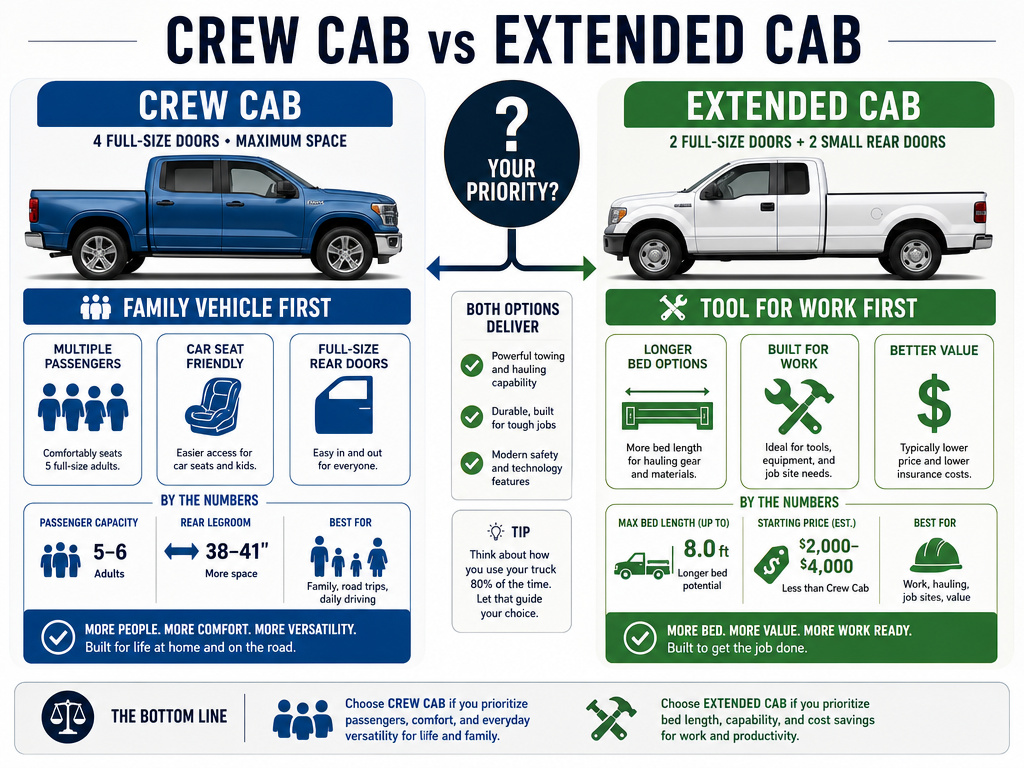
The choice between crew cab and extended cab isn’t about which is universally better. It’s about which is better for your three most important variables: people, stuff, and money.
Start with your passenger needs. If you regularly carry more than one adult passenger, or if car seats are in the picture, a crew cab is the only humane choice. The ease of accessing the rear seats with full-size doors is a daily convenience that outweighs most other factors. For an extended cab, honestly assess if the rear seat will be used for people more than twice a month. If the answer is no, its utility as a locked, interior storage box becomes a genuine asset.
Next, measure your bed needs. What do you actually haul? Mulch and plywood demand length; tools and coolers demand depth and organization. If an 8-foot bed is non-negotiable, your cab options will immediately shrink, often to an extended or regular cab. If a 5.5-foot short bed works, the world of crew cabs opens up. Remember, a crew cab’s shorter bed can sometimes be mitigated with a bed extender or thoughtful loading.
Finally, confront the financial and practical reality. Crew cabs are more expensive. They also have a larger footprint, affecting garage fit and city driving. An extended cab is cheaper to buy, easier to park, and often comes with the bed length you need for work. But it asks your passengers to compromise.
The bottom line: If your truck is a family vehicle first, get the crew cab and figure out the bed. If your truck is a tool for work first, get the extended cab with the bed you need and accept the rear-seat limitations.
Frequently Asked Questions
Are extended cab rear seats safe for kids?
The seats themselves meet the same federal safety standards. The challenge is access and proper installation of child seats through the smaller, rear-hinged doors. It’s more cumbersome than in a crew cab, but it can be done. Always check the vehicle manual for specific guidance.
Can you get a crew cab with an 8-foot bed?
It is exceedingly rare on modern light-duty trucks due to the resulting enormous overall length and wheelbase. Some heavy-duty (3/4-ton and 1-ton) trucks offer this “mega cab” style configuration, but for a Ford F-150, Silverado 1500, or Ram 1500, the answer is typically no.
Do crew cabs have worse towing capacity?
Not inherently. Towing capacity is determined by a complex formula including engine, transmission, axle ratio, cab configuration, and bed length. A properly equipped crew cab can have an identical or even higher tow rating than an extended cab of the same model, as the longer wheelbase can aid stability. Always check the specific truck’s payload sticker and towing guide.
What’s the difference between a Double Cab and a Crew Cab?
The naming is a brand-specific mess. Toyota uses “Double Cab” to mean its crew cab (four full doors). Chevrolet uses “Double Cab” to mean its extended cab (with smaller, front-hinged rear doors on the Silverado). Always look at the door design, not the name, to know what you’re getting.
Is resale value better for crew cabs or extended cabs?
Crew cabs generally have stronger and broader resale value because they appeal to the largest buyer pool (families). Extended cabs can retain value well in specific markets, like rural areas or among buyers seeking a specific long-bed configuration, but their audience is narrower.
Before You Go
The crew cab versus extended cab debate ultimately answers one question: what is the truck’s primary job? The crew cab is a passenger vehicle that can haul. The extended cab is a hauling vehicle that can occasionally carry passengers. Your daily reality, the school run versus the lumber yard trip, should write the answer for you. Measure your life, then measure the doors.
