
Determining If Wheel Adapters Are Safe for Trucks & Trucks
This post contains affiliate links. As an Amazon Associate, we earn from qualifying purchases.
Wheel adapters can be safe on trucks, but only if they meet three non-negotiable criteria: they are made from 6061-T6 grade aluminum or stronger, they are hub-centric with a minimum thickness of 15mm, and they are torqued with a precise sequence and thread-locking compound. A 2022 engineering report found adaptors thinner than 15mm fail at the stud mountings under cornering loads, and there are many recorded instances overseas of wheels detaching.
That 15mm floor isn’t a suggestion. It’s the result of Finite Element Analysis modeling by the Low Volume Vehicle Technical Association, a body that certifies modified vehicles. They built that spec after their technical staff started seeing 10mm-thick adaptors, a trend that directly correlates with their “wall of shame” collection of failed parts.
What follows is a breakdown of those official safety specs, the real difference between an adapter and a spacer, and the five mechanical consequences, from toasted wheel bearings to illegal certification, that happen when you treat them as a simple bolt-on accessory.
Key Takeaways
- The LVVTA engineering standard sets a hard minimum thickness of 15mm for any wheel adaptor. Anything thinner fails Finite Element Analysis stress tests.
- Hub-centric bolt-on adapters are the only safe type for thicknesses over 5mm. Slip-on spacers reduce stud engagement and rely on lug nuts for centering.
- Adapters increase leverage on wheel bearings and ball joints. Expect to replace them 20-30% sooner than stock, especially with wider tires.
- Torque is not a one-time event. You must re-torque to spec after 25-50 miles, then again after 1,000-2,000 miles, using thread locker.
- Installing adaptors can void your vehicle’s original certification against Federal Motor Vehicle Safety Standards, transferring liability to the installer or owner.
Spacer vs. Adapter: The Load Path Changes Everything
People use the terms interchangeably. The mechanics are not the same. A spacer is a flat plate that slides over your factory studs, pushing the wheel outward. The wheel then mounts directly to your original, now-extended studs.
Where this goes sideways: Using a thick slip-on spacer without installing longer wheel studs. You lose critical thread engagement. If you have only three or four full turns of nut on the stud, road vibration will work it loose within a few hundred miles. The wheel comes off.
An adapter is a different component. It bolts to your hub using your original studs or bolts. It has its own set of pressed-in studs protruding outward. Your wheel then mounts to these new studs. This design allows for a change in bolt pattern, say, from a Toyota 6×139.7 to a Ford 8×180.
The critical distinction is the load path. On a spacer, the load travels through your factory studs, which are now in bending because the wheel is pushed out. On a hub-centric adapter, the load goes through the adapter’s body, which is centered on the hub’s pilot bore. The factory studs see only clamp load, not bending stress.
For a small clearance fix under 5mm, a quality slip-on spacer is acceptable. For any change in bolt pattern or a push beyond half an inch, you need a hub-centric bolt-on adapter. Mixing the two types is how you end up with a vibration that feels like a bent rim at 55 mph.
The LVVTA Minimum Specs You Cannot Compromise
The Low Volume Vehicle Technical Association in New Zealand deals with modified vehicles daily. Their 2022 Information Sheet is the closest thing to an official engineering standard for wheel adaptors. It exists because they kept seeing adaptors as thin as 10mm.
Their Finite Element Analysis modeling showed these would fail. So they published hard numbers.
A wheel adaptor fitted to a low volume vehicle between the hub and wheel assembly to affect a change in the wheel stud pattern, must locate, with a close tolerance fit, using the centre spigot or tapered wheel nuts or bolts: (a) the adaptor against the hub assembly; and (b) the wheel assembly against the adaptor. . NZ Car Construction Manual 12.23.1, cited in LVVTA Info Sheet 01-2022
Here are the minimum dimensions pulled directly from that document, which should be your shopping checklist:
| Dimension | Minimum Spec | Why It Matters |
|---|---|---|
| Overall Thickness (A) | 15 mm | Provides material for stud strength and nut seat depth. Below this, shear stress around the studs causes cracking. |
| Material Above Stud Shoulder (B) | 8 mm | Ensures the tapered lug nut has enough metal to seat against. Less than this, and the nut can pull through. |
| Taper Seat Height (C) | 8 mm | Allows for proper conical lug nut engagement. Shallow tapers don’t center the wheel. |
| Retaining Nut Height (E) | 10 mm | Provides adequate thread engagement for the nuts that hold the adapter to your hub. |
| Material | 6061-T6 Aluminium | This grade specifies yield strength, ultimate strength, and hardness. Cheaper cast aluminum is brittle. |
If a seller cannot confirm these specs, walk away. The LVVTA report notes “many recorded instances overseas of wheel adaptors failing while driving,” with breaks typically at the stud mountings or where the adaptor contacts the hub. A failed adapter doesn’t just stop the truck. The wheel departs, and you lose braking and steering on that corner.
How Adapters Stress Your Truck (And Your Wallet)
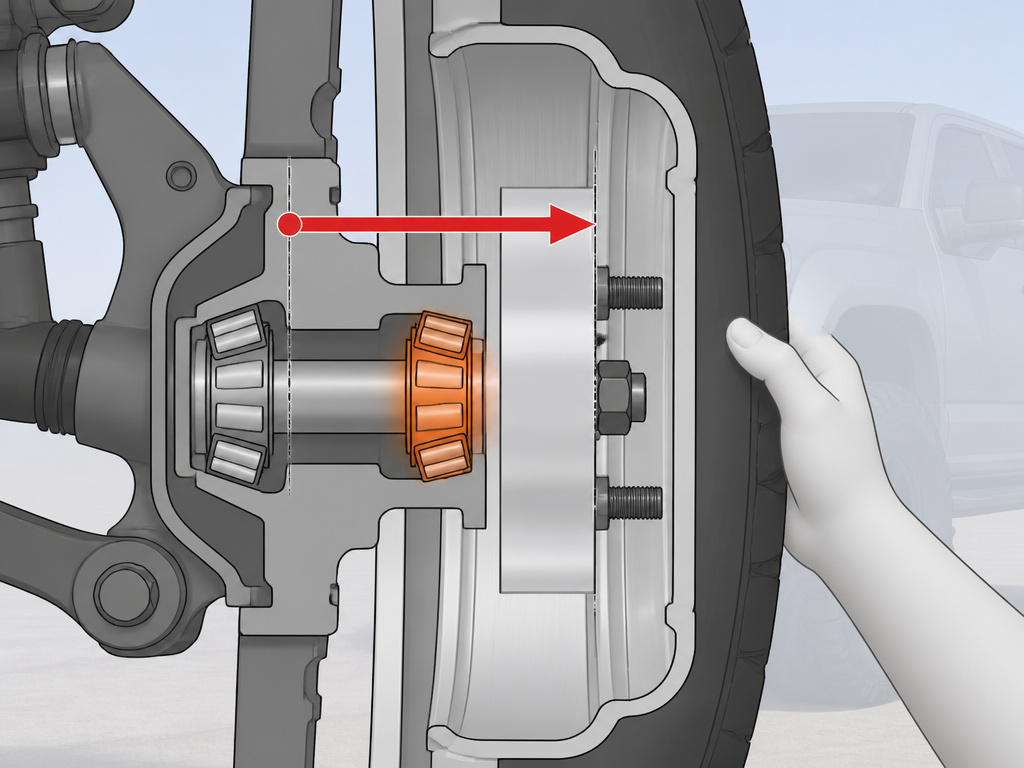
Adapters move the wheel’s centerline outward. This increases the lever arm acting on your hub assembly. Physics does the rest.
Wheel bearings see the direct hit. The bearing is designed for a specific offset. Pushing the wheel out increases the load on the outer bearing race. The result is heat, wear, and premature failure. If you’re running aggressive tires or often carry heavy loads, expect to replace bearings 20-30% sooner. This is not unique to adapters, any wheel spacer or negative-offset wheel does the same, but adapters add another interface that can wear.
Suspension geometry shifts. The scrub radius, the distance between the steering axis and the tire’s centerline, changes. This can lead to torque steer, heavier steering feel, and accelerated wear on tie rods and ball joints. The wider track can improve stability in a straight line, but it alters the handling balance.
Payload and towing ratings are affected. The factory rating assumes stock track width. Widening the stance changes load distribution across the suspension. While a quality adapter rated for your truck’s weight is safe for normal use, towing at the maximum GCWR with adapters adds uncalculated stress. It’s a gray area most owners ignore until a component fails.
Finally, there’s a legal consideration many miss. A Toyota service bulletin explicitly states that installing dual rear wheels (which requires adapters) on pickup trucks “could overstress the original suspension components, resulting in component failure and loss of vehicle control.” More broadly, any modification that alters a certified vehicle can void its compliance with Federal Motor Vehicle Safety Standards. The liability for that non-compliance often falls on the last modifier, which could be you.
The 5-Step Installation Protocol That Actually Works
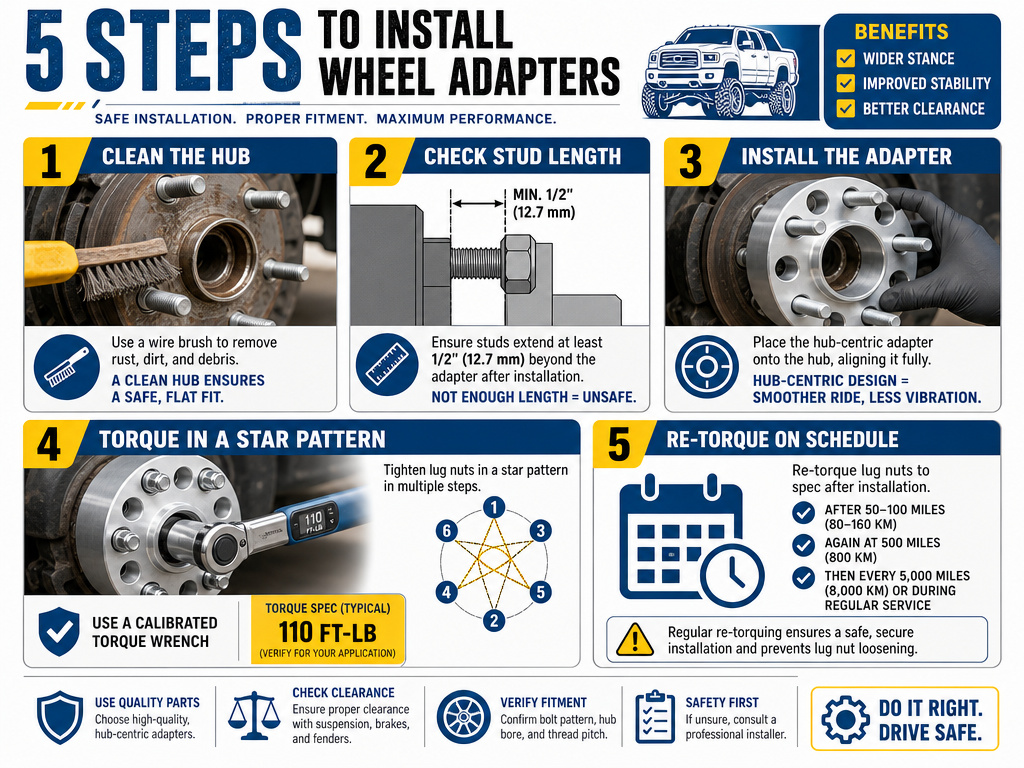
Getting adapters safe is about procedure, not just parts. Here is the sequence that matches OEM workshop manual rigor.
- Clean and inspect the hub face. Remove all rust, dirt, or old gasket material. Any high spot prevents flush mating. An uneven seat creates a bending moment on the studs with every rotation. That’s how studs snap.
- Check factory stud length. The TeraFlex guide for Jeep adapters states a maximum protrusion of 1.25 inches. If your stud is longer, you must grind the tip down, without touching the threads. An adapter must sit completely flush against the hub.
- Dry-fit and verify centering. Slide the adapter on. A hub-centric adapter should drop into place with light hand pressure. If it rocks, the center bore is wrong. Do not proceed.
- Torque in stages with a calibrated wrench. Apply red thread-locking compound to the studs. Hand-tighten the supplied lug nuts, then torque them to the manufacturer’s spec, typically 85-95 ft-lbs for the adapter nuts. Use a star pattern. An impact wrench is banned here; it can crack cast nuts or strip threads.
- Re-torque on a strict schedule. This is the step every quick-guide glosses over. The VEVOR spacer manual mandates re-torquing after 25-50 miles, then again after 1,000-2,000 miles. Vibrations settle the metal and seating surfaces. Skipping this is how a seemingly tight adapter develops dangerous play.
Common mistake: Assuming “torqued once is torqued forever.” The NHTSA recall for defective Toyota lug nuts specifically cited improper torque as a cause of cracking and detachment. Their fix protocol includes the exact torque sequence and a final verification.
After installation, do a lock-to-lock steering check while the truck is still lifted. Ensure the tire doesn’t contact the fender liner or suspension at full turn. Lower the truck and re-check clearance under full weight.
When to Walk Away: Three Red Flags
Not every truck and adapter combination is viable. Here are the deal-breakers.
Red Flag 1: Tapered-head OE bolts. Some European vehicles use bolts, not studs and nuts, to attach the wheel. The LVVTA explicitly warns that adapters designed to reuse these OE bolts have “significant potential issues” and are outside their safety scope. If your truck uses bolts, consult a professional engineer before buying anything.
Red Flag 2: No verifiable material certification. The stamp “6061-T6” means it underwent solution heat treatment and artificial aging. A seller saying “aircraft aluminum” or “billet” without the T6 grade is selling you an unknown. Demand a material certification sheet if you’re spending real money.
Red Flag 3: You just want a “cooler stance.” If you’re considering adapters purely for aesthetics, especially over 1 inch thick, you’re solving the wrong problem. Buy wheels with the correct offset instead. You eliminate an extra failure point, save your wheel bearings, and achieve the same look. Adapters are a tool for a specific fitment problem, not a cosmetic shortcut.
The Long-Term Relationship: Inspection and Maintenance
Adapters turn a simple wheel mount into a maintenance item. Your checklist gets two new lines.
First, re-torque as specified. Mark one lug with paint pen. If that mark shifts relative to the adapter after a few months, you have movement. Second, listen for bearing hum. The tell is a low-pitched roar that changes with vehicle speed and lessens in a turn. It starts faint.
Visually inspect the adapter during tire rotations. Look for cracks radiating from the stud holes or the inner bore. Check for corrosion, especially between the adapter and the hub face, this is where galvanic corrosion between dissimilar metals can seize everything together.
If you off-road, the inspection frequency triples. Mud and grit packed between the adapter and wheel can act as an abrasive, wearing both surfaces. The TeraFlex warning sticker that comes with their adapters advises checking all fasteners after every off-road trip for this reason.
Frequently Asked Questions
Are 2-inch wheel adapters safe?
They can be, but the safety margin shrinks. A 2 inch spacer massively increases leverage on bearings and ball joints. Safety depends entirely on the adapter meeting the LVVTA 15mm thickness minimum (which a 2-inch adapter should), being hub-centric, and made from 6061-T6 aluminum. Expect accelerated suspension wear regardless.
Do I need longer wheel studs for adapters?
For a bolt-on hub-centric adapter, no. It uses its own studs. For a slip-on spacer, yes, absolutely. The spacer thickness directly reduces the number of threads engaged by your factory lug nuts. If engagement is less than the diameter of the stud, it will fail.
Can wheel adapters cause vibration?
Yes, and it’s usually one of three things: a non-hub-centric adapter (the wheel is centered by the lugs alone, which is imperfect), an uneven mating surface on the hub, or improper torque sequence allowing the adapter to sit crooked. A vibration that starts suddenly after installation is an immediate red flag.
Do wheel adapters affect alignment?
They do not directly change your alignment settings (toe, camber, caster). However, by widening the track, they can amplify the feel of existing minor alignment issues and change the vehicle’s steering feedback and stability, which some mistake for an alignment problem.
Are wheel adapters legal?
This is state-specific. They are generally legal for on-road use if they do not cause the tires to extend beyond the fenders. However, as the Toyota technical bulletin highlights, any modification that affects compliance with Federal Motor Vehicle Safety Standards (FMVSS) can be deemed illegal for a certified vehicle. The legal responsibility often falls on the owner.
Before You Go
Wheel adapters are an engineering solution, not a cosmetic accessory. The safe path is narrow and well-marked with specific numbers: 15mm minimum thickness, 6061-T6 material, hub-centric design, and a torque wrench used twice after installation.
The unsafe path is everything else, vague marketing, unknown metals, and the assumption that bolting anything between your wheel and hub is consequence-free. The LVVTA’s wall of shame and the NHTSA’s recall database exist because that assumption is wrong.
For a daily-driven truck that tows or carries loads, your default pick should be wheels with the correct offset. Use adapters only when you must, to salvage a great set of wheels with the wrong bolt pattern, or to solve a precise clearance issue that a minor spacer can’t fix. That’s the line between modifying your truck and compromising it.
