
How Much Does a Monster Truck Tire Cost? Price Explained
This post contains affiliate links. As an Amazon Associate, we earn from qualifying purchases.
A single new 66-inch BKT monster truck tire, the professional standard, costs between $2,500 and $3,500. That price covers a tire measuring 66 inches tall, 43 inches wide, and designed for a 25-inch wheel. Multiply by four, and you’re looking at a $10,000 to $14,000 investment before you even consider mounting, beadlocks, or the 50 hours of hand-cutting required for competition.
The sticker price is one thing. The why behind it is another. This isn’t about a bigger version of your pickup’s rubber. It’s about a hand-built, bias-ply, 645-pound behemoth engineered to survive 10,000-pound trucks landing from 20-foot jumps on crushed cars.
What follows is a breakdown of what you’re actually paying for: the anatomy of the pro tire, the hidden costs that double the bill, and the realistic lifespans from professional racing to weekend hobby use. You’ll also find out what happens when you try to save money, and the one compromise most builders make.
Key Takeaways
- The BKT 66×43.00-25 is the undisputed professional standard, but its $2,500-$3,500 per-tire price tag is just the start.
- Hand-cutting the tread for competition is a 50-hour per-tire craft that adds significant labor cost and defines performance.
- Beadlock wheels are non-optional for safety at low pressures, adding $500-$1,500 per corner to the total setup.
- Lifespan varies wildly: Pro tires last 8-12 events; a hobbyist’s set can survive for years with gentle use.
- Smaller flotation tires (43″-54″) are the most common budget alternative, costing $400-$1,200 each.
What You’re Actually Buying: The Anatomy of a Pro Tire
Forget everything you know about radial passenger tires. A monster truck tire is a different species.
It starts with a bias-ply construction. The cords run diagonally across the carcass, creating a stiff, unforgiving sidewall. That rigidity is a feature, not a bug. It prevents the tire from rolling over under the extreme lateral loads of cornering and the massive vertical impacts from landings. A radial tire’s flexible sidewall would fold and fail instantly.
The rubber compound is softer than you’d expect. It has to be. Running at 16-20 psi, sometimes as low as 8 psi for maximum traction and bounce, the tire needs to conform to the terrain. That softness, combined with the bias-ply stiffness, creates the unique handling feel drivers describe.
Then there’s the weight. A single BKT tire mounted on its wheel clocks in at 645 pounds. That unsprung mass dictates everything about the truck’s suspension and axle design. You can’t just bolt these onto a reinforced pickup axle; the entire drivetrain is engineered around them.
The 66-inch BKT tire used in Monster Jam competition has a bias-ply construction for sidewall stiffness, runs at 16-20 psi for ground conformity, and weighs 645 lbs when mounted. Its tread is hand-cut over 50 hours to reduce weight and tailor traction for specific track conditions.
The BKT 66×43.00-25: The Pro Standard
When you picture a monster truck, you’re almost certainly picturing this tire. The BKT 66×43.00-25 is the spec sheet made real: 66 inches tall, 43 inches wide, on a 25-inch wheel. It’s the tire that won the contract for Monster Jam and dominates the professional scene.
Its dominance isn’t about marketing. It’s about a consistent manufacturing process that delivers a blank canvas teams can modify. The tread that comes from BKT is essentially smooth. This allows each team’s fabricator to hand-cut a custom pattern, a process taking about 50 hours per tire, to match the dirt, clay, or concrete of the next event.
The performance window is narrow. In professional competition, a set of these tires typically lasts between 8 and 12 events. After that, the hand-cut grooves wear down to a point where traction and bounce characteristics change, affecting consistency. For a top team, that means a tire budget is a fixed, recurring line item, not a one-time purchase.
The Real Cost: It’s Never Just the Tire
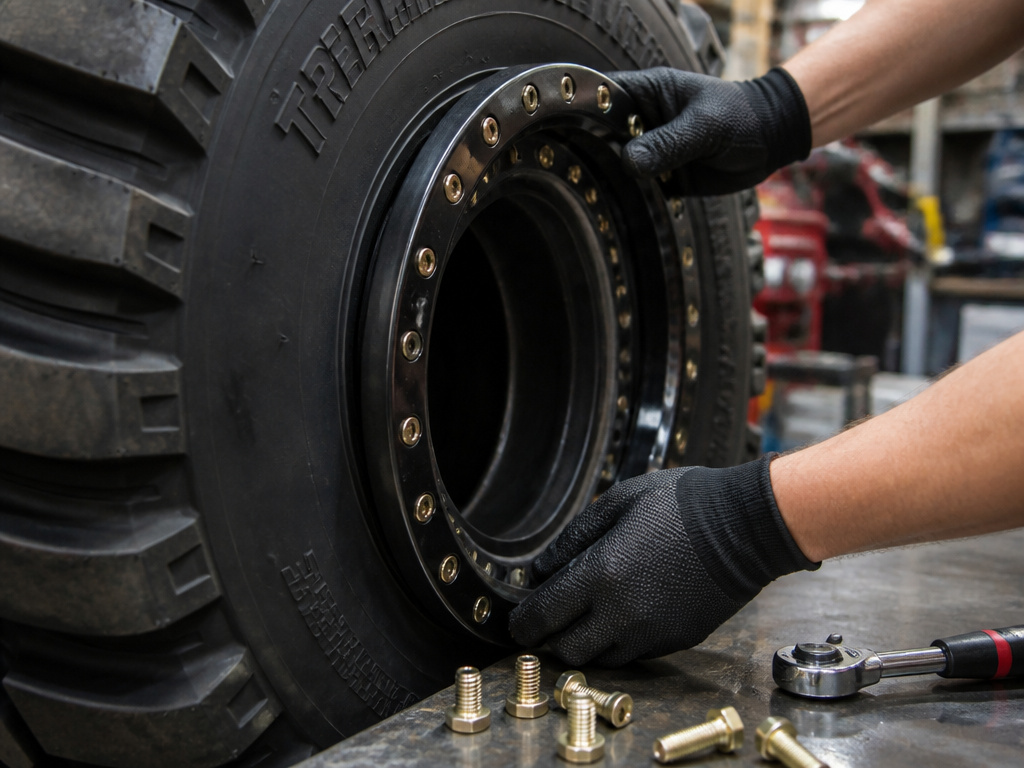
Seeing a price of $3,000 for a single tire is the first shock. The second is realizing that number might be less than half of what you’ll spend to get it on the truck and working.
The Hidden Costs Beyond the Tire Itself
Beadlock wheels are mandatory. At the low pressures these tires run, a standard wheel would let the tire spin on the rim or unseat entirely under cornering force. A beadlock system physically bolts the tire’s bead to the wheel. The rings, hardware, and the labor to install them add $500 to $1,500 per corner. Skipping beadlocks isn’t an option for anything beyond a static show truck.
Mounting and balancing is a specialty job. You need a shop with a heavy-duty tire machine capable of handling a 600+ pound assembly. Labor rates apply, and the job takes time. A full set mounting can easily add another $500 to $1,000 to the bill.
Cutting and grooming is where the art meets the expense. That 50-hour hand-cutting process? If you’re not doing it yourself, you’re paying a fabricator’s hourly rate. This can double the effective cost of a “new” competition tire.
Axle and suspension modifications are a prerequisite. Your stock Dana 60 isn’t going to hold up. Upgrading to rockwell axles or custom portal axles to handle the weight and torque is a five-figure project all on its own.
| Cost Component | Low Estimate | High Estimate | Notes |
|---|---|---|---|
| Tire (BKT 66″) | $2,500 | $3,500 | Per tire. The base commodity. |
| Beadlock Wheel | $500 | $1,500 | Per wheel. Required for safety. |
| Mounting/Balancing | $500 | $1,000 | For a set of four. Specialty shop required. |
| Hand-Cutting | $1,000 | $2,500+ | Per set. 50 hours of skilled labor per tire. |
| Total Per Corner | ~$4,500 | ~$8,500+ | Before axles, shipping, or spares. |
The financial reality is that for a serious build, the tires themselves often represent less than half of the total outlay for a rolling chassis. This is why a full tire and wheel package for a monster truck can easily eclipse the cost of a new economy car.
Where This Goes Sideways: Buying Used Tires
The used market is tempting. Prices range from $800 to $1,500 per tire, sometimes as low as $500 for well-worn examples. It’s where many hobbyists start.
The risk is in the condition. You’re buying a tire that has already lived a hard life. Sidewall damage from debris, uneven wear from a chassis misalignment, or tread that’s been cut down to its limit are all common. A $500 tire often means you’re getting one or two events out of it before it’s scrap. The initial savings evaporate if you’re replacing them twice as often.
The smart move in the used market is to buy from a known source, often a professional team cycling out their competition sets, and to visually inspect for dry rot, deep cuts, and remaining tread depth. Even then, you’re buying someone else’s custom cut pattern, which may not suit your truck or local terrain.
How Long Do They Actually Last? Pro vs. Hobbyist
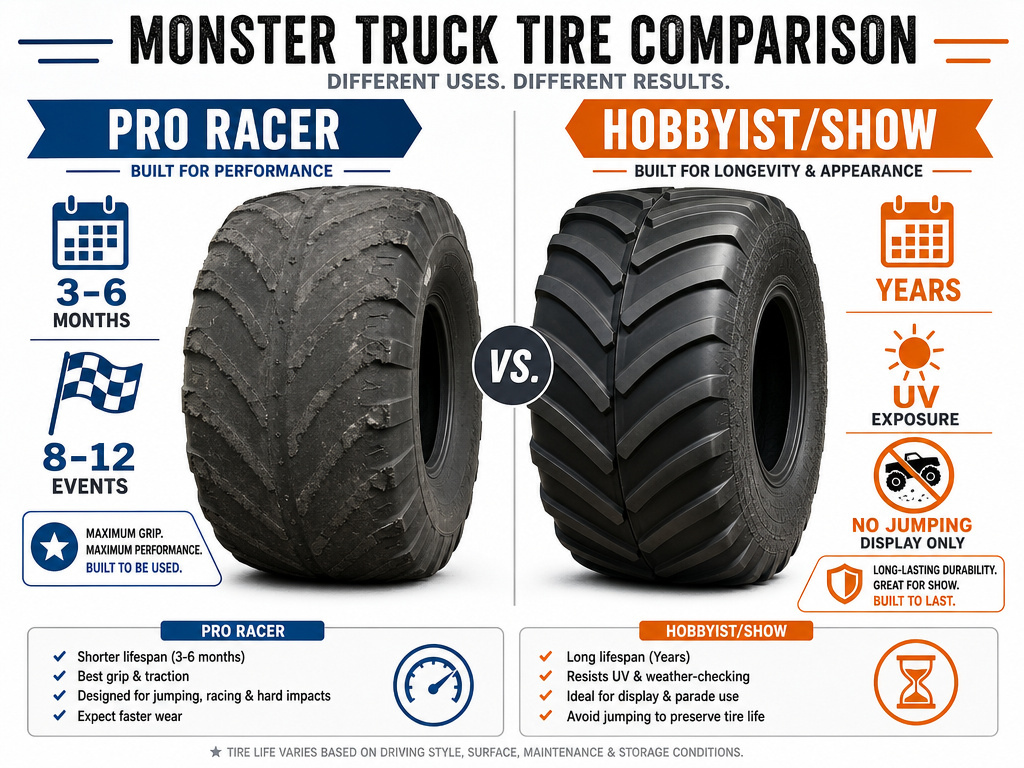
A tire’s lifespan is the biggest variable in the total cost of ownership. The gap between a professional racer and a weekend show truck is a chasm.
Professional Competition: In Monster Jam or similar series, a set of tires is a consumable. Teams track usage by the event. The 8 to 12 event lifespan is a hard rule born from experience. Beyond that, the carefully cut tread is worn smooth, traction drops, and the predictable bounce that drivers rely on for freestyle tricks disappears. For a race truck running a full schedule, this can mean new tires every 3 to 6 months.
Hobbyist & Show Use: This is the other end of the spectrum. A truck that only sees pavement, fairground grass, and the occasional slow cruise can make a set of tires last for years. The wear isn’t from impact and abrasion; it’s from sun exposure and time. The key is avoidance of the behaviors that destroy tires: high-speed jumps, sharp debris, and constant hard cornering.
The part nobody mentions: A tire’s calendar age matters as much as its tread depth. Rubber compounds degrade over 5-7 years regardless of use. A “like-new” 10-year-old tire pulled from a barn is a safety hazard, not a bargain.
Alternatives to the 66-Inch Behemoth
Not every build needs, or can accommodate, the full professional spec. For mega trucks, mud boggers, and budget-conscious builders, smaller flotation tires are the standard fallback.
These are typically agricultural or industrial tires repurposed for off-road use. They come in sizes like 54″, 48″, and 43″. Their key advantage is price and availability.
- 54-inch tires suit “mega truck” and heavy mud racing builds. They offer a massive footprint but are slightly narrower than BKT tires. Prices range from $800 to $1,200 each.
- 48-inch and 43-inch tires are the entry point. They allow builders to use lighter axles and can fit under a moderately lifted full-size pickup. These can be found for $400 to $900 per tire.
The trade-off is performance. Flotation tires are almost universally radial construction. Their sidewalls are more flexible, which can lead to instability under hard cornering. Their tread patterns are designed for mud and soft earth, not for the controlled bounce needed for arena stunts. For a mud bog or trail rig, they’re perfect. For a true monster truck, they’re a compromise.
What About Other Brands?
BKT’s dominance is near-total in modern professional circles, but it hasn’t always been that way.
Firestone Terra Tires are legends. The original Bigfoot truck ran on them, and they carry a vintage, nostalgic appeal. They’re still produced in limited runs and can cost $1,000 to $2,000 each. They’re heavier and often have a more squared-off profile, which changes handling.
Other manufacturers like Goodyear and Michelin have produced monster truck tires in the past, often at a premium price point ($2,500-$3,000 historically). Today, they are rarely seen in competition, making them more of a collector’s item than a practical purchase.
The choice often comes down to rules (Monster Jam mandates BKT), sponsorship, or the specific look a builder is going for. For pure performance and parts commonality, the BKT is the default.
Frequently Asked Questions
How much does a full set of 4 monster truck tires cost?
For four new 66-inch BKT tires, budget between $10,000 and $14,000 just for the rubber. A complete ready-to-roll set, including beadlock wheels, mounting, and basic balancing, typically starts around $20,000 and can exceed $30,000 with custom cutting and premium components.
Can you put monster truck tires on a regular truck?
Technically, yes, but practically, no. A regular pickup’s axles, brakes, suspension, and frame are not designed for the 645-pound unsprung weight per corner or the extreme stresses. Attempting it without a full custom chassis, rockwell or planetary axles, and a serious powertrain upgrade will result in immediate and catastrophic failure.
What size tires do monster trucks use and how does size affect cost?
The professional standard is 66 inches in diameter. Larger custom sizes (68 inches and up) exist and cost more due to limited production runs and extra material. Smaller flotation tires (43″-54″) are significantly cheaper but are used for different types of vehicles like mud trucks and amateur builds.
Is it cheaper to buy used monster truck tires instead of new ones?
It can be, but it’s risk-intensive. Used tires cost $800-$1,500 each, offering 40-60% savings over new. However, they often have limited remaining tread life, may have hidden sidewall damage, and their custom-cut tread pattern may not suit your needs. For a show truck that sees gentle use, they can be a good deal. For competition, they are a false economy.
The Bottom Line
A monster truck tire isn’t a purchase; it’s an ongoing operational cost. The $2,500-$3,500 figure for a BKT 66-incher is merely the ticket to the game. The real spend is in the beadlocks, the skilled labor, and the constant replacement cycle dictated by how hard you drive.
For a professional team, tires are a calculated, recurring line item as essential as fuel. For a hobbyist, a single set can be a decade-long investment if treated with care. Your decision hinges entirely on what you want the truck to do. Want to crush cars and backflip? Open your wallet. Want a showpiece that rumbles slowly through a parade? Your tires might outlive the truck’s first engine.
The sheer scale of everything, the cost, the weight, the labor, is what separates a monster truck from every other vehicle on the planet. That’s the price of playing in the biggest league there is.
