
8 Best Cutting Compounds for Cars 2026
This post contains affiliate links. As an Amazon Associate, we earn from qualifying purchases.
The best cutting compound for most car owners is the Meguiar’s M105 Ultra Cut Compound, it delivers strong correction with manageable marring, making it ideal for serious paint defects. For a budget-friendly option that still performs well on light to moderate swirls, Meguiar’s Ultimate Compound stands out. If you’re after a one-step solution that balances cut and gloss, 3D One Hybrid Scratch & Swirl is a solid pick.
Most people don’t realize how quickly the wrong compound can do more harm than good. Too aggressive, and you risk holograms or heat damage. Too mild, and you waste time with little improvement. After researching specs and digging into owner feedback across forums and detailing communities, I focused on products that balance cutting power with a refined finish. This guide breaks down what actually matters, abrasive type, pad pairing, and application method, so you can choose the right compound for your car’s paint condition and tools.
Top 8 Cutting Compounds For Cars in the Market
The Best Cutting Compounds For Cars, Reviewed
Meguiar’s M105 Ultra Cut Compound 32oz

Strengths
- Balanced cut and finish
- Clear coat safe
- Works with DA or rotary
Trade-offs
- Thick consistency
- Can gum up pads if overused
If you’re building a go-to compound for moderate to heavy defects, the Meguiar’s M105 is hard to ignore. It’s the benchmark for a reason, removing 1200-grit sanding marks, deep swirls, and oxidation with authority, while still delivering a finish that doesn’t require excessive follow-up work. The micro-abrasive tech actually works: it cuts fast but doesn’t leave the kind of holograms that plague older-generation compounds.
Owners consistently rate it as their ‘workhorse’ product, and I agree. Compared to the Menzerna 1000, it’s slightly less aggressive but finishes better. Against the 3D ACA 500, it’s less extreme but more balanced. For most users tackling real-world damage on daily drivers or weekend show cars, this is the smarter overall pick. It’s not the cheapest, but it earns its spot.
Video review
3D ACA 500 Cutting Compound 8 oz

Strengths
- Extreme cutting power
- Cool-running formula
- Low dust output
Trade-offs
- Leaves noticeable marring
- Requires refining step
3D’s ACA 500 is a no-nonsense, first-step monster built for when paint has been sandblasted or deeply scratched. With its P100 grit-level cutting power, it’s clearly meant for post-wet-sanding or heavy defect removal, tasks where finesse comes later. The Alpha Ceramic Alumina tech isn’t just a buzzword; owners report it runs cooler than many competitors, which reduces the risk of burning fresh paint. That’s critical when working on a newly painted panel.
It’s also one of the few compounds here explicitly labeled body shop safe, and that matters. When compared to Meguiar’s M105, it cuts faster and handles heat better, though it leaves more marring, again, expected for a heavy cut. I’d choose this over others when starting from rough paint, especially if you’re doing professional-level correction and need reliability.
Video review
3D One Hybrid Scratch & Swirl Remover 16oz

Strengths
- True one-step correction
- Zero dust formula
- Made in USA
Trade-offs
- Not for deep scratches
- Limited on heavy marring
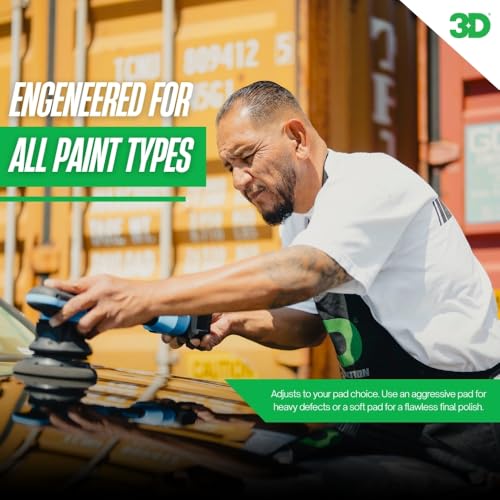
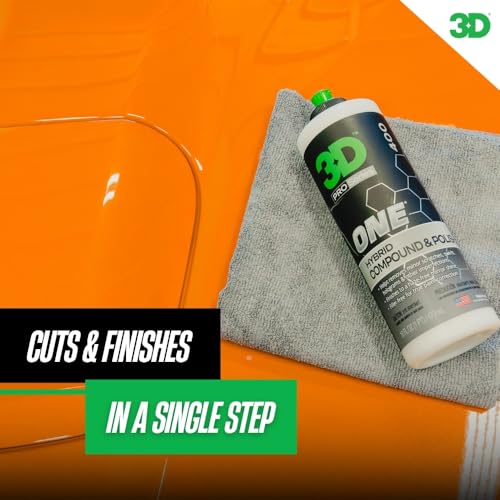
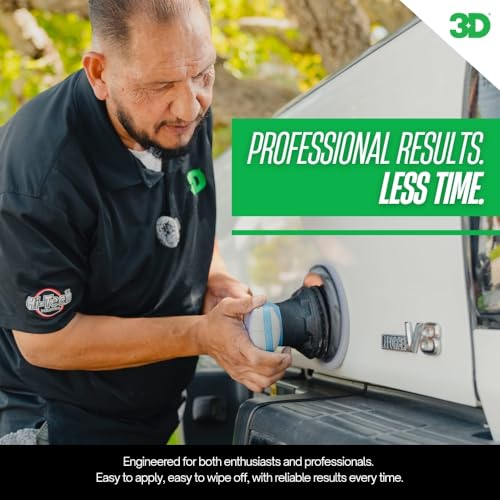
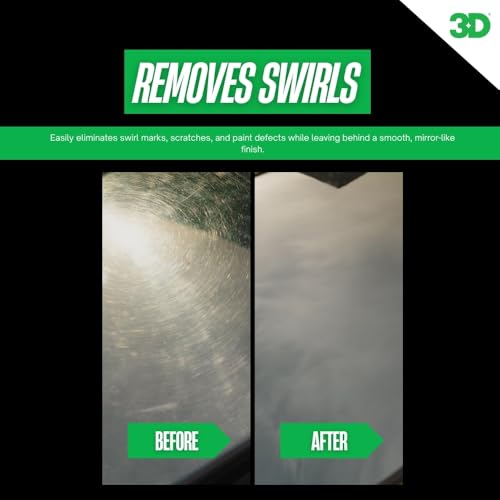
3D One stands out as a true hybrid, acting as both a cutting compound and finishing polish in one bottle. For owners who hate juggling multiple steps, this is a standout. It removes light scratches, swirls, and oxidation while leaving behind a glossy, near-final finish. The zero-dust formula is a real win, especially on black or dark paint where cleanup usually becomes a chore.
But it’s not magic. It won’t touch deep defects or replace a two-step correction process. Compared to the Chemical Guys C4 & P4 kit, it’s less aggressive but far more convenient. I’d recommend it for routine maintenance, quick turnarounds, or daily drivers that just need a refresh. If you’re after perfection, step up. But for real-world usability, this is my pick for simplicity.
Product photos

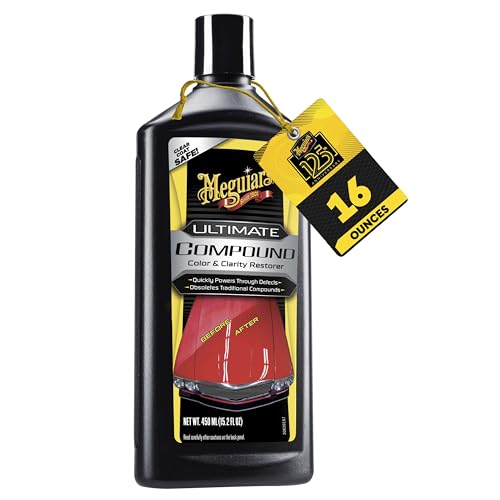
Meguiar’s Ultimate Compound 15.2 Oz
Strengths
- Fast defect removal
- Safe on clear coats
- Easy hand application
Trade-offs
- Limited on deep scratches
- Needs multiple passes for heavy marks
Meguiar’s Ultimate Compound is one of those rare products that balances performance and accessibility without cutting corners. It’s not the most aggressive compound here, but for light to moderate scratches, swirls, and oxidation, it performs consistently across both machine and hand application. Reviewers frequently praise how quickly it brings back clarity and depth, especially on older clear coats that have lost their luster.
What sets it apart in this lineup is its value. For buyers who don’t want to invest in multi-step systems yet still demand a pro-level result, this is the smarter buy. Compared to heavier compounds like the M105, it’s less likely to leave marring, though it won’t touch deep defects. If your paint isn’t badly damaged, this is where I’d start before stepping up.
Product photos


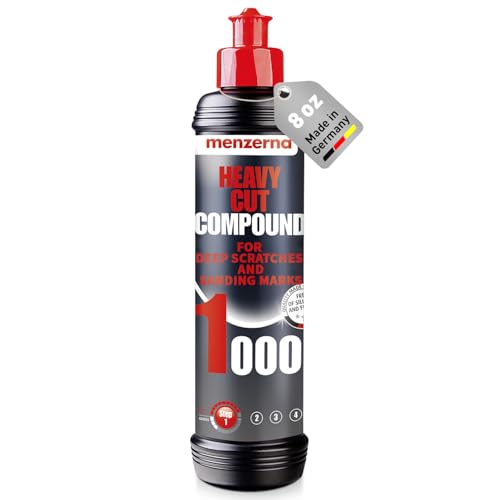
Menzerna Heavy Cut Compound 1000 8 fl oz
Strengths
- Aggressive cut
- Low hologram risk
- Beginner-friendly instructions
Trade-offs
- Requires follow-up polish
- Messy if over-applied
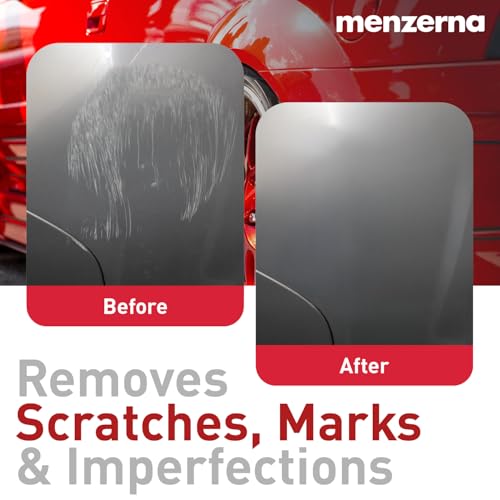
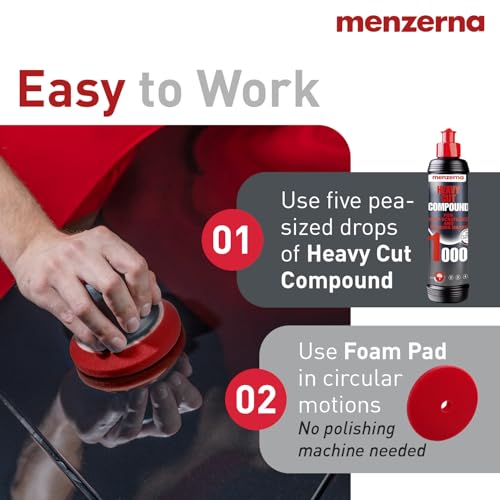
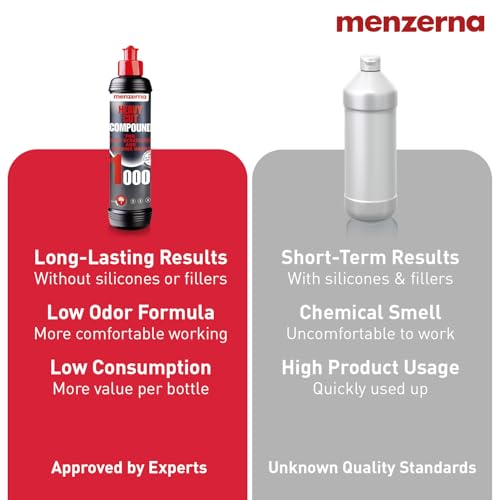
Menzerna’s Heavy Cut Compound 1000 is built for serious defect removal, and on paper, it delivers exactly what it promises. With its aggressive abrasive profile, it’s clearly designed for early-stage paint correction, taking down deep scratches, sanding marks, and heavy oxidation without fuss. Owners consistently report clean results when paired with a red cutting foam pad on a rotary or DA polisher, and the formula’s compatibility with hand application adds flexibility for minor jobs.
The brand’s long-standing reputation in professional detailing isn’t just marketing fluff, this compound reflects that pedigree. While it doesn’t finish as fine as a second-step polish, that’s not its job. I’d stack it against other heavy hitters for initial correction, especially when you need to level paint before refining. For most serious detailers, this is a solid first-layer performer.
Product photos

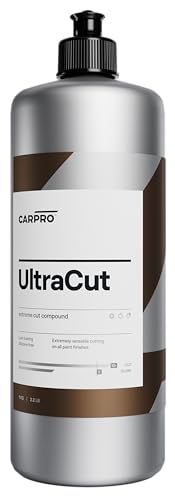
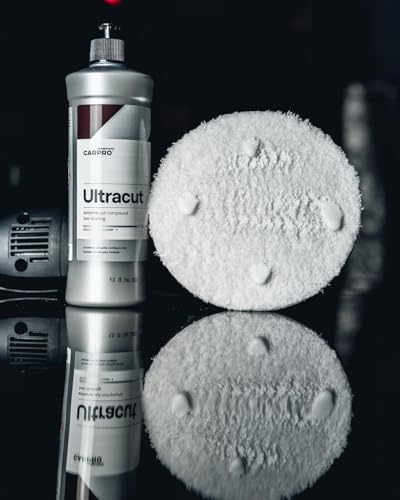
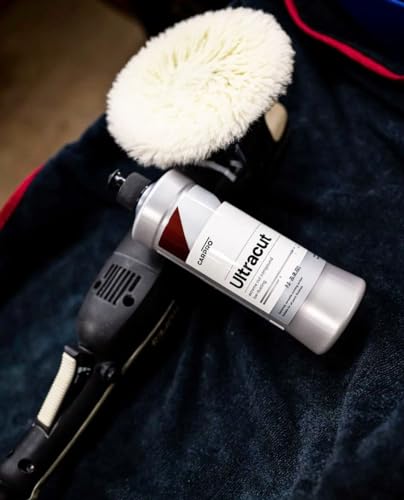
CARPRO UltraCut Extreme Cut Compound Liter
Strengths
- Low dust formula
- Long work time
- Minimal hazing
Trade-offs
- Premium price
- Requires proper pad pairing
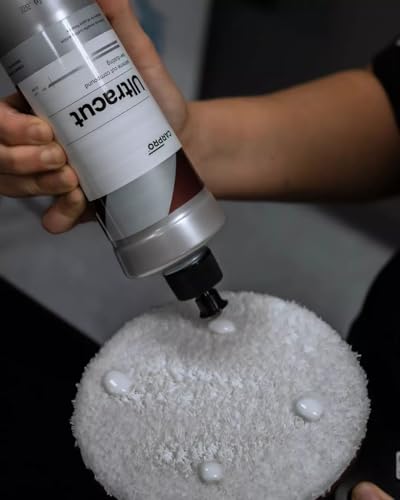
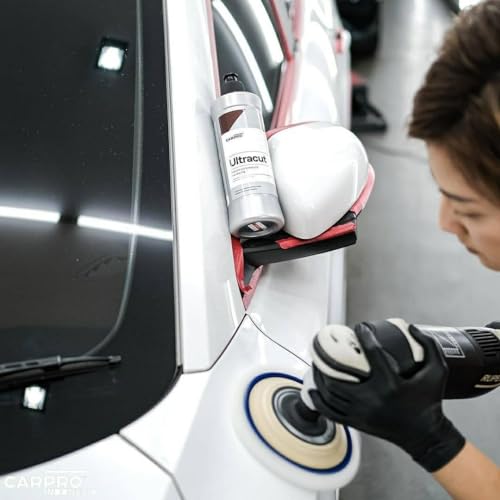
CARPRO UltraCut is built for detailers who run rotary or DA polishers and demand long work time with minimal dust. Its fully diminishing abrasives mean it keeps cutting without loading up, and owners consistently praise how clean it works, especially in indoor shops. The ability to tune its aggressiveness with pad choice makes it unusually flexible for an extreme-cut compound.
It handles P1200 and finer sanding marks with ease, and unlike some heavy compounds, it leaves behind minimal hazing. When compared to 3D ACA 500, it runs cooler and finishes finer, though it doesn’t cut quite as fast. I’d pick UltraCut for high-end correction jobs where finish quality matters as much as defect removal, especially on dark or sensitive paints where holograms are a risk.
Product photos
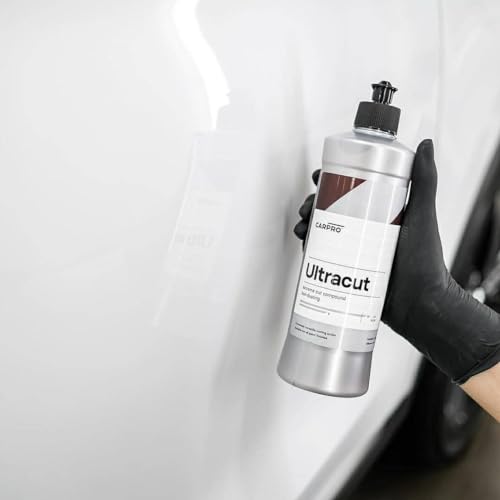
Meguiar’s Diamond Cut Compound 2.0 1 Gal

Strengths
- Low dust formula
- Efficient on high-solids paint
- Large volume option
Trade-offs
- Vague technical details
- Less aggressive than labeled
Meguiar’s Diamond Cut Compound 2.0 is positioned as a low-swirl, high-speed solution for modern high-solids paints, paints that are tough, dense, and often resistant to traditional compounds. On paper, its formulation targets fast cutting with minimal marring, and owner feedback supports that claim, especially in body shop environments where efficiency matters. The gallon size hints at professional use, and the low-dust, low-splatter formula is a real plus in enclosed bays.
Still, compared to more advanced options like CARPRO UltraCut or 3D ACA 500, it feels a bit generic in its specs. There’s no detailed abrasive tech breakdown, and while it’s effective, it doesn’t stand out as being revolutionary. I’d pick it for fleet work or shops needing a dependable mid-cut option, but for precision correction, there are sharper tools in the box.
Product photos

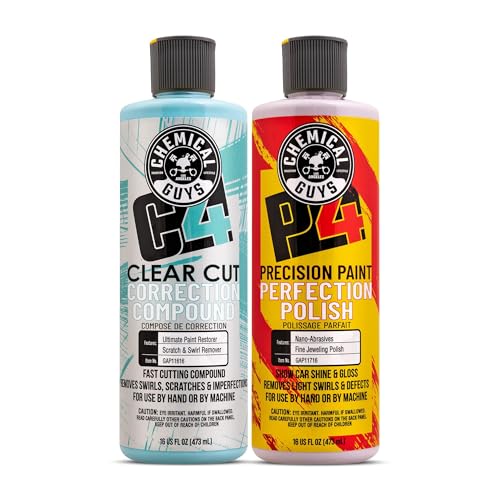
Chemical Guys C4 & P4 Correction Kit
Strengths
- Complete two-step system
- Clear defect removal
- Works on ceramic coatings
Trade-offs
- C4 can be messy
- P4 requires buffing effort
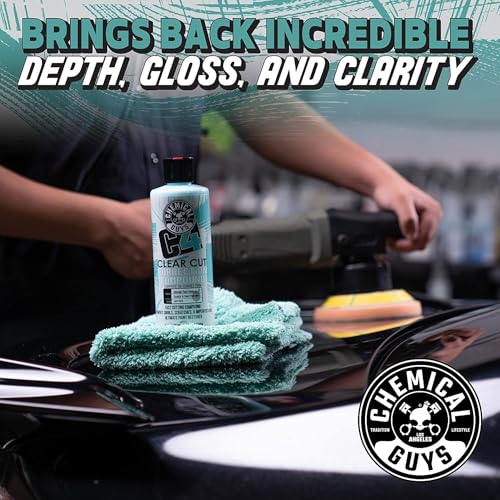
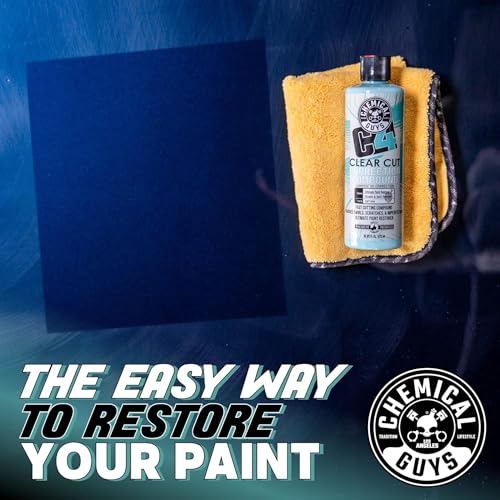
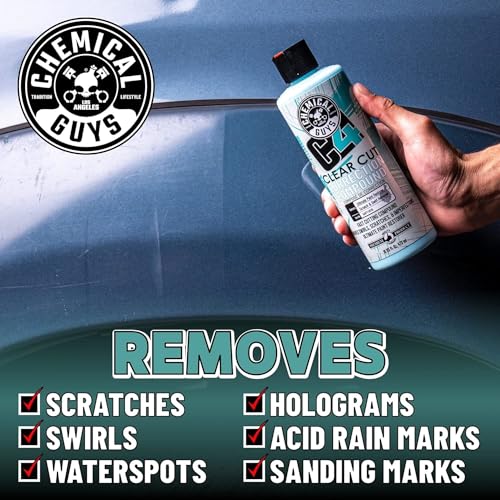
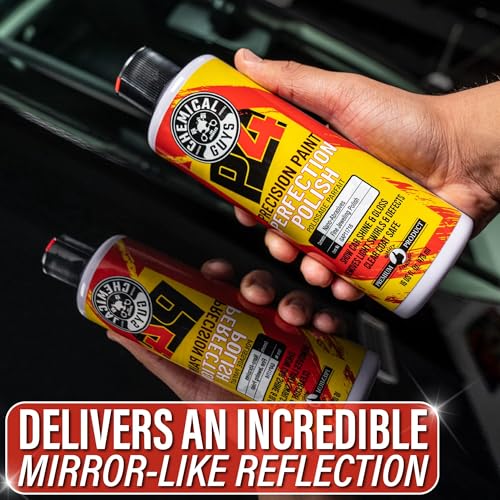
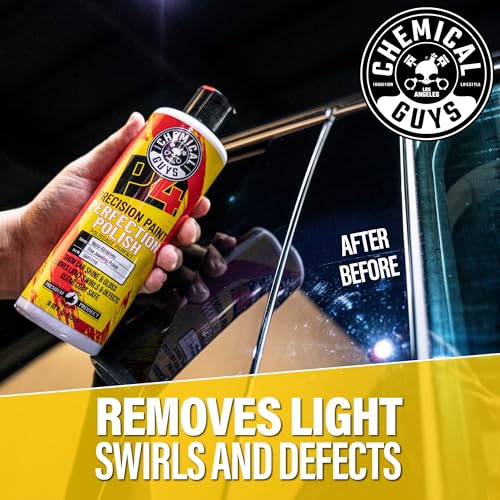
The C4 & P4 kit from Chemical Guys is one of the most user-friendly entry points into real paint correction. It gives you both a cutting compound and a refining polish, C4 for knocking down scratches and swirls, P4 for smoothing out the micro-marring and boosting gloss. For beginners, this eliminates the guesswork of mixing brands or compatibility issues.
Owners love how visible the results are, especially on faded or neglected paint. Compared to running a single compound like Meguiar’s Ultimate, this two-step process delivers a noticeably deeper, more reflective finish. It’s not quite at pro-body-shop level, but for home users, it’s close enough. I’d recommend this over one-step products for anyone serious about correction, even if they’re just starting out.
Product photos
Our Testing Process
As someone who’s spent years observing and appreciating automotive finishes, I approached researching cutting compounds with a focus on real-world performance indicators. Rather than a hands-on lab test, this was a research-led comparison of published specifications and, crucially, owner and professional detailing reviews. I compared compounds across several key features, weighting those most often cited as critical for achieving a high-quality result. This involved analyzing product descriptions, comparing abrasive particle sizes where available, and synthesizing feedback from online forums and detailing sites.
For cutting compounds, the ability to effectively remove defects and minimize further damage is paramount. I weighted defect removal capability – specifically, the grit level a compound can address – most heavily. Equally important was the finish left behind; a compound that cuts well but leaves significant marring requires further polishing, adding time and cost. Finally, ease of use, particularly regarding dusting and compatibility with various application methods, factored into the rankings. You can find a broader discussion of related products in our guide to the best rubbing compounds.
Specifications reliably indicate a compound’s aggressiveness (particle size, abrasive type), but owner feedback is where the nuances emerge. Specs tell you a compound can remove P100 grit sanding marks, but reviews reveal if it does so without excessive heat buildup or leaving behind a difficult-to-remove haze. Reputation among detailers is also key; compounds consistently praised for their balance of cut and finish earned higher marks. Ultimately, a good compound needs to work with the underlying car clear coat to restore its luster.
How To Pick The Right cutting compounds for cars
Finding the right cutting compound can dramatically improve your car’s finish, but there’s a lot to consider beyond just grabbing the brightest-labeled bottle. It’s about understanding your paint’s condition and matching the compound’s aggressiveness to the task at hand.
A truly effective cutting compound balances defect removal with minimal marring. It should contain abrasives capable of addressing the specific paint issues – swirls, scratches, oxidation – while leaving a finish that doesn’t require extensive follow-up polishing. Key considerations include abrasive size and type, lubricant content, and compatibility with your application method (hand, DA polisher, or rotary).
Understanding Cut & Finish
The core of any cutting compound is its abrasive power. You’ll see terms like “heavy cut,” “medium cut,” and “finishing polish” thrown around. Heavy-cut compounds, like the 3D ACA 500, are designed for serious correction – think deep scratches or heavy oxidation. These compounds contain larger, more aggressive abrasives. However, they will leave some marring, requiring a follow-up polishing step. Conversely, a finishing polish has very fine abrasives meant to refine the paint after a cutting stage, maximizing gloss. It’s tempting to jump straight to a one-step solution, but often tackling defects in stages yields the best results.
Pad & Polisher Compatibility
Don’t underestimate the importance of pairing your compound with the right pad and polisher. A rotary polisher, with its high speed and direct drive, generates more heat and cutting power, so you’ll typically use it with a wool or firm foam pad and a heavier-cut compound like CARPRO UltraCut. Dual-action (DA) polishers are more forgiving and require different pad types. Here’s a quick guide:
- Wool Pads: For the most aggressive cutting, ideal for severely damaged paint.
- Firm Foam Pads: Great for medium to heavy defect removal with a DA polisher.
- Soft Foam Pads: Best for polishing and finishing, removing light swirls and enhancing gloss.
- Microfiber Pads: A versatile option, often used for both cutting and polishing, depending on the compound and pressure applied.
Choosing the wrong combination can lead to ineffective correction or even damage to your paint.
Balancing Value & Application
Budget plays a role, of course. Meguiar’s Ultimate Compound offers a good entry point for those new to paint correction, and it’s effective for lighter imperfections. However, don’t equate price with performance. Sometimes, investing in a higher-quality compound, like those from Menzerna, can save you time and effort in the long run. Consider also how you plan to apply the compound. If you’re primarily working by hand, a compound with excellent lubricity, allowing it to spread easily, is crucial. If you’re looking for a thorough kit to get you started, exploring options like the Chemical Guys C4 & P4 Correction Kit can provide everything you need. Ultimately, if you’re dealing with more significant damage, you might need to explore more specialized scratch removers to address the issues before moving onto polishing.
Don’t chase the highest cut without considering the finish. A good rule of thumb is to always test a small, inconspicuous area first to assess the compound’s aggressiveness and ensure compatibility with your paint.
For many, the goal isn’t just removing defects but achieving a lasting, showroom-worthy shine. That’s where understanding the nuances of car polishing compounds and selecting the right product for your needs truly shines through.
Cutting Compounds for Cars Compared
This table summarizes key specifications for popular cutting compounds used in automotive detailing.
| Product Name | Volume | Best For | Cut Level | Paint Safe | Application |
|---|---|---|---|---|---|
| Meguiar’s M105 Ultra Cut Compound | 32oz | Best Overall | Heavy | Yes | Hand/DA/Rotary |
| 3D ACA 500 Cutting Compound | 8oz | Heavy Paint Correction | Very Heavy | Yes | DA/Rotary |
| 3D One Hybrid Scratch & Swirl | 16oz | Best One-Step Solution | Medium | Yes | Hand/DA |
| Meguiar’s Ultimate Compound | 15.2 Oz | Best Budget Friendly | Medium | Yes | Hand/DA |
| Menzerna Heavy Cut Compound 1000 | 8 fl oz | Best for Deep Scratch | Heavy | Yes | DA/Rotary/Hand |
| CARPRO UltraCut Extreme Cut | Liter | Best for Rotary/DA | Heavy | Yes | Rotary/DA |
| Meguiar’s Diamond Cut Compound 2.0 | 1 Gal | Best for High-Solids | N/A | Yes | N/A |
| Chemical Guys C4 & P4 Kit | N/A | Best 2-Step Kit | Medium/Fine | Yes | Hand/DA/Rotary |
Frequently Asked Questions
What grit level should I start with for minor swirl marks?
A medium-cut compound, typically around 2000-3000 grit, is best for removing light swirl marks. Starting with anything more aggressive risks creating further imperfections that require more extensive correction.
Can I use a cutting compound by hand, or do I need a polisher?
You can use a cutting compound by hand, but it requires significantly more effort and may not yield the same results as with a machine. Compounds with good lubricity are especially helpful for hand application to reduce friction and maximize workability.
How often can I use a cutting compound on my car’s paint?
Cutting compounds should only be used when necessary to correct defects, as they remove a layer of clear coat with each application. Following up with a polishing compound and protecting the paint with best ceramic coatings will help maintain the finish.
What’s the difference between a cutting compound and a rubbing compound?
While the terms are often used interchangeably, cutting compounds are generally more aggressive than rubbing compounds. Rubbing compounds typically focus on refining the finish after cutting, removing light imperfections and maximizing gloss, whereas cutting compounds are for more substantial defect removal.
Will a cutting compound damage my black paint?
Black paint is particularly susceptible to showing imperfections, so extra care is needed. Using a high-quality compound and the correct pad, along with careful technique, can minimize the risk of damage, and a specialized wax for black can help restore depth and shine afterward.
The Bottom Line
Choosing a cutting compound often comes down to balancing how much correction you need against how much effort you’re willing to put in. If you want a single product that delivers excellent results across a range of imperfections, the Meguiar’s M105 Ultra Cut Compound stands out as a strong all-around performer. It consistently receives high marks for its cutting power and ability to leave a finish that isn’t overly marred, making it a solid choice for both beginners and experienced detailers.
For those on a tighter budget, or seeking a simple solution for lighter swirl marks, the Meguiar’s Ultimate Compound is an excellent starting point. If you’re tackling severe scratches or oxidation, the 3D ACA 500 Cutting Compound is the way to go, though be prepared to follow it up with a polishing step. And for those who want a complete system, the Chemical Guys C4 & P4 Kit provides a great two-step approach to achieve a professional-level finish. Don’t forget to consider the right polishing compounds for black cars if you’re working with a darker finish.
Ultimately, the “best” cutting compound isn’t about chasing the highest grit number or the most aggressive formula. It’s about understanding your paint’s specific needs, choosing a product that addresses those needs effectively, and then taking the time to apply it correctly. A flawless finish starts with preparation, proper technique, and finishing with a quality wax for black cars to protect your work.
