
How Much is One Tire for a Car | The Invoice Breakdown
This post contains affiliate links. As an Amazon Associate, we earn from qualifying purchases.
One tire for a car costs between $90 and $468 for the tire itself, before mounting or fees. The final out-the-door price for a single tire, installed, typically lands between $125 and $550. The exact figure is dictated by your vehicle’s tire size, the brand tier you choose, and a set of non-negotiable service fees most quotes bury until the last minute.
The price range is the result of a 2026 market analysis that benchmarked 40 common tire sizes. A 205/55R16 for a Honda Civic starts under $100.A 295/25R22 for a performance sedan cracks $450 before you’ve touched a lug nut. Your car’s door jamb sticker holds the answer.
What follows is the 2026 invoice breakdown. We’ll map tire size to price, dissect the four line items that inflate your bill, and show you where the manufacturer’s own service manuals draw a hard line on what to buy.
Key Takeaways
- Your tire’s size, found on the door jamb sticker, is the single biggest price driver. Moving from a 17-inch to a 20-inch wheel can triple the per-tire cost.
- Always demand an “out-the-door” quote. Ancillary fees for mounting, disposal, and road hazard protection routinely add 30-150% to the base tire price.
- Match the OEM specification. Tesla, Ford, and Kia service manuals specify exact part numbers, load ratings, and even EPA range estimates for replacement tires.
- Tread depth and age are non-negotiable replacement triggers. The legal minimum is 2/32″, but most manufacturers and states advise replacement at 4/32″ for safety. Tires over six years old are a failure risk regardless of tread.
- Skip the nitrogen fill upsell. The NHTSA states the marginal benefit for passenger vehicles is negligible.
The 2026 Benchmark: What One Tire Actually Costs
Forget averages. The cost of one tire is a function of its dimensions and its intended job. The 2026 MechanicNow report provides the most current snapshot, breaking prices into budget, mid-range, and premium tiers for the most common sizes on the road.
This data shows the price of the tire alone. It does not include mounting, balancing, taxes, or the protection plans shops will try to add.
| Tire Size | Typical Vehicle | Budget Tier | Mid-Range Tier | Premium Tier |
|---|---|---|---|---|
| 205/55R16 | Honda Civic, Toyota Corolla | $89 | $142 | $218 |
| 235/65R17 | Honda CR-V, Toyota RAV4 | $118 | $172 | $258 |
| 265/70R17 | Ford F-150, Chevy Silverado | $138 | $198 | $285 |
| 255/40R19 | BMW 3-Series, Mercedes C-Class | $145 | $215 | $312 |
| 295/25R22 | High-Performance Sedans | $225 | $325 | $468 |
The jump from a compact sedan to a full-size truck adds about $50 to the mid-range price. The leap to a low-profile performance tire adds another $130. This is why knowing your exact size, not the one on your current worn tire, but the one on your vehicle’s door jamb placard, is the first step to an accurate quote.
The national average for mounting and balancing one tire is $28-$45 for standard sizes, scaling to $52-$75 for oversized wheels (22-inch and above). If you’re quoted over $50 per tire for a standard 16-18 inch wheel, you’re being overcharged.
The tire is the raw material. The service is the labor. The final bill is where things get creative.
Why “Tire Size” is Your First and Most Important Number
The string of numbers and letters on your tire’s sidewall is a precise recipe that determines fit, load capacity, speed rating, and ultimately, price. A “235/65R17” is not interchangeable with a “235/55R19,” even if they bolt onto the same car.
The first number (235) is the tire’s width in millimeters. The second number (65) is the aspect ratio, the sidewall height as a percentage of the width. The “R” denotes radial construction. The last number (17) is the wheel diameter in inches. Changing any one of these variables changes the tire’s physical footprint, its ride characteristics, and its cost. This is why the order new tires process always starts at the door jamb, not the parts catalog.
Manufacturers are specific for a reason. The Kia owner’s manual includes tables pairing tire sizes like 235/65R18 with exact wheel widths, load indexes (106), speed symbols (H), and inflation pressures (36 psi). Deviating from these specs can affect handling, trip safety systems, and void warranties. Your car was engineered around a specific tire’s rolling diameter and sidewall flex. Straying from that blueprint introduces variables the stability control and antilock brakes weren’t programmed to handle perfectly.
The Hidden Cost Line Items
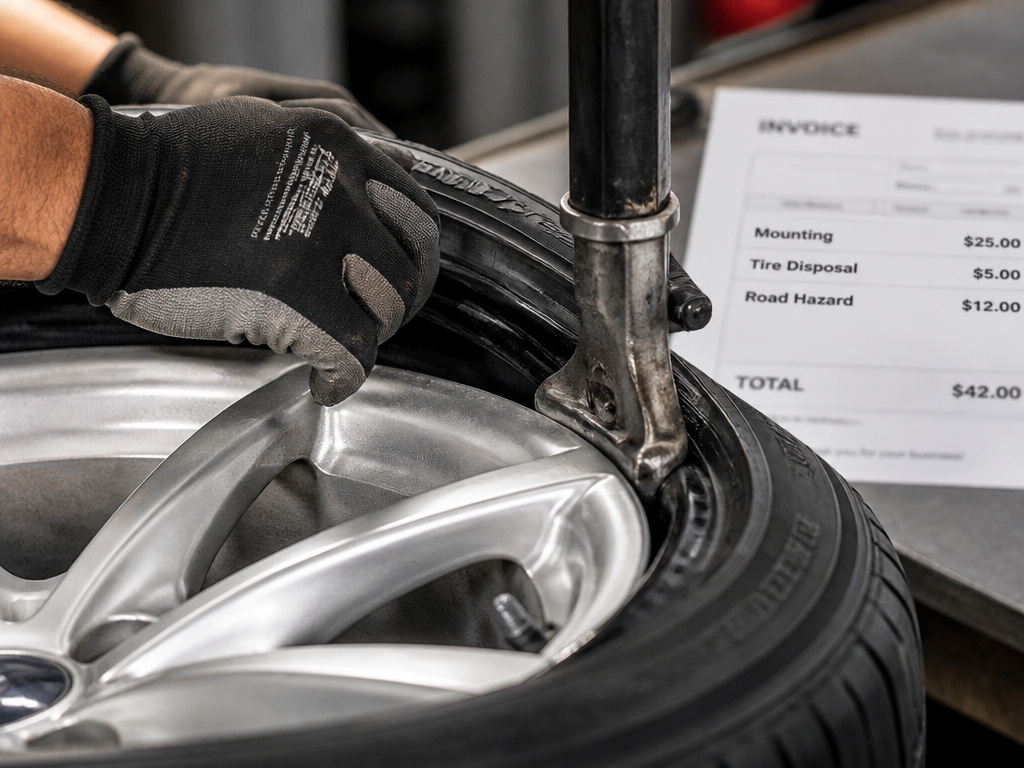
Marcus Torres expected to pay around $600 for four tires on his 2019 Camry in March of 2026. His final quote was $1,847. The tires were $189 each. The add-ons, mounting, balancing, a road hazard plan, disposal fees, valve stems, and an environmental charge, added 127% to the bill. His story, documented in the 2026 Price-Quotes Research Lab analysis, is the rule, not the exception.
Here are the fees that transform a tire price into a tire bill.
Mounting and Balancing ($28-$75 per tire): This is the labor to remove the old tire, seat the new one on the rim, and ensure it spins without vibration. Pricing is relatively consistent. A charge over $50 for a standard sedan tire is a red flag.
Road Hazard Protection ($12-$189 per tire): This optional warranty covers damage from potholes, nails, and curbs. It’s a prorated plan, typically covering 100% of replacement cost in the first year, then less over time.
When this goes sideways: Buying road hazard for all-terrain tires on a Jeep or 4Runner. These tires are built with reinforced sidewalls to resist the exact damage the plan covers. The additional protection is redundant.
The plan makes financial sense only for low-profile performance tires (35-series or lower) or if you drive in high-debris urban areas. If the fee exceeds 15% of the tire’s value, decline it.
Disposal / Environmental Fees ($0-$6.50 per tire): Tires are banned from landfills. This fee covers the cost to shred and process them. The national average is $3.25 per tire. It’s a small line item, but one that frequently appears on the final invoice without being included in the verbal quote. Always ask for an itemized “out-the-door” total upfront.
The Nitrogen Upsell ($10-$15 per tire): Politely decline. Air is already 78% nitrogen. The NHTSA’s research confirms the marginal benefit for fuel economy in a passenger vehicle is less than 1%, and that benefit vanishes the first time you top off with regular air from a gas station compressor.
Model-Specific Reality: Tesla, Ford, and Kia Don’t Guess
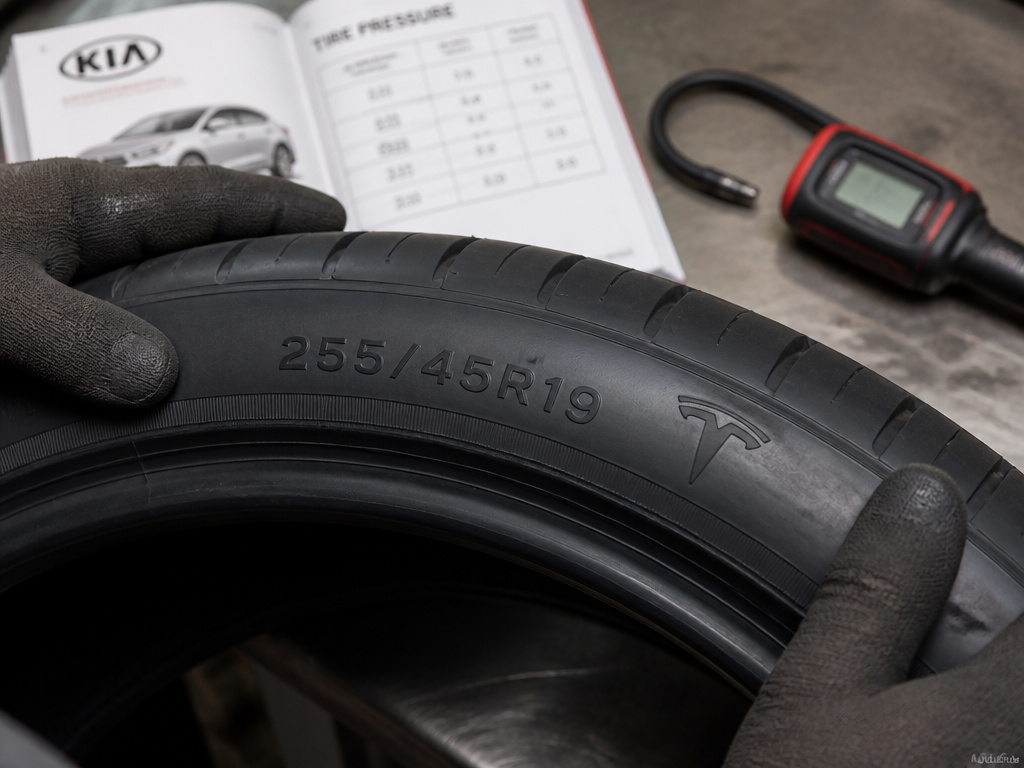
For many modern vehicles, especially EVs and those with advanced driver aids, “any tire that fits” is the wrong answer. OEMs specify exact replacements for a reason.
The Tesla Model Y service manual lists the Continental RX, size 255/45R19, with Tesla part number 1188213-00-B. It claims an EPA-estimated 10-mile range improvement over prior variants. The Model 3 manual details specific T-marked tires for each wheel size: the Michelin Primacy A/S for 18-inch wheels promises a 20-mile range improvement and better noise dampening. These are engineered matches for the car’s weight, regenerative braking behavior, and noise-frequency targets.
Ford’s stance is binary. Its manuals recommend replacing tires in pairs for two-wheel-drive vehicles, and all four for all-wheel-drive systems to avoid damaging the drivetrain. More critically, Ford states plainly: “In general, tires should be replaced after six years regardless of tread wear.” The rubber compounds degrade over time, becoming brittle and prone to failure.
This level of specificity extends to pressure. The Kia manual notes that for every mile above sea level, you should add 3.3 PSI to the recommended pressure. This isn’t generic advice; it’s a calculated adjustment for atmospheric pressure change. It underscores why a quality tire pressure gauge is a necessary tool, not an accessory.
When You Must Replace, Not Repair
The decision between a $25 plug and a $250 replacement isn’t always yours to make. Safety regulations and tire construction dictate the rules.
| Situation | Action | Why |
|---|---|---|
| Nail in tread, hole < 1/4″ | Repair | The tread’s steel belts allow for a proper patch/plug from the inside. |
| Any puncture in the sidewall | Replace | The sidewall flexes constantly; a repair cannot hold. |
| Tread depth at or below 2/32″ | Replace | This is the legal minimum in most states. |
| Visible cords or fabric | Replace Immediately | The tire’s structural integrity is compromised. |
| Bulge or bubble on sidewall | Replace Immediately | Internal damage has created a weak spot that can explode. |
The 2/32″ tread depth is a hard stop. The Toyo Tires safety manual states it plainly: “Tires must be replaced when tread is worn to 2/32” (1.6 mm).” Most experts, however, advise replacement at 4/32″ for significantly compromised wet-weather braking. Worn tires don’t just slide; they fail to evacuate water, leading to hydroplaning at highway speeds.
Age is the silent killer. Both Ford’s six-year and Toyo’s ten-year recommendations are based on rubber oxidation, which happens even to a spare tire never used. The sidewall cracks may be small, but they represent a direct path to catastrophic failure.
The Final Tally: How to Walk In Prepared
You now have the 2026 numbers, the OEM fine print, and the fee map. The final step is a strategy.
First, know your exact tire size from the door jamb. Get quotes from three shops, and demand the “out-the-door” price inclusive of all fees before you agree. Use the benchmark table to spot outliers. If a shop’s mid-range quote is more than 20% above the figures listed here, ask for a line-item justification.
Second, match the OEM spec where it matters. For a Tesla, that might mean the exact T-marked tire. For a truck, it means matching the Load Index and Speed Symbol in your manual. This is where understanding tire types, all-season versus all-terrain versus performance, pays off. A wrong choice, like using passenger car tires on a slide-in camper, voids warranties and risks your safety.
Third, bundle alignment with your purchase if you’re replacing two or more tires. An out-of-spec alignment will destroy your new cost of new tires investment in under 10,000 miles. The $100-$150 alignment fee protects the $800 tire investment.
Frequently Asked Questions
Why is there such a huge price range for one tire?
The price range, from under $100 to nearly $500, is driven by three factors: physical size (larger diameters cost more), performance technology (premium brands invest in compound and tread design), and vehicle class (truck and performance tires require more robust construction). A 22-inch low-profile tire uses more specialized materials and is produced in lower volumes than a mass-market 16-inch all-season tire.
Are cheap tires a false economy?
Not always. For a low-mileage driver on a secondary vehicle, a budget-tier tire can offer 70-80% of the performance at half the average tire price. The trade-off is typically in treadwear warranty and wet-weather grip. For daily drivers or families, the mid-range tier (Continental, Michelin, Bridgestone) represents the best value, blending longevity, safety, and noise comfort.
Do I need to replace all four tires at once?
For all-wheel-drive vehicles, yes. Mismatched tread depths can strain the drivetrain. For front- or rear-wheel drive, you can replace in pairs (always put the new tires on the rear axle for stability). The key is that the tires on each axle must match in size, type, and wear state. Never mix truck tires with passenger car tires on the same vehicle.
How can I avoid hidden fees?
Get a written, itemized estimate that includes every potential fee: tire cost, mounting/balancing, disposal, shop supplies, and tax. Ask “Is this the total out-the-door price if I decline additional services?” before authorizing work. Shops that hesitate or add surprise fees later are the ones to avoid.
Before You Go
One tire’s cost is a search for a single number that doesn’t exist. The real answer is a bracket defined by your car’s sticker, a set of unavoidable service charges, and a timeline written in tread depth and rubber age.
The power move is walking into any shop knowing the fair 2026 price for your size, recognizing the worthwhile upsells from the pure profit, and understanding that your vehicle’s manual likely already named the exact replacement part. Use that knowledge to get a clear, itemized quote.Anything less is just guessing.
