
Replacing 275/60R20 with 275/55R20 Tires: A Complete Guide
This post contains affiliate links. As an Amazon Associate, we earn from qualifying purchases.
You can replace 275/60R20 tires with 275/55R20 tires, but it depends on three things: your vehicle’s specific recall status, its suspension type, and your willingness to recalibrate the speedometer and tire pressure monitoring system (TPMS). The 275/55R20 is one inch shorter, which can cause rubbing on some air-suspension trucks and triggers a documented federal safety recall if installed on the wrong Chevrolet Colorado trim.
That recall is where the simple size swap turns into a legality check. General Motors issued recall N242444030 because some 2024 Colorados shipped with the wrong tires, violating federal safety standards. Installing a 275/55R20 on a Trail Boss trim that calls for a 275/60R20 fails the inspection. The reverse is also true for other trims. This isn’t hypothetical—it’s a dated, specific mandate with a paper trail.
What follows is a breakdown of the physical swap, the legal and mechanical landmines hidden in the specs, and the step-by-step process to verify your truck won’t fail an inspection or chew up its own fenders. You’ll have the numbers, the manufacturer bulletins, and the real-world forum reports that show where the swap works and where it grenades a perfectly good Saturday.
Key Takeaways
- The 275/55R20 is 1.08 inches shorter in diameter than the 275/60R20, a 3.4% difference that directly affects your speedometer accuracy and ground clearance.
- A 2024 Chevrolet Colorado recall (N242444030) makes this swap illegal on certain trims, as mixing the sizes violates FMVSS No. 110 and No. 138.
- On vehicles with factory air suspension, the taller 275/60R20 can rub the fender liner in the lowered “entry/exit” mode, while the shorter 275/55R20 usually clears it.
- Swapping between P-metric and LT-metric tires of the same size requires a pressure adjustment—LT tires need ~15 PSI more to carry the same load, per Nitto’s technical bulletin.
- Never mix these sizes front-to-rear; it disables tire rotation and can trigger fault codes in the powertrain control module (PCM).
The 275/55R20 vs. 275/60R20 Spec Sheet
Both tires share a 275mm section width and mount on a 20-inch wheel. The only difference is the second number: the aspect ratio. This is the sidewall height expressed as a percentage of the width. A 55 aspect ratio means the sidewall is 55% of 275mm; a 60 aspect ratio is 60% of 275mm. That small percentage creates a measurable gap in real-world performance.
The 275/55R20 tire has a diameter of 31.91 inches and a sidewall height of 5.95 inches. The 275/60R20 measures 32.99 inches in diameter with a 6.5-inch sidewall. This 1.08-inch difference in overall height changes the tire’s revolutions per mile by 3.3%, which is enough to throw a speedometer off by roughly 2 mph at 60 mph.
Here is how the numbers break down side-by-side:
| Specification | 275/55R20 | 275/60R20 | Difference |
|---|---|---|---|
| Overall Diameter | 31.91 inches (810.5 mm) | 32.99 inches (838 mm) | +1.08 inches (3.4%) |
| Sidewall Height | 5.95 inches (151.25 mm) | 6.5 inches (165 mm) | +0.55 inches (9.1%) |
| Circumference | 100.25 inches | 103.65 inches | +3.4 inches (3.4%) |
| Revs per Mile | 632.04 | 611.3 | -20.74 revs (-3.3%) |
| Width | 10.83 inches (275 mm) | 10.83 inches (275 mm) | None |
These aren’t abstract figures. They dictate what you’ll feel: the shorter 275/55R20 will make the truck sit slightly lower, respond quicker to steering inputs, and read a faster speed on the dash than you’re actually traveling. The taller 275/60R20 adds ground clearance, soaks up bumps better, and will make your speedometer read slow.
Why a Simple Size Swap Isn’t Just About Fitment
The physical dimensions are only half the story. Federal regulations and manufacturer load ratings form the other half, and they carry the weight of a recall.
In 2024, General Motors issued recall N242444030 for certain Chevrolet Colorado models. The cause: some trucks left the factory with 275/60R20 tires when their certification label specified 255/55R20, and vice-versa. This mismatch violates Federal Motor Vehicle Safety Standard (FMVSS) No. 110 for tire selection and No. 138 for TPMS accuracy. The corrective action is specific: if a Trail Boss trim has 275/60R20 tires, it passes. If it has 255/55R20, it fails and the tires must be replaced.
The part nobody mentions: This recall creates a legal precedent. Installing a 275/55R20 on a vehicle whose doorjamb sticker calls for a 275/60R20 is now a documented violation of a federal safety standard. It may not trigger a check-engine light, but it could fail a state safety inspection or complicate warranty and liability claims after an accident. Check your vehicle’s tire information placard before you buy.
Common mistake: Assuming all 275-width 20-inch tires are interchangeable. The load index and speed rating must also match or exceed the original equipment spec, regardless of the physical fit.
The second layer is load capacity. Your original tires are either P-metric (Passenger) or LT-metric (Light Truck). The Nitto Tire technical bulletin NTSD-12-011 states a hard rule: any replacement tire must offer equal or higher load capacity. It then details the critical nuance: LT-metric tires require higher inflation pressures to carry the same load as a P-metric tire.
For example, a P265/75R16 with a max load of 2,601 lbs at 35 PSI requires an LT265/75R16 Load Range C to be inflated to 50 PSI to carry the same weight. If you replace a P-metric 275/60R20 with an LT-metric 275/55R20 and keep the pressure at the doorjamb spec, you are under-inflating the tire relative to its load requirement. The bulletin’s conclusion is blunt: under-inflation leads to excessive heat buildup and tire failure.
The 275/55R20 vs. 275/60R20: Which One Wins for Your Use Case?
This isn’t a “depends on your needs” cop-out. Each size has a clear best application, defined by the trade-offs in the spec sheet.
Pick the 275/60R20 if you prioritize ride comfort and off-road clearance. The extra 0.55 inches of sidewall acts as a longer suspension travel, absorbing sharp impacts from potholes or rocky trails. The taller diameter also adds about half an inch of ground clearance, which can be the difference between scraping and clearing a rock. The cost is a slight reduction in steering precision and a minor fuel economy penalty from increased rolling resistance.
Pick the 275/55R20 if your driving is 90% pavement and you want sharper handling. The shorter, stiffer sidewall flexes less during cornering, translating steering input to contact patch movement more directly. You get a more connected feel. The smaller diameter also reduces rotational mass, which can marginally improve acceleration and fuel efficiency. The trade-off is a firmer, busier ride on broken pavement and less protection for the wheel rim from curbs.
Where this goes sideways: Installing 275/60R20 tires on a vehicle with factory air suspension. Owners of 5th Gen Rams report slight rubbing on the fender liner when the system lowers the truck into “entry/exit” mode. The 275/55R20 typically clears without issue on the same truck.
What about mixing them? One forum user ran 275/60R20 on the rear axle and kept 275/55R20 on the front. A shop said it was fine, and mechanically, it won’t hurt a rear-wheel-drive system if the axle pairs match. But you sacrifice the ability to rotate tires, and your speedometer will be wrong for one set of wheels. More critically, a PCM update during a recall service can trigger fault codes if the tire circumference stored in the module doesn’t match any of the actual tires.
The Step-by-Step Safety Check Before You Swap
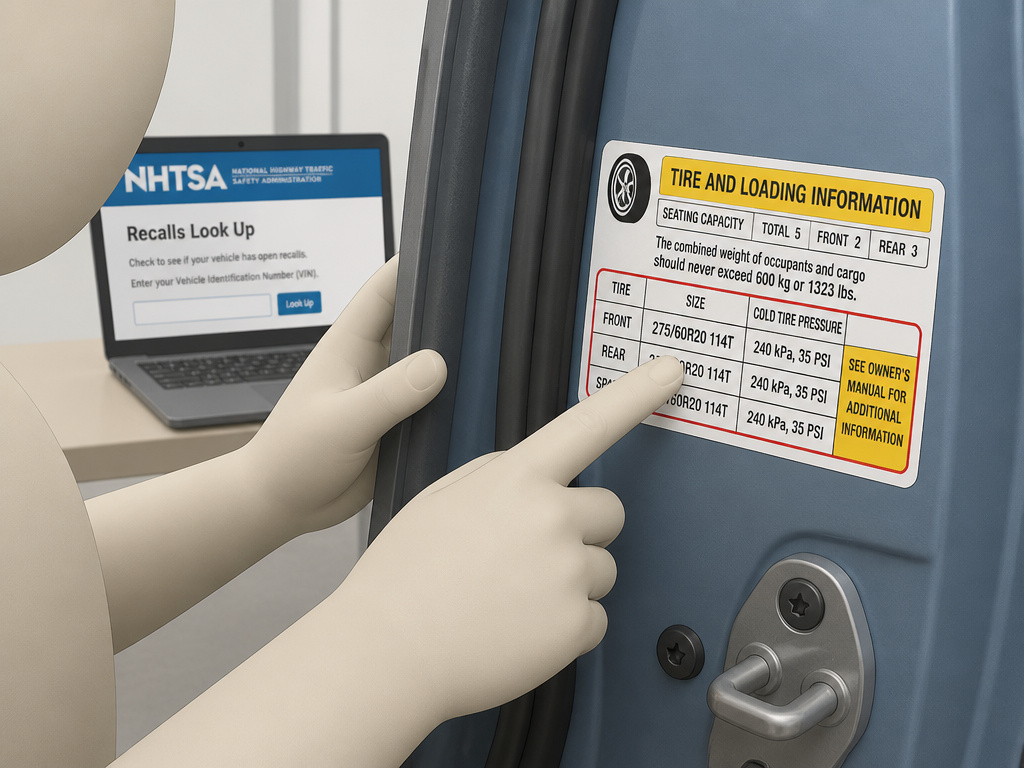
Replacing 275/60R20 with 275/55R20 tires is a four-step verification, not a one-step purchase.
- Check your doorjamb sticker and recall status. Find the Tire and Loading Information placard on the driver’s door jamb. Note the exact size, load index, and speed rating. Then, check for any open recalls on your vehicle using your VIN on the NHTSA website. If your truck is a 2024 Chevrolet Colorado, this step is non-negotiable.
- Identify your suspension type. Do you have factory air suspension? If so, test the full range of motion. Have someone cycle the suspension while you watch the space between the tire and the fender liner at full wheel lock. The 275/60R20 may rub; the 275/55R20 likely won’t.
- Match the load and construction type. Are you swapping P-metric for P-metric, or moving to LT-metric? If moving to LT, you must use the Tire and Rim Association load tables to find the new, higher inflation pressure needed to carry the original load. Write that new pressure down.
- Plan for the electronic fallout. Your speedometer will read about 2 mph faster than actual speed with the shorter 275/55R20s. You must decide if that’s acceptable. More importantly, the TPMS may trigger a warning because the rotational difference can be interpreted as a pressure loss. Many vehicles require a recalibration tool or a dealer visit to reprogram the TPMS module for the new tire circumference.
Skip step one, and you might install tires that are illegal for your specific trim. Skip step three, and you’ll under-inflate LT tires, which the Nitto bulletin says leads to heat fatigue and blowouts.
The Tools You’ll Need for a Successful Swap
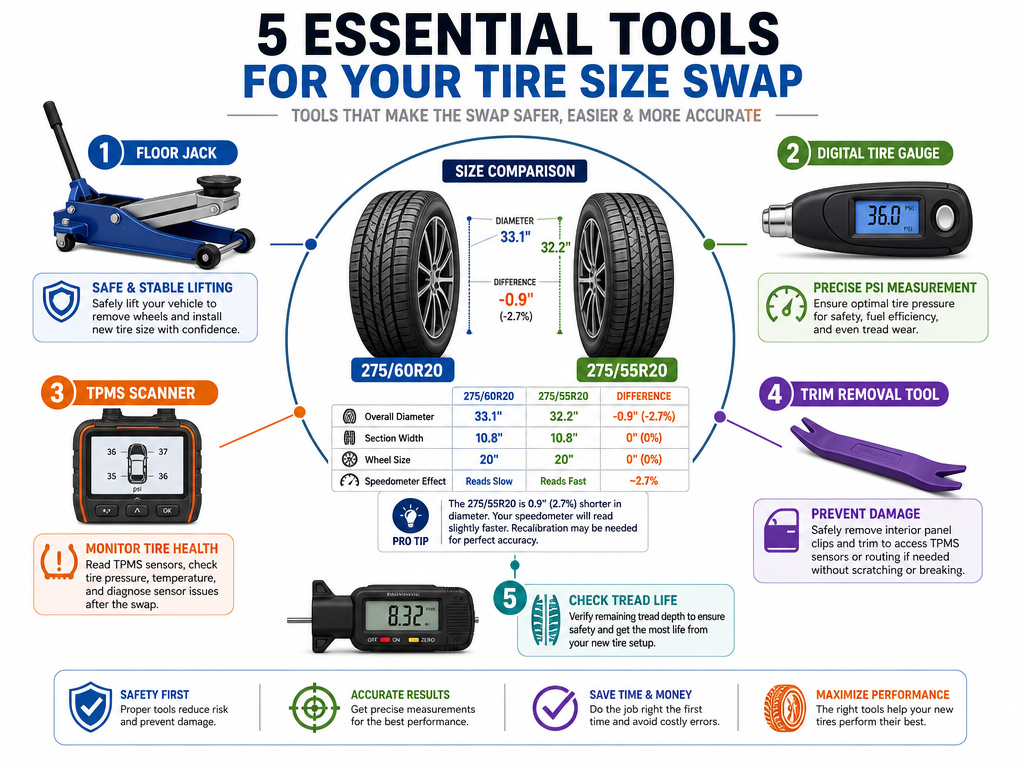
Gathering the right tools prevents a half-finished project and a trip to the dealer. You need more than a jack and a torque wrench.
- A quality low-profile floor jack and jack stands. The taller 275/60R20 tire gives you more clearance to slide a jack under the differential or crossmember.
- A digital tire pressure gauge that reads in 1 PSI increments. This is critical if you’re switching between P-metric and LT-metric tires, where a 5 PSI error can shift the load capacity by hundreds of pounds.
- A TPMS relearn tool or scanner. This is vehicle-specific. Some Fords and GMs need a magnet-based tool held near the valve stem; others require a professional scan tool to access the body control module. Check your owner’s manual.
- A trim removal tool. You’ll need this to gently pop off the fender liner clips if you have to check for clearance or address minor rubbing.
- A tread depth gauge. If you’re replacing only two tires, the new ones must have tread depth within 2/32nds of an inch of the remaining tires to avoid straining the differential.
Forgetting the TPMS tool is the most common hiccup. You’ll mount the new tires, lower the truck, and then have a persistent warning light on the dash because the truck doesn’t recognize the new sensors’ positions. The tool resets the system in five minutes.
Frequently Asked Questions
Will 275/55R20 tires affect my gas mileage?
Yes, but marginally. The smaller 275/55R20 diameter reduces rotational mass and rolling resistance slightly, which can lead to a minor improvement in fuel economy, perhaps 1-2%. However, the difference is often smaller than the variation caused by your driving habits or tire pressure.
Do I need to recalibrate my speedometer if I switch sizes?
Absolutely. The 3.3% difference in revolutions per mile means your speedometer will be off. With the shorter 275/55R20, your speedometer will read approximately 2 mph faster than your actual speed at 60 mph. Some vehicles allow recalibration through the infotainment system or a dealer scan tool; others require a dedicated programmer like FORScan or a third-party module.
Can I put 275/55R20 tires on the front and 275/60R20 on the back?
You can, but you shouldn’t. This mix disables tire rotation, creating uneven wear. It also confuses stability control systems that rely on comparing wheel speeds between axles. Most critically, it guarantees your speedometer will be inaccurate for one axle, and a future software update could trigger diagnostic trouble codes.
Are all-terrain tires available in both 275/55R20 and 275/60R20?
Yes. Popular all-terrain models like the BFGoodrich KO2, Toyo Open Country A/T III, and Falken Wildpeak A/T3W are commonly produced in both sizes. The choice between sizes then comes down to your preference for sidewall height and the specific clearance checks outlined above.
What is the cost difference between the two sizes?
The price difference is typically brand- and model-dependent, not size-dependent. A premium all-terrain tire in 275/55R20 will cost roughly the same as the same model in 275/60R20. The deciding financial factor is more often the need for new TPMS sensors, mounting, balancing, and potential alignment.
Before You Go
Swapping 275/60R20 for 275/55R20 tires is a technical decision with physical, electronic, and legal layers. The shorter tire sharpens handling and fits air-suspension trucks better, but it also changes your speedometer reading and ground clearance. The taller tire smooths the ride and adds clearance, but it can rub on some setups.
The non-negotiable rules are drawn from manufacturer bulletins and a federal recall: check your doorjamb sticker first, never mix P-metric and LT-metric pressures blindly, and always recalibrate your TPMS. If your truck is a 2024 Chevrolet Colorado, verify it’s not part of recall N242444030 before you spend a dime. This isn’t scare talk. It’s the difference between a straightforward upgrade and a violation that could leave you stranded.
