
Turning the Steering Wheel When the Car is Off: Is It Safe?
This post contains affiliate links. As an Amazon Associate, we earn from qualifying purchases.
You can turn the steering wheel when the car is off, but doing so engages the anti-theft steering column lock. This puts pressure between a lock pin and a lock plate inside the column, which is why your ignition key can jam. A 2006 recall on 67,104 Nissan Muranos proved this lock could engage at speeds above zero if the wheel turned more than 60 degrees with the ignition off.
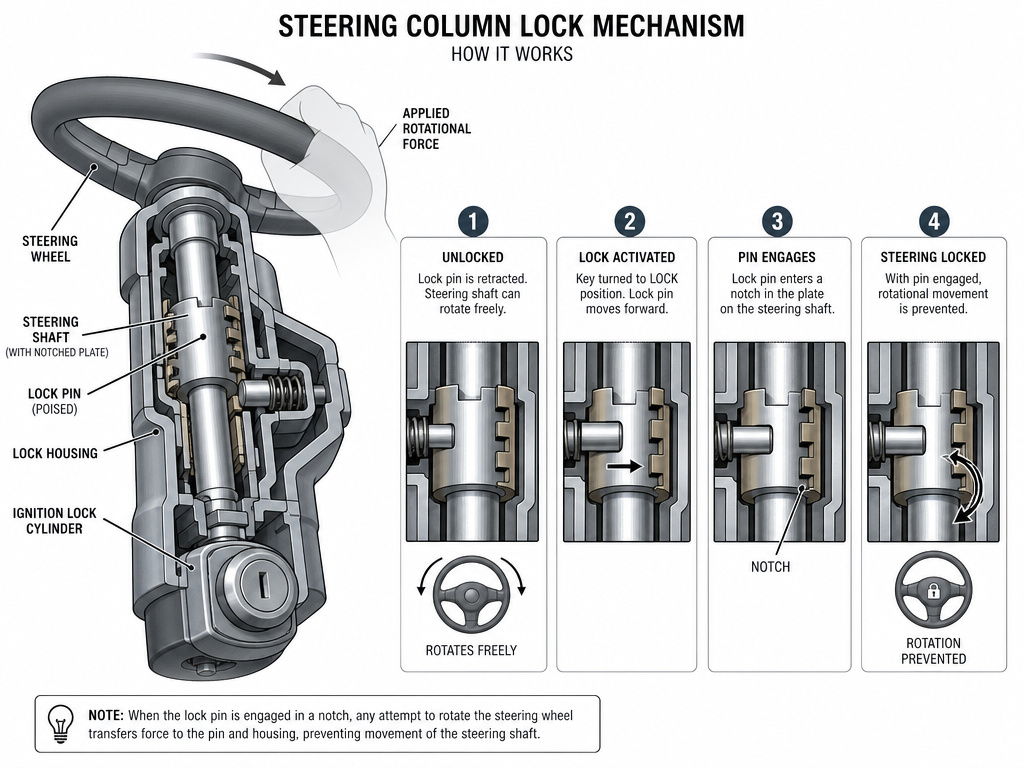
That lock pin is the whole game. It’s a hardened steel rod that slides into a notched plate the moment you remove the key or shut down a push-button system. Turn the wheel afterward, and you’re grinding metal on metal. The official fix from a 2018 NHTSA bulletin is to jiggle the wheel while turning the key.
What follows is the physics of that pin, the federal safety rule it exists to satisfy, and the exact model years where that safety system failed. You’ll learn how to unstick a locked wheel, why some cars don’t have this feature, and what that faint “click” from your column really means.
Key Takeaways
- Turning the wheel with the ignition off engages a steel lock pin against a notched plate inside the column, which can jam the ignition key.
- Federal safety standard FMVSS No. 114 mandates this lock to prevent theft by immobilizing steering when the key is removed.
- A 2006 recall affected 2005-2006 Nissan Muranos with Intelligent Key because the steering could lock if turned >60 degrees with the ignition off, even if not in Park.
- To free a jammed ignition, gently rotate the steering wheel left or right while simultaneously turning the key, this relieves pin pressure.
- Modern push-button start systems have electronic steering locks that engage only after you exit the vehicle, but the mechanical principle is the same.
The Locking Pin and Plate: How a Standard Column Lock Works
Look at the base of your steering column. Behind the plastic shroud sits a lock housing assembly. Inside it, a spring-loaded steel pin rests against a slotted plate fixed to the steering shaft. When you turn the ignition to “off” and remove the key, a cam or solenoid releases that pin. If the slots on the plate align, the pin drops in. If they don’t, because the wheels are turned, the pin presses against the plate’s solid surface.
Now turn the wheel. You force the plate to rotate against the pressure of that pin. The pin grinds along the plate until it finds the next slot and snaps in with an audible click. That’s the steering lock engaging. The problem is the friction this creates. That same friction is what makes your key impossible to turn the next time you try to start the car.
NHTSA technical service bulletin PIT5233D, published in 2018, diagnoses this exact issue for GM trucks and SUVs. It states: “If the steering wheel is turned with the ignition key in the off position, this may cause excessive pressure between the lock plate and lock pin. The next time the ignition key is rotated from the ‘Off’ to the ‘On’ position, it may be difficult or unable to be rotated.”
The bulletin’s recommended fix is the universal procedure: rotate the steering wheel in either direction while turning the key to relieve the binding pressure. This isn’t a repair. It’s the designed mechanical reset.
| Component | What It Is | What Happens When It Binds |
|---|---|---|
| Lock Pin | Hardened steel rod, spring-loaded | Jams against the lock plate, preventing key rotation. |
| Lock Plate | Notched disc attached to steering shaft | The pin catches in a notch to lock the wheel; misalignment causes binding. |
| Ignition Cylinder Cam | Links the key cylinder to the pin | Torque from the stuck pin transfers to the key cylinder, freezing it. |
| Anti-Theft Bolts | One-time-use shear bolts on the housing | Prevent easy disassembly of the lock assembly; must be drilled out for service. |
The Federal Rule Behind the Click: FMVSS No. 114
That locking mechanism isn’t optional. It’s mandated by Federal Motor Vehicle Safety Standard No. 114 – Theft Protection. The rule is simple: when the key is removed, the system must prevent both normal engine activation and either steering or forward movement of the vehicle. Most manufacturers choose to lock the steering. It’s the most effective mechanical way to satisfy the “or both” clause.
The standard has a critical timing clause. The lock should only engage after the transmission is in Park. This prevents the scenario where a driver shuts off the engine while coasting and suddenly finds the steering locked. Compliance is verified by regulators, and failures result in recalls. This is where the physical design of specific steering wheel locks meets federal law.
Where this goes sideways: Forgetting the Park-before-Lock sequence. If the lock mechanism wears or has a design flaw, it can engage before the transmission is secured. The consequence is a locked steering column while the vehicle is still in motion, a failure mode documented in a specific recall.
The Recall That Proved the Stakes: 2005-2006 Nissan Murano
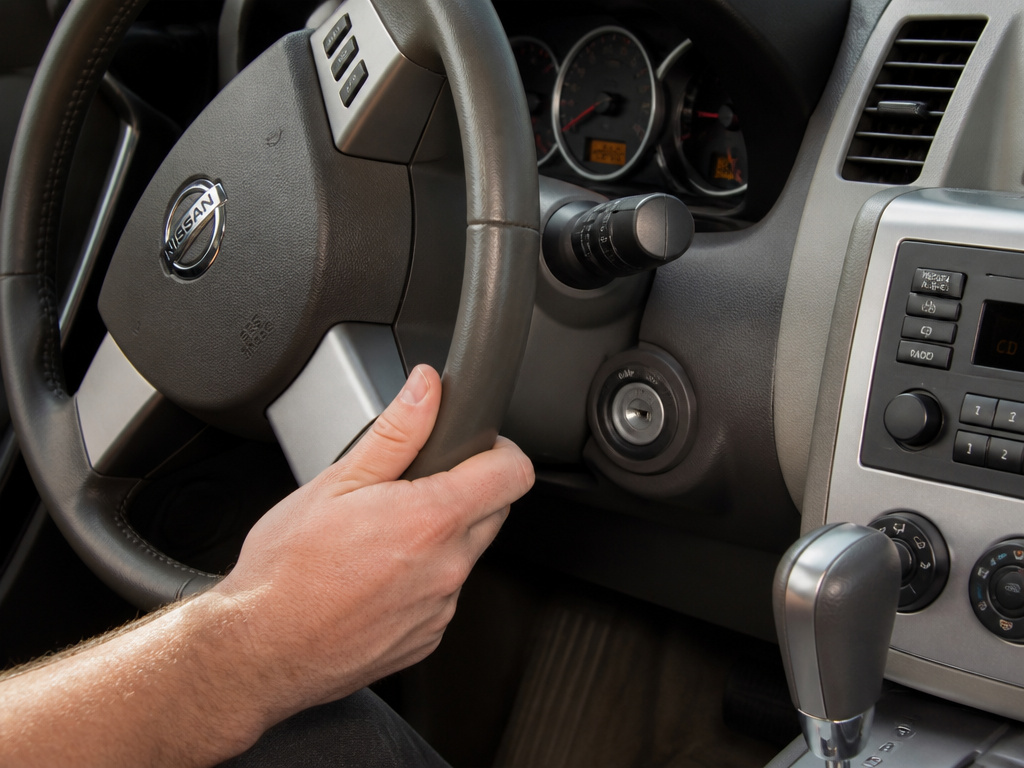
In 2006, Nissan issued Voluntary Recall Campaign R0614 (NHTSA #06V-401) for approximately 67,104 2005-2006 Murano vehicles equipped with the Intelligent Key system. The defect was a violation of FMVSS No. 114. The steering wheel lock assembly could engage with the ignition knob in the “OFF” position even if the transmission lever was not in Park, provided the steering wheel was turned more than 60 degrees.
The recall owner’s letter stated the risk plainly: “If you shut off your engine while the vehicle is in motion, and turn your steering wheel at least 60 degrees, the steering wheel lock could engage. This could result in loss of control of the vehicle and a crash.” The repair involved inspecting and, if necessary, replacing the entire steering wheel lock assembly, a 2.5-hour job that included installing new anti-theft bolts.
This incident is the non-commodity proof. It’s not a theoretical “could happen.” It’s a documented failure in a specific model year range (VINs provided in the recall) that triggered a federal safety action. It underscores why the lock’s engagement sequence is a safety feature, not just a theft deterrent.
Push-Button Start and Electronic Steering Locks
Modern keyless systems change the user experience, not the core requirement. Vehicles with push-button start use an Electronic Steering Column Lock (ESCL). When you park and press the engine stop button, the ESCL doesn’t engage immediately. It typically waits for a door to be opened or the key fob to leave the proximity zone. This is why you can often turn the wheel slightly after shutting off a modern car.
The Ford owner’s manual for such systems notes: “You may have to slightly rotate the steering wheel to assist unlocking it.” If the battery dies, most systems have a mechanical override, often a small access cover near the steering column to insert a physical key or tool. The Honda manual directs drivers to “Move the steering wheel left and right after pressing the ENGINE START/STOP” if the mode won’t change from VEHICLE OFF.
The principle remains: a lock pin must engage a plate to immobilize the steering. The computer just controls the timing.
How to Fix a Jammed Ignition Key (The Right Way)
Your key won’t turn. Don’t force it. Forcing a key can shear the wafer tumblers inside the cylinder, requiring a costly replacement. Here is the correct sequence, grounded in the NHTSA bulletin.
- Ensure the transmission is in Park (automatic) or gear (manual). This is the first check. An out-of-Park position can mechanically block the key in some models.
- Firmly apply the brake pedal. Some shift interlock systems require brake pedal input to release the key cylinder.
- Gently rotate the steering wheel. Try turning it left and right. You’ll feel a point of higher resistance, that’s the lock pin binding. Turn the wheel slightly past that point in the direction that gives the most slack.
- Simultaneously turn the ignition key. As you ease pressure on the wheel, apply steady turning force to the key toward the “On” or “Acc” position. The key should release.
If the wheel is under extreme tension, you might need to rock it more aggressively. The goal is to realign the lock plate’s slot with the pin. This is the same mechanical dance required when installing or adjusting an aftermarket steering wheel.
Common mistake: Using excessive force on the key only. This twists the ignition cylinder cam against the seized lock pin. The fix is always in the wheel, not the key.
When Your Car Doesn’t Have a Steering Lock
Some vehicles lack a traditional steering column lock. Certain older models, some race or track-focused cars, and vehicles where the steering wheel replacement process deleted the lock assembly are examples. How do they comply with FMVSS 114? They use an alternative: locking the transmission shift lever or the engine control unit itself.
If your car has no lock, you’ll notice the steering wheel turns freely with the key out. The theft protection comes from an electronic immobilizer that prevents the engine from starting without the correct key chip. This is why understanding your vehicle’s specific anti-theft devices is part of knowing its security profile.
Frequently Asked Questions
Why does my steering wheel lock when I park?
It’s your car’s primary anti-theft device engaging. When you remove the key or shut off a push-button system, a mechanism releases a lock pin that engages a plate on the steering shaft. This physically prevents the wheels from turning, making the car very difficult to steer even if a thief manages to start it.
Is it bad to turn the steering wheel when the car is off?
It’s not inherently damaging, but it’s mechanically stressful. Each time you do it, you’re grinding the lock pin against the lock plate. Over years, this can wear the pin and plate, leading to a sloppy lock or increased likelihood of the key jamming. It’s better to straighten the wheels before turning off the ignition.
Can a steering wheel lock break?
Yes. The spring that retracts the lock pin can fail, leaving it permanently engaged or disengaged. The pin itself can wear or shear. This is a security-critical component. If your wheel stops locking or permanently locks, it requires professional service, often involving drilling out security bolts on the housing.
Do all cars have a steering wheel lock?
Almost all road-legal cars sold in the US since the early 1970s have one, as it’s the most straightforward way to comply with FMVSS 114. Some modern high-end cars use only an electronic immobilizer, and some modified or vintage vehicles may have had the lock removed, but this is non-standard.
The Bottom Line
You can turn the wheel with the car off, but you’re fighting a hardened steel pin designed to stop thieves. That faint click is a federal safety standard engaging. The 2005-2006 Nissan Murano recall is the case study in what happens when that engagement sequence fails, it’s a physical safety system with real consequences.
For daily driving, straighten your wheels before you shut down. If your key jams, move the wheel, not the key. And if you’re adding security, remember that a built-in steering column lock is your first line of defense, which is why many owners add a visible physical anti-theft device like a top-rated steering wheel lock as a deterrent. The mechanism is simple, but its job isn’t. It stands between your parked car and a roll down the street.
