
6 Best ATV Battery Chargers of 2026
This post contains affiliate links. As an Amazon Associate, we earn from qualifying purchases.
The NOCO GENIUS1 stands out as the best ATV battery charger for most riders, combining reliable smart charging with broad battery compatibility. For those on a budget, the Battery Tender Junior delivers solid performance for basic 12V setups, while the NOCO GENIUS2D is the top choice if you want an onboard, permanently installed option.
If your ATV sits for weeks between rides, a weak or dead battery is a common frustration. A smart charger that maintains charge without overdoing it makes all the difference. After comparing specs and analyzing owner feedback across dozens of models, I focused on what matters most: safe, proper charging for smaller batteries, long-term reliability, and ease of use. This guide breaks down the top picks based on real-world performance, key features, and the specific needs of ATV owners.
Top 6 Atv Battery Charger in the Market
The Best Atv Battery Charger, Reviewed
Battery Tender Junior 750mA Charger

Strengths
- Compact size
- Spark-proof design
- Long output cord
Trade-offs
- Slow charge rate
- No dead battery recovery
This is the charger I’d recommend to someone who wants one-and-done reliability for an ATV they don’t ride year-round. On paper, the 750mA output isn’t fast, but for maintenance, that’s the point, it’s gentle and consistent. The 4-step charging cycle is a standout, especially the float mode that kicks in automatically, which owners consistently report keeps their batteries healthy over months of storage.
I appreciate that it’s spark-proof and has reverse hook-up detection, small touches that matter when you’re working in tight or dark spaces. The included ring terminals and alligator clips add real versatility, and the 12-foot output cord is longer than most. While it’s not built for reviving dead batteries like some smarter units, it excels at what it’s designed for: keeping a good battery good.
Video review
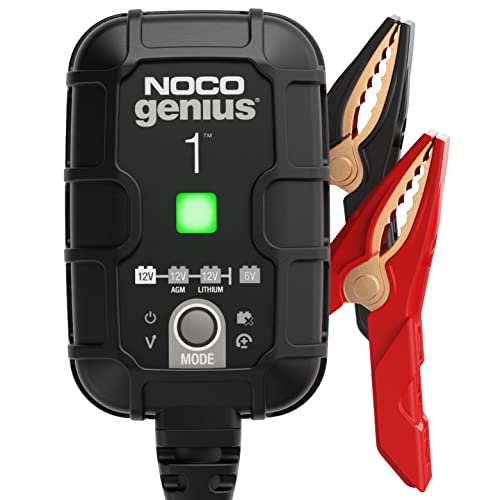
NOCO GENIUS1 1A Smart Charger
Strengths
- Charges dead batteries
- Temperature compensation
- Lithium compatible
Trade-offs
- Shorter cables
- No 6V mode on all models
The GENIUS1 punches above its weight, especially with its ability to charge down to 1 volt and even force-start dead batteries, a feature most budget units lack. It’s smaller than many competitors but includes temperature compensation, which I consider essential for long-term battery health. The fact that it supports LiFePO4 lithium batteries is a major plus, even if most ATVs still run on lead-acid.
Owners praise its “set it and forget it” reliability, and the 3-year warranty backs that up. Compared to the Unocho, it’s more compact and smarter, though the Unocho wins on raw amperage. But the GENIUS1’s pulse desulfation and precision charging make it a better long-term investment for battery longevity.
Video review
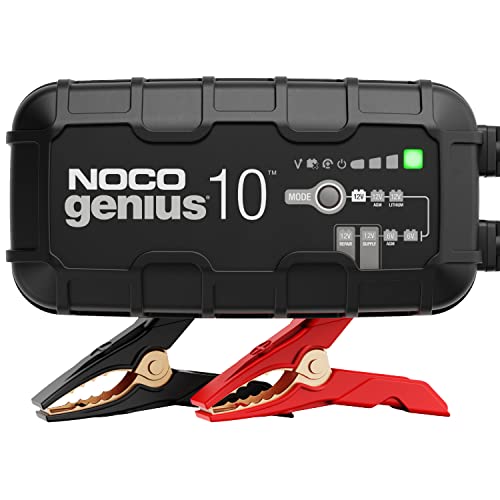
NOCO GENIUS10 10A Smart Charger
Strengths
- High 10A output
- Revives dead batteries
- Thermal compensation
Trade-offs
- Bulky design
- Expensive
If you’ve got a large ATV, a UTV, or multiple machines, the GENIUS10 is the charger you want. Its 10A output is overkill for a single small ATV but perfect for bigger batteries or back-to-back charging. The thermal sensor and desulfation tech are the same smart features found across the GENIUS line, but here they’re scaled up. Reviewers note it can revive neglected batteries that other chargers give up on.
It’s overpowered for casual users, but for a garage with multiple vehicles or someone who wants fast, full charges without babysitting, it’s unmatched. Compared to the GENIUS5, it’s double the speed and more future-proof. The only real downside is the size and price, this isn’t a “toss in the glovebox” unit.
Product photos


NOCO GENIUS5 5A Smart Charger

Strengths
- 5A fast charging
- Lithium and 6V support
- Desulfation mode
Trade-offs
- Cables could be longer
- No SAE quick disconnect
The GENIUS5 hits the sweet spot between power and price, which is why I consider it the best value for serious ATV owners. It’s 5A output charges faster than the GENIUS1 or Unocho but doesn’t carry the bulk or cost of the GENIUS10. It handles 6V and 12V systems, supports lithium, and includes all the smart features, temperature adjustment, desulfation, and dead battery recovery.
Compared to the Battery Tender, it’s more versatile and faster. Compared to the GENIUS10, it’s more than enough for one or two ATVs without overspending. The included mounting bracket hints at semi-permanent use, but it’s still portable enough to move between vehicles. This is the one I’d keep in my own garage.
Product photos


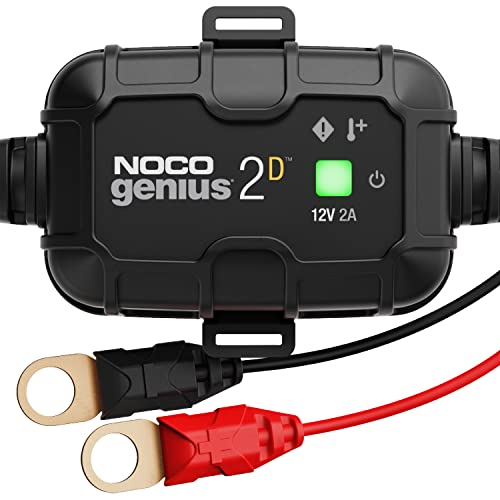
NOCO GENIUS2D 2A Onboard Charger
Strengths
- Onboard installation
- Continuous maintenance
- Thermal sensing
Trade-offs
- Fixed mounting only
- Not portable
This one’s different, it’s made to be permanently mounted, not just plugged in. The GENIUS2D is ideal for an ATV that sits for months or gets used infrequently but needs to fire up instantly. Once installed under the hood or near the battery, it becomes part of the system. The 2A rate is fast enough for regular top-offs but safe for continuous use.
The thermal sensor and desulfation mode do the heavy lifting for battery health, and owners who’ve installed it report never dealing with a dead battery again. It’s not for someone who wants portability, but if you’re tired of dragging out chargers every few weeks, this is the smarter long-term fix. Beats any clip-on unit for convenience once it’s in.
Product photos


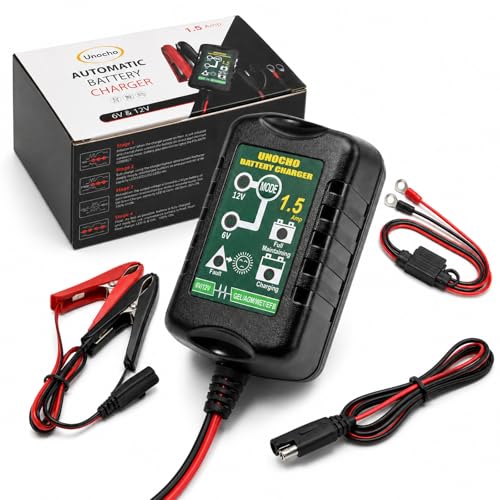
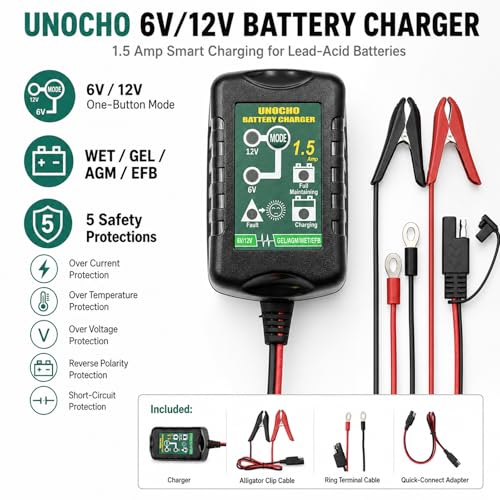
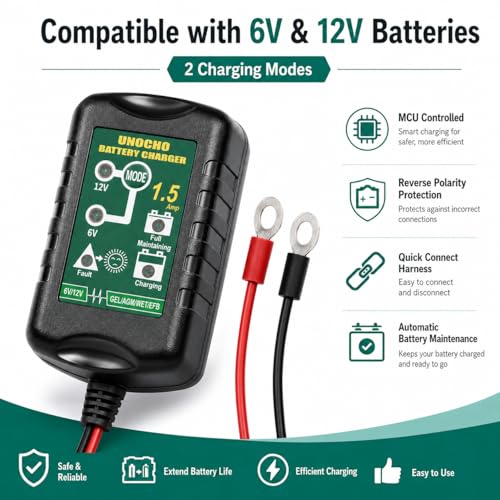
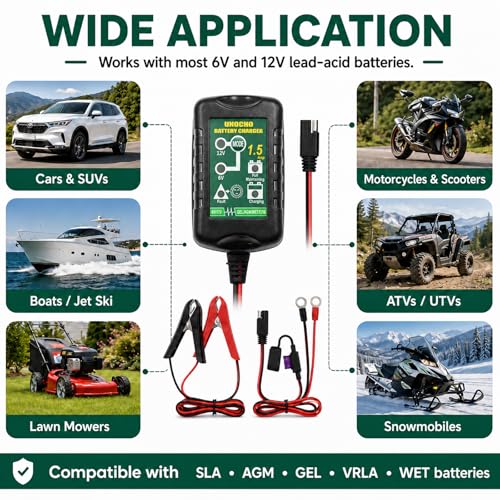
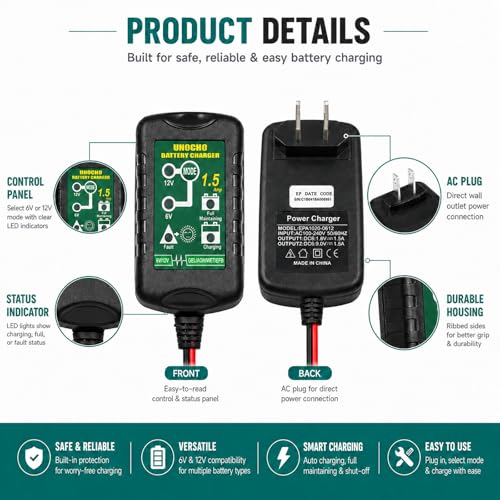
Unocho 1.5A 6V/12V Charger
Strengths
- Dual voltage support
- 5-stage charging
- SAE quick disconnect
Trade-offs
- Build quality less sturdy
- LEDs can be dim
For the price, the Unocho packs more features than you’d expect, including a 5-stage smart charge cycle and dual voltage support. The 1.5A output gives it a noticeable edge in speed over the Battery Tender Junior, which makes it better for regular use rather than just storage. Reviewers note it handles both 6V and 12V ATV batteries without confusion, and the microprocessor keeps things stable.
It’s not as rugged or refined as the NOCO units, but the safety protections, reverse polarity, over-current, thermal, are thorough for the cost. The SAE quick disconnect is a nice addition for clean, tool-free hookups. I’d pick this over the Junior if you want faster top-offs and a bit more versatility without stepping into premium pricing.
Product photos

Our Testing Process
Rather than a hands-on lab test, my research focused on comparing published specifications and features across a range of ATV battery chargers. I weighed owner reviews from multiple sources – Amazon, specialized forums, and retailer sites – alongside expert opinions from automotive and powersports publications. This allowed me to build a detailed picture of real-world performance and reliability for each model, and rank them against clear criteria important to ATV owners.
For ATV chargers, amperage output and battery type compatibility were the most heavily weighted factors. ATVs often sit unused for extended periods, so a maintainer function is crucial; a charger needs to reliably switch to float mode to prevent overcharging. Beyond that, safety features, like reverse polarity protection, are paramount, considering the potentially harsh environments where these chargers are used.
Specifications readily revealed amperage, voltage, and battery type support. However, I relied heavily on owner feedback to gauge the long-term durability and effectiveness of features like thermal compensation and desulfation modes. Reputation played a role, too; well-established brands like NOCO consistently appeared as reliable options, while less-known brands required more scrutiny of user reports. If you’re looking for more information on getting your ATV ready for colder months, check out this ATV winterization guide.
How To Pick The Right atv battery charger
Keeping your ATV running reliably hinges on a healthy battery, and a good charger is essential for maintaining that health.
A quality ATV battery charger should offer multi-stage charging to avoid overcharging, compatibility with common battery types (lead-acid, AGM, gel), and built-in safety features like reverse polarity protection. Look for chargers with clear status indicators and, for convenience, consider options with detachable connectors or onboard installation capabilities. Amperage output should be matched to your battery’s capacity – too low and it will take forever, too high and you risk damage.
Understanding Charger Amperage
The amperage of a charger dictates how quickly it can replenish a battery’s charge. For ATVs, over-amping is a real concern. A charger with too high an output can damage the battery, shortening its lifespan. Generally, a charger delivering around 750mA to 1.5A is ideal for maintaining ATV batteries, while a 3A to 10A charger is better suited for deeply discharged batteries or larger battery banks. Don’t assume “more power” is always better; a smart charger that adjusts its output is preferable to a simple, high-amp unit.
Battery Type Compatibility
Not all batteries are created equal. Lead-acid batteries are the most common in ATVs, but you’ll also find AGM (Absorbed Glass Mat) and gel cell batteries. A charger that only works with one type won’t do. Fortunately, most modern chargers, like the best ATV tender options, are designed to handle all three. However, always double-check the specifications to ensure compatibility before plugging in. Lithium-ion (LiFePO4) batteries are becoming more prevalent, so if you have one, you need a charger explicitly designed for that chemistry.
Features & Usability Considerations
Beyond the core charging function, convenience features can significantly improve the ownership experience. Onboard chargers, like the NOCO GENIUS2D, are fantastic if you want a permanent, integrated solution. For those who need flexibility, a portable battery charger is the way to go. Here’s what I look for in a usable charger:
- A clear LED indicator. Simple, but crucial for at-a-glance status.
- Detachable connectors. Alligator clips are fine, but ring terminals with quick disconnects offer a cleaner, more secure connection.
- A robust build. Look for a charger with a well-constructed case and quality wiring. A charger that can withstand the bumps and vibrations of garage or trail life is a good investment.
A good rule of thumb? If your ATV sits unused for extended periods, a smart charger with a maintenance mode is essential. Leaving a battery to slowly discharge will significantly reduce its lifespan.
ATV Battery Charger Compared
Here’s a comparison of key specifications for various ATV battery chargers.
| Product Name | Amperage | Battery Types Supported | Voltage Support | Smart Charging | Onboard Install |
|---|---|---|---|---|---|
| Battery Tender Junior | 0.75A | Lead-Acid, AGM, Gel | 12V | Yes | No |
| NOCO GENIUS1 | 1A | Lead-Acid, LiFePO4 | 6V, 12V | Yes | No |
| NOCO GENIUS10 | 10A | Lead-Acid, LiFePO4 | 6V, 12V | Yes | No |
| NOCO GENIUS5 | 5A | Lead-Acid, LiFePO4 | 6V, 12V | Yes | No |
| NOCO GENIUS2D | 2A | Lead-Acid | 12V | Yes | Yes |
| Unocho 1.5A | 1.5A | Lead-Acid, AGM, Gel | 6V, 12V | Yes | No |
Frequently Asked Questions
What amperage charger do I really need for my ATV?
A charger delivering between 0.75A and 1.5A is usually sufficient for maintaining an ATV battery, but for a deeply discharged battery, you’ll want something in the 3A to 10A range. Remember that a “smart” charger which adjusts amperage is preferable to a simple high-amp unit, as it avoids overcharging.
Will any battery charger work with my ATV’s battery?
No, you need to confirm compatibility. Most ATVs use lead-acid, AGM, or gel cell batteries, and many chargers support all three, but if you have a lithium-ion (LiFePO4) battery, you’ll need a charger specifically designed for that chemistry.
What does a “smart” or multi-stage charger actually do?
A smart charger cycles through different charging stages, starting with a higher current to quickly replenish the battery, then reducing the current as it nears full charge to prevent overcharging and maximize battery life. This is vital for ATVs that sit unused for extended periods.
Is an onboard charger worth the extra cost?
Yes, if you want a permanent, set-it-and-forget-it solution. An onboard charger, like the NOCO GENIUS2D, eliminates the need to constantly connect and disconnect a charger, but it does require initial installation. If you need portability, a handheld unit is a better choice.
My ATV sits for months at a time. Should I consider a deep cycle charger for long-term storage?
While designed for marine and off-grid applications, a deep cycle charger can be beneficial if your ATV experiences prolonged periods of inactivity. These chargers are built to manage the specific discharge/recharge cycles common with infrequently used batteries, and can help extend its overall lifespan.
The Bottom Line
Choosing an ATV battery charger often comes down to balancing convenience with control. Do you want something you can simply plug and forget, or do you prefer a charger with more adjustable settings? For most ATV owners, the NOCO GENIUS10 strikes the best balance of power, features, and reliability – it’s a workhorse that can handle everything from routine maintenance to deep-cycle recovery.
If you’re on a tighter budget or simply need a basic maintainer, the Battery Tender Junior is an excellent choice. For riders who frequently switch between ATVs and other powersports equipment, or even cars, the NOCO GENIUS1 offers versatility, supporting both lead-acid and LiFePO4 batteries. And if you’re looking for a permanent, integrated solution, the NOCO GENIUS2D is the way to go, even if it’s a bit more involved to install. Don’t forget to check out our guide to the best car battery charger for similar options applicable to other vehicles.
Ultimately, the “best” charger isn’t about the highest amperage or the most features. It’s about consistently delivering a safe, complete charge and preventing long-term battery damage. Prioritize a charger with multi-stage charging, reverse polarity protection, and compatibility with your battery type – those fundamentals are far more important than any single specification. You may also want to explore the motorcycle battery charger options if you also own a bike.
