
8 Best Analog Tire Gauges of 2026
This post contains affiliate links. As an Amazon Associate, we earn from qualifying purchases.
The JACO ElitePro 100 PSI stands out as the best analog tire gauge for its durable brass build, clear 2-inch dial, and lifetime warranty, while the AstroAI 0-60 PSI is a solid, ANSI-certified budget pick. If you want long-term reliability without breaking the bank, the Vondior ANSI 0-60 PSI also delivers strong accuracy and a 10-year warranty.
Most drivers don’t realize how much an inaccurate tire gauge can cost them, poor fuel economy, uneven tread wear, even safety risks on the road. A lot of cheap gauges fail within months or give inconsistent readings, which defeats the whole purpose.
After researching the market, comparing ANSI ratings, and reviewing owner feedback across forums and retail sites, I focused on gauges that combine proven accuracy, rugged construction, and real-world reliability. This guide cuts through the noise to highlight the ones that actually hold up over time.
Top 8 Analog Tire Gauges in the Market
The Best Analog Tire Gauges, Reviewed
ETENWOLF 0-100 PSI Tire Gauge

Strengths
- ANSI Grade A accuracy
- 100 PSI range
- Glow-in-dark dial
- 360-degree swivel
- Works in extreme temps
Trade-offs
- Slightly bulkier
- Hose could be longer
If you’re looking for the most balanced mix of range, accuracy, and usability, this ETENWOLF model makes a strong case for being the best overall pick. It’s ANSI B40.1 Grade A certified at ±1%, which is top-tier for analog gauges, and the 0-100 PSI range means it handles everything from motorcycles to large pickups.
Owners praise the 360-degree swivel chuck and the glow dial for making nighttime checks effortless. It’s built tough enough for regular use, and unlike some pencil gauges, it doesn’t feel disposable. Compared to the AstroAI 60 PSI version, this offers more range without sacrificing much in durability. For most users, this is the easy pick over single-use or low-range models.
Video review
JACO ElitePro 100 PSI Gauge
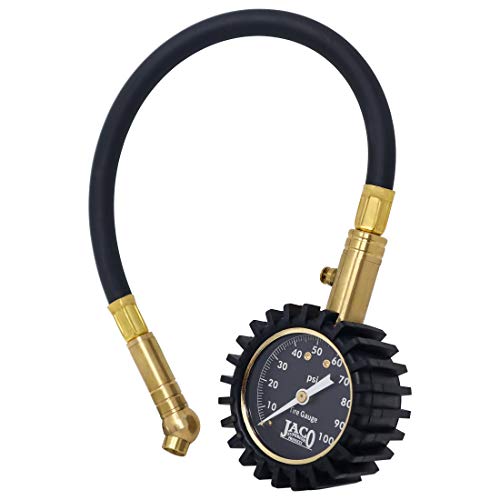
Strengths
- Solid brass build
- Locking glow dial
- 360-degree swivel chuck
- Lifetime warranty
- High pressure range
Trade-offs
- Heavier than most
- Higher price point
This gauge stands out in a sea of budget analogs by feeling like a tool a pro would actually use. The solid brass construction and shock-resistant guard aren’t just marketing fluff, owners consistently report it surviving drops and long-term garage use without losing accuracy. The 2-inch glow dial is a standout, locking readings in place until you press the reset button, which avoids the bounce issue common in cheaper gauges.
On paper, its ANSI certification at ±1.5% is solid, and the 100 PSI range covers everything from daily drivers to heavy-duty trucks. Paired with the 360-degree swivel chuck and HybridFlex hose, it delivers convenience and durability that most can’t match. I’d pick this over the AstroAI or Vondior models if you want something that feels like it’ll last decades.
Video review
AstroAI 0-60 PSI Glow Dial
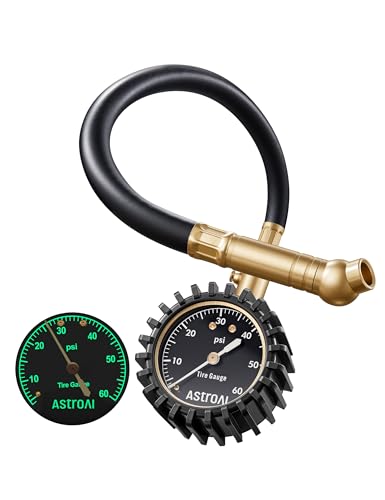
Strengths
- ANSI certified accuracy
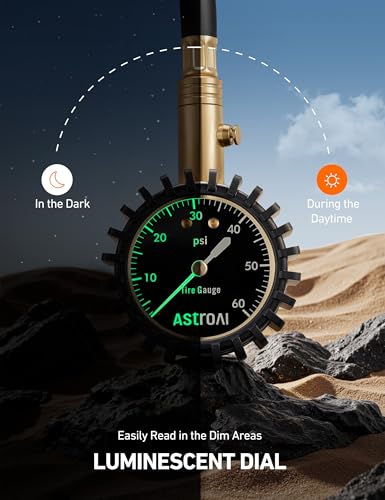
- Glow-in-dark dial
- Leak-proof swivel chuck
- Stainless steel build
- Universal Schrader fit
Trade-offs
- Max 60 PSI limit
- No locking needle
- Rubber shield can wear
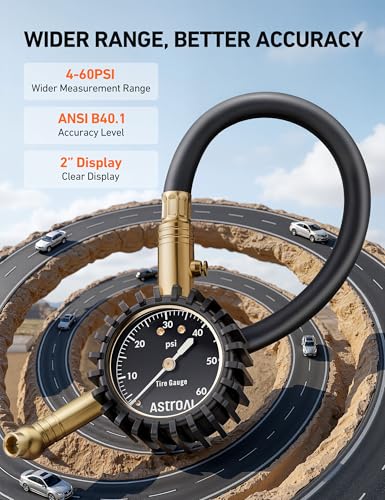
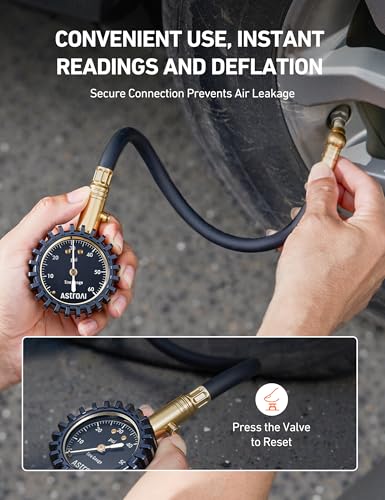
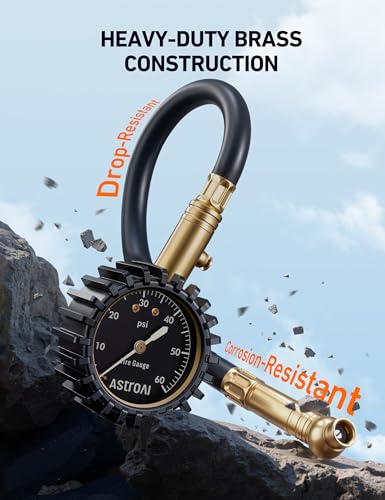
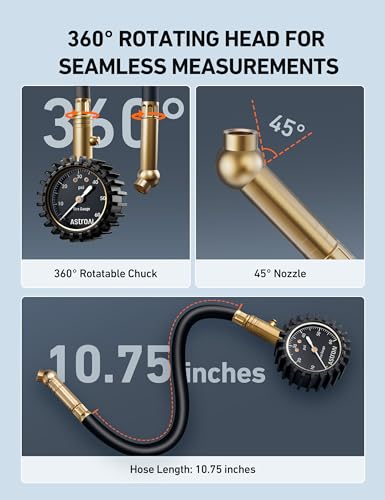
This AstroAI model hits a sweet spot between price and performance, which is why it’s often called the best value. It’s ANSI B40.1 certified with ±1% accuracy, stainless steel and brass construction, and a 2-inch glow dial that works well at night. The 360-degree swivel chuck seals tightly and prevents leaks, something multiple owners highlight.
It’s not as rugged as the JACO ElitePro, but for under $10, it offers serious specs. Compared to the Vondior, it feels more refined, and against the Slime, it’s clearly more accurate and durable. The lack of a higher PSI range keeps it from beating the ETENWOLF 100 PSI model, but for most cars and SUVs, it’s more than enough.
Product photos
ETENWOLF Glow Dial 0-75 PSI

Strengths
- Excellent glow dial
- ANSI Grade A accuracy
- 75 PSI range
- 360-degree swivel
- Weather resistant
Trade-offs
- Not for high-pressure trucks
- Slightly less durable housing
This model is nearly identical to the 100 PSI ETENWOLF but with a slightly narrower range, still plenty for most cars, SUVs, and trucks. The standout here is the glow dial, which owners consistently praise for brightness and longevity in darkness. It’s ANSI Grade A certified, so accuracy is top-tier, and the 360-degree chuck makes angled valves easy to read.
It’s a niche upgrade over the 60 PSI AstroAI if you need that extra headroom for higher-pressure tires. Compared to the JACO, it lacks the brass heft but costs half as much. For night work or cold climates, this one shines, literally. If low-light visibility is your priority, this is the clear winner.
Product photos


Campbell Hausfeld 0-60 PSI
Strengths
- Ultra-compact
- Lightweight
- Simple operation
- Built-in bleeder
- Affordable
Trade-offs
- No glow-in-dark dial
- Basic materials
- Limited to 60 PSI
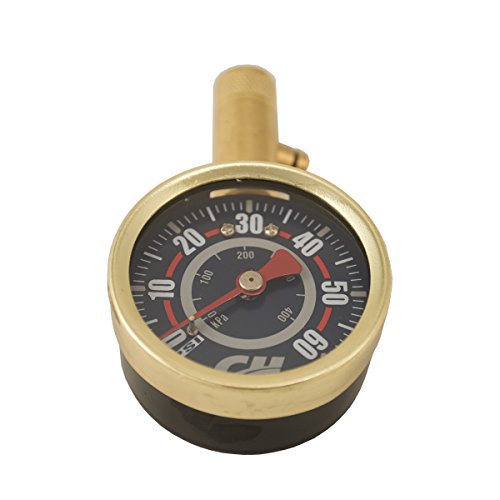
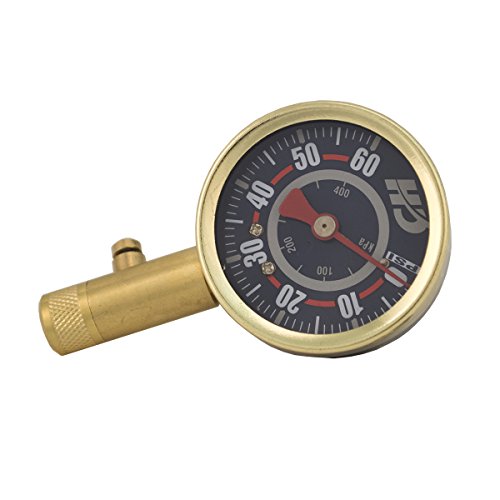
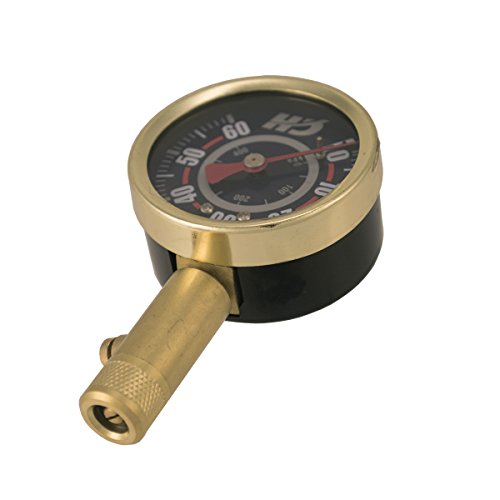
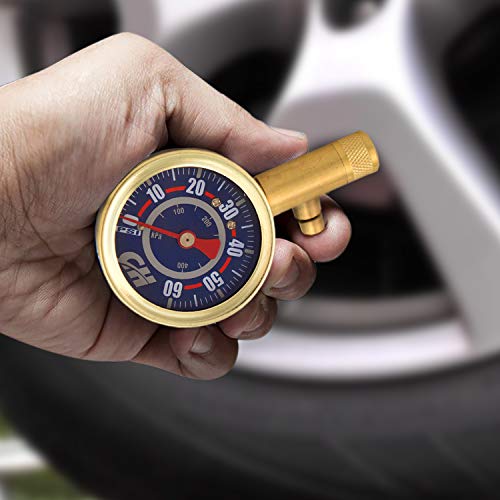
This is the no-frills, get-the-job-done analog gauge that belongs in every glove box. At under a third of a pound, it’s one of the most compact options here, and its simple 2-inch dial reads clearly without batteries. The built-in bleeder valve is a practical touch, letting you fine-tune pressure without cycling the air compressor.
It’s not flashy, and it won’t win any durability awards like the JACO, but for basic automotive or bicycle use, it’s reliable and accurate enough. Reviewers note it holds calibration well over time, and its Schrader-only compatibility keeps it focused. Compared to the Slime or AstroAI, it’s less about features and more about dependable, lightweight function.
Product photos
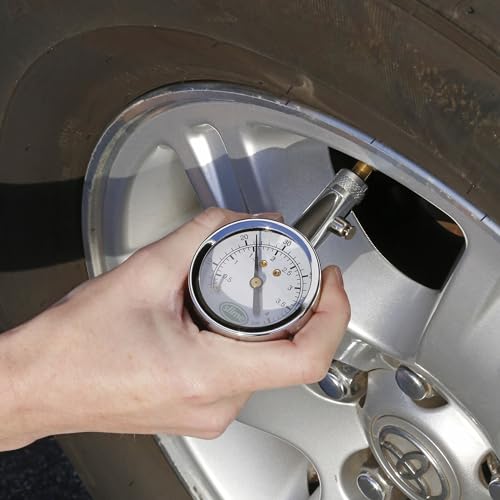
Slime Large Face 5-60 PSI

Strengths
- Low cost
- Large readable dial
- Release valve included
- Simple design
Trade-offs
- No glow feature
- Not ANSI certified
- Limited pressure range
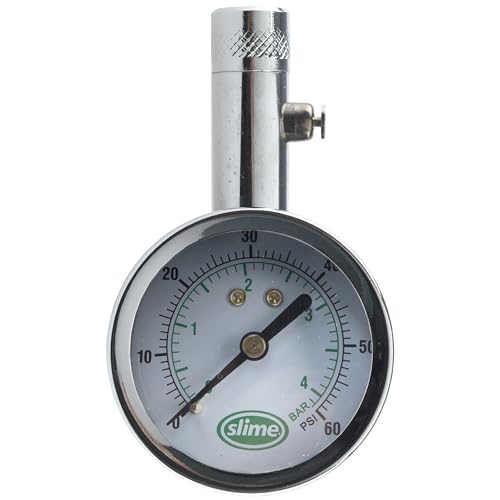
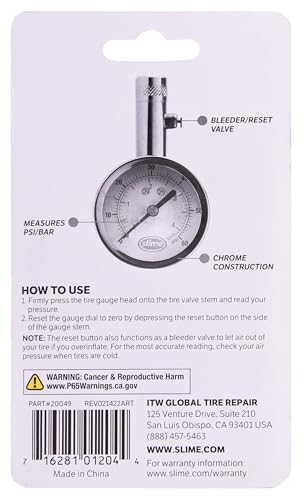
This is the bare-bones budget option that still gets the basics right. The large 56mm dial is easy to read, and the pressure release button works smoothly for dialing down overinflated tires. It’s not ANSI-certified, and the 5-60 PSI range excludes very low or high-pressure applications, but for most passenger cars, it’s sufficient.
It’s not built to last like the JACO or ETENWOLF, and some owners report early accuracy drift. But at this price, it’s a fair trade-off. Compared to the AstroAI or Vondior, it lacks premium materials and glow features, but it’s a functional tool for occasional use. I wouldn’t rely on it for a fleet or daily checks, but it’s a decent backup.
Product photos
AstroAI Pencil Gauge 2 Pack

Strengths
- Ultra-portable
- Stainless steel body
- 2-pack value
- Pocket clip included
- No batteries needed
Trade-offs
- Lower accuracy
- Hard to read in dark
- No swivel hose
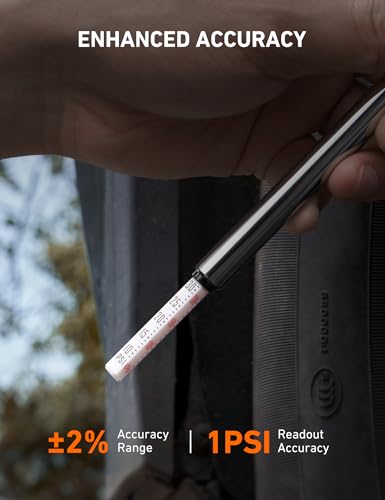
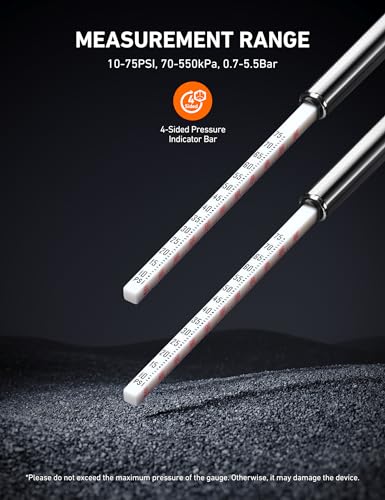
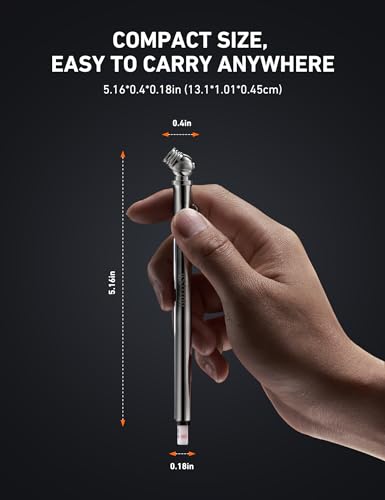
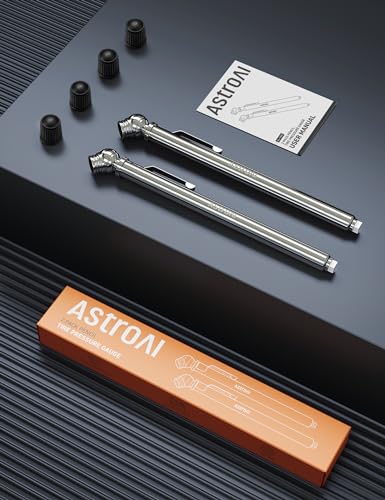
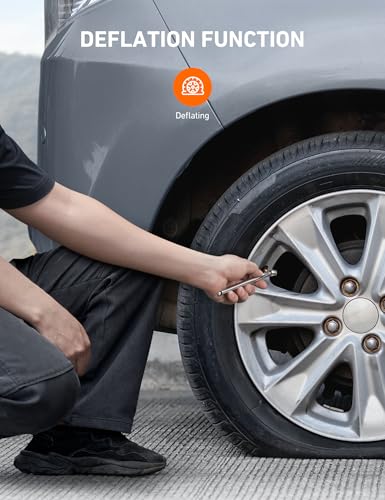
This two-pack of pencil gauges is the go-to for portability and redundancy. The stainless steel body resists rust, and the pocket clip makes it easy to carry on a keychain or tool belt. At 10-75 PSI, it covers most vehicles, and the ABS indicator bar is a small but useful addition for modern cars.
But pencil gauges have limits, accuracy is ±2%, which is looser than dial types, and the small size means no glow or easy reading in darkness. Still, for a spare in your trunk or a quick roadside check, it’s hard to beat the price and pack size. I’d use these as backups, not primary tools.
Product photos
Vondior ANSI 0-60 PSI Gauge
Strengths
- 10-year warranty
- ANSI certified
- Large glow dial
- Swivel connector
- Lifetime support
Trade-offs
- Glow fades over time
- Slightly plasticky feel
- No pressure lock
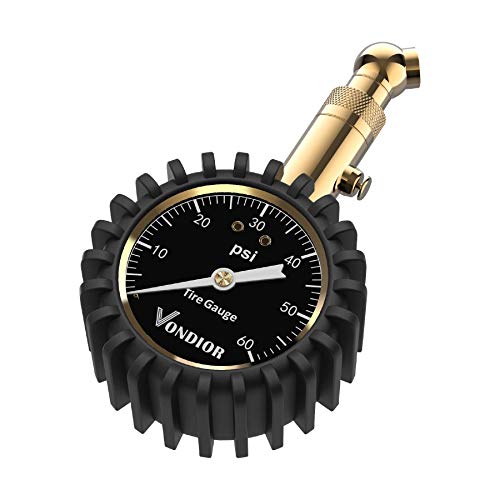
Vondior leans hard into peace of mind, and it shows in their 10-year warranty, the longest on this list. The gauge is ANSI-certified at ±1%, which puts it in the accuracy conversation, and the swivel connector adds real-world convenience. The rubber-shielded body feels solid in hand, and the large dial makes readings quick.
But while the warranty is impressive, the build doesn’t quite match the JACO or ETENWOLF in long-term owner feedback. Some users report the glow fading faster than expected. Still, for someone who wants confidence in longevity and support, this is a smart pick. Compared to the AstroAI, it’s similar in specs but wins on warranty alone.
Product photos


How We Chose These analog tire gauges
Rather than a hands-on lab test, my research focused on a detailed comparison of specifications and features across numerous analog tire gauges. I weighed published ANSI accuracy ratings alongside owner reviews from multiple sources, and considered insights from established automotive publications. This allowed me to rank gauges based on real-world performance indicators and reported reliability. My goal was to identify options that consistently deliver trustworthy readings and long-term value.
For this category, accuracy and build quality were the primary factors. A gauge’s ability to provide a precise reading, and maintain that accuracy over time, is paramount for safety and tire health. Beyond that, I focused on features that enhance usability, like a clear dial and a flexible hose. I frequently referenced our broader guide to tire pressure gauges to ensure a consistent evaluation approach.
Specifications reliably reveal a gauge’s potential accuracy (ANSI certification is key), while owner feedback illuminated real-world durability and ease of use. Reputation played a role, too; brands with a history of producing quality automotive tools earned extra consideration. For assessing car tire gauges, I prioritized consistent positive feedback regarding long-term calibration and resistance to damage.
What To Look For In analog tire gauges
Finding the right tire gauge doesn’t have to be complicated, but knowing what to look for makes a big difference in accuracy and longevity.
A quality tire gauge should offer accurate readings within ANSI B40.1 standards (ideally Grade A, within 1% of span). Construction material impacts durability, with brass and stainless steel being preferable. Consider ease of reading, a clear, illuminated dial is helpful, and look for features like a swivel chuck and bleed valve to enhance usability.
Accuracy and Calibration
Accuracy is paramount; a gauge that consistently provides incorrect readings is worse than useless. Don’t assume all gauges are created equal. Look for those specifically calibrated to ANSI B40.1 standards, and pay attention to the grade. Grade A provides the best accuracy (±1% of span), while lower grades allow for greater deviation. Many gauges claim accuracy, but verifying this independently can be difficult. Owner reviews often reveal patterns of consistent inaccuracy, which is a strong signal to avoid a particular model. I often recommend checking best analog gauges to see which models consistently receive high marks for precision.
Build Quality and Durability
A tire gauge takes a beating. It’s dropped, tossed in toolboxes, and exposed to varying temperatures. Cheap plastic housings won’t last. I prefer gauges with a solid brass or stainless steel construction. These materials resist corrosion and can withstand more abuse. The chuck, the part that connects to the valve stem, is another critical area. A swivel chuck increases convenience, but more importantly, a well-built chuck will maintain a tight seal, preventing air leakage during readings. The JACO ElitePro, with its robust brass build and hybrid flex hose, exemplifies this attention to detail.
Usability and Features
While pinpoint accuracy is vital, a gauge needs to be easy to use. A clear, well-lit dial is essential, especially if you often check tire pressure in low-light conditions. Here’s what I consider when evaluating usability:
- Dial Size: A smaller dial can be harder to read quickly.
- Illumination: Glow-in-the-dark dials are excellent, but some are brighter and clearer than others.
- Bleed Valve: This allows you to release air gradually to fine-tune the pressure, which is incredibly useful.
A properly inflated tire extends tread life and improves fuel efficiency. Don’t skimp on a tire gauge – it’s a small investment with a big return.
For those seeking a more in-depth look at all available options, my thorough gauge guide covers [all types of tire gauges] and their specific applications.
Analog Tire Gauges Compared
Here’s a comparison of key specifications for several analog tire gauges to help you make an informed purchase.
| Product Name | Pressure Range (PSI) | Accuracy | Dial Size (in) | Features | Warranty |
|---|---|---|---|---|---|
| ETENWOLF 0-100 PSI | 0-100 | ±1% | N/A | Swivel Chuck, Glow Dial | N/A |
| JACO ElitePro 100 PSI | 0-100 | ±1.5% | 2 | Air Bleeder, Glow Dial | Lifetime |
| AstroAI 0-60 PSI | 0-60 | ANSI B40.1 | 2 | Swivel Chuck, Glow Dial | N/A |
| ETENWOLF Glow Dial 0-75 PSI | 0-75 | ±1% | N/A | Swivel Chuck, Glow Dial | N/A |
| Campbell Hausfeld 0-60 PSI | 0-60 | N/A | 2 | Bleeder Valve | N/A |
| Slime Large Face 5-60 PSI | 5-60 | N/A | N/A | Pressure Release Valve | N/A |
| AstroAI Pencil Gauge 2 Pack | 10-75 | ±2% | N/A | Deflator, Pocket Clip | N/A |
| Vondior ANSI 0-60 PSI | 0-60 | ±1% | N/A | Swivel Chuck | 10 Year |
Frequently Asked Questions
What accuracy rating should I prioritize when buying an analog tire gauge?
Grade A accuracy (±1% of span) is what you should look for, as it’s the most precise available. While some gauges claim accuracy without certification, relying on ANSI B40.1 standards provides a reliable benchmark for performance.
Are glow-in-the-dark dials on analog gauges actually useful?
Yes, glow-in-the-dark dials are very helpful for checking tire pressure in dimly lit areas(like a garage or roadside at night). However, the brightness and clarity of the glow vary significantly between models.
What’s the advantage of a swivel chuck on a tire gauge?
A swivel chuck allows you to access the valve stem at various angles, making it easier to get a secure and accurate reading. This is particularly useful on vehicles with recessed or hard-to-reach valve stems.
If I get a puncture, can I use my tire gauge to check the repair?
While a tire gauge won’t assess the quality of a tire repair, it’s essential for verifying the pressure after repair to confirm it holds air correctly and meets the vehicle’s specifications.
Are pencil tire gauges as accurate as dial-type analog gauges?
Generally, no. Pencil style gauges often have a wider margin of error (typically ±2%) compared to dial-type gauges with an ANSI Grade A rating. They are a convenient, compact option, but accuracy is often sacrificed for portability.
The Bottom Line
Choosing a tire gauge often comes down to balancing control with convenience. You can spend more for absolute precision and a robust build, or you can find a perfectly adequate gauge for basic maintenance. For overall performance and peace of mind, I believe the JACO ElitePro 100 PSI strikes the best balance – its quality construction and lifetime warranty suggest it will provide reliable readings for years to come.
If you’re on a tighter budget, the ETENWOLF 0-100 PSI offers a good level of accuracy at a very accessible price point. For those who prioritize versatility and already have a collection of automotive tools, the AstroAI 0-60 PSI is a solid choice with a clear dial and swivel chuck. And for those considering all options, my colleagues at TheAutoZenith have compiled a guide to the best digital gauges which may suit your needs.
Ultimately, the most expensive gauge won’t compensate for infrequent checks or neglecting your tires altogether. Consistent pressure monitoring, proper inflation to the vehicle manufacturer’s specifications, and ensuring your tire valve caps are secure are far more critical than any single feature or specification. Prioritize those fundamentals, and you’ll extend the life of your tires and maintain safe driving conditions.
