
Toyota Highlander Recalls: What Owners Need to Know & Check
This post contains affiliate links. As an Amazon Associate, we earn from qualifying purchases.
The Toyota Highlander automobile is a three-row family SUV known for reliability, but its real-world owner experience is defined by three specific, documented issues: a front bumper cover that can detach after minor impact, accessory tires with an insufficient load rating on certain trims, and an HVAC system that can leak water or produce a wax odor. The first two are active NHTSA safety recalls; the third is a widespread technical service bulletin.
Those recalls aren’t just paperwork. One involves a clip that fails under stress you can’t see, and the other is about a tire upgrade that dealerships installed incorrectly for years. If your Highlander falls into the affected build dates, the fix is free, but you have to know to ask for it.
What follows is a breakdown of those recalls and bulletins by the numbers from the source documents, the mechanical why behind each failure, and a straight answer on what you should do next if you own one.
Key Takeaways
- Check your VIN for two active recalls: NHTSA 23V-720 (front bumper cover detachment) and 24V-452 (insufficient tire load rating on L, LE, XLE trims with 20-inch accessory wheels).
- The bumper recall fix isn’t just a visual check. Dealers install an improved retention clip because the original mounting tabs shear off under repeated stress.
- If you smell a greasy, oily odor from your vents, it’s likely paraffin wax from the evaporator, addressed in TSB MC-10238131-9999. The repair involves replacing the air conditioning radiator assembly.
- The hybrid system’s 288-volt NiMH battery pack is sealed and considered non-spillable, but the orange high-voltage cables require caution during any under-hood work.
- Your factory warranty covers most major components for 3 years/36,000 miles, but the restraint system (seatbelts, airbags) is covered for 5 years/60,000 miles.
What Actually Breaks on a Highlander: The Documented Failure Modes
Most reviews talk about cargo space and fuel economy. Owners talk about things that break. For the Toyota Highlander, the conversation is dominated by a few specific, well-documented problems that span model years. These aren’t random gremlins; they’re manufacturing or design issues Toyota and the NHTSA have formally acknowledged.
The value in knowing these isn’t to scare you off. It’s to turn a vague “something’s wrong” feeling into a specific, actionable check. You can walk into a dealer with a recall number or a TSB code and skip the diagnostic runaround. That saves time, money, and the headache of being told the strange smell from your vents is “normal.”
Where this goes sideways: Ignoring the bumper recall because the bumper “looks fine.” The failure happens inside the mounting tabs. You won’t see the stress fracture until the whole assembly detaches at highway speed, becoming a road hazard.
The Two Highlander Recalls You Must Check For
Two issues rose to the level of federal safety recalls. That means the NHTSA determined they pose an unreasonable risk to safety.
Recall 23V-720: The Detachable Bumper Cover
This recall affects approximately 750,800 Highlander and Highlander HV vehicles from the 2020 through 2023 model years, produced between late June 2019 and early August 2023. The problem is the resin front lower bumper cover assembly.
The official description says “minor impact” can cause detachment. The real mechanism is fatigue. The plastic mounting tabs that secure the lower cover to the upper bumper flex and stress with normal driving vibrations and tiny impacts from road debris. Over time, they can crack and shear off. Once one tab goes, the load redistributes, and the whole assembly can separate.
The remedy is specific. Dealers inspect the tabs and slots for damage. If they’re intact, they install new, improved retention hardware—a stronger clip design. If the tabs are damaged, they replace the entire bumper cover assembly. The inspection and clip installation take about an hour under warranty.
Recall 24V-452: The Under-Spec Tires
This is a more niche but critical recall from Southeast Toyota Distributors (SET), a major distributor that adds accessories before sale. It affects about 4,763 vehicles: 2021-2024 Highlander L, LE, and XLE grades with SET-installed 20-inch accessory tires. Limited and Platinum trims are not affected.
The issue is pure non-compliance. The installed tires have a load rating that is insufficient for the vehicle’s Gross Axle Weight Rating (GAWR), violating Federal Motor Vehicle Safety Standard 110. An overloaded tire heats up more and is more likely to fail, especially under heavy load or at sustained high speeds.
The fix is a full tire replacement with correctly rated tires, free of charge. If you bought a Highlander in the southeastern U.S. With flashy 20-inch wheels, you need to check this recall immediately.
| Recall Number | Affected Models | Core Problem | What the Dealer Does |
|---|---|---|---|
| NHTSA 23V-720 | 2020-2023 Highlander & Highlander HV | Front lower bumper cover mounting tabs can fatigue and detach. | Inspects tabs; installs improved retention clips or replaces bumper. |
| NHTSA 24V-452 | 2021-2024 Highlander L, LE, XLE (SET vehicles only) | Accessory tires have insufficient load rating for the vehicle’s weight. | Replaces all four tires with compliant ones, updates tire placard. |
Beyond Recalls: The Highlander’s Common Technical Service Bulletins
Recalls are for safety. Technical Service Bulletins (TSBs) are for widespread annoyances and non-safety-related defects. Toyota has issued several for the Highlander, but one in particular generates a lot of owner complaints.
TSB MC-10238131-9999: The HVAC Water Leak & Wax Odor
This bulletin covers some 2020–2022 Highlanders (and some RAV4s and Tundras). It describes two related symptoms: water leaking into the passenger footwell from a disconnected HVAC drain hose, and a distinct grease or oil odor from the vents.
The cause is paraffin wax. A wax-coated evaporator core can leak that wax into the drain system. It can clog the hose, causing water to back up and disconnect the hose. It also emits that smell when the A/C runs. The repair isn’t a simple clean-out. The official procedure is to remove and replace the entire air conditioning radiator assembly and drain cooler hose—a 5.1-hour job for a dealer tech, covered under the 3-year/36,000-mile basic warranty if you’re within that period.
The part nobody mentions: This wax odor is often misdiagnosed as a “dirty cabin air filter” or “normal A/C smell.” If a cabin air filter change doesn’t fix it, mention this specific TSB code. It points the tech directly to the known issue.
Understanding the Highlander Hybrid’s Unique Anatomy
If you have a Highlander Hybrid, you’re driving a more complex machine. Appreciating what’s different under the hood explains both its efficiency and the special care it sometimes requires.
The heart of the system is Toyota’s Hybrid Synergy Drive. It pairs a 3.3-liter gasoline engine with electric motors on the front axle (165 hp) and, in 4WD models, the rear axle (67 hp). The system is powered by a 288-volt Nickel-Metal Hydride (NiMH) battery pack.
All high-voltage components and cables are sheathed in bright orange insulation. This is your visual warning. Never cut, pierce, or modify anything orange under the hood without proper training and equipment.
The NiMH battery is sealed. The electrolyte is absorbed into the cell plates, making it non-spillable under normal conditions—even in a crash. This is a key safety design. The system includes multiple safeguards, including an automatic high-voltage disconnect in a collision.
For owners, this means two things. First, you can’t “jump” the high-voltage system like a 12-volt battery. Second, while the hybrid system is extremely reliable, any repair involving those orange cables or the battery pack itself must be done by a dealer or a specialist with the right tools and safety protocols.
Your Highlander’s Warranty: What’s Covered and For How Long
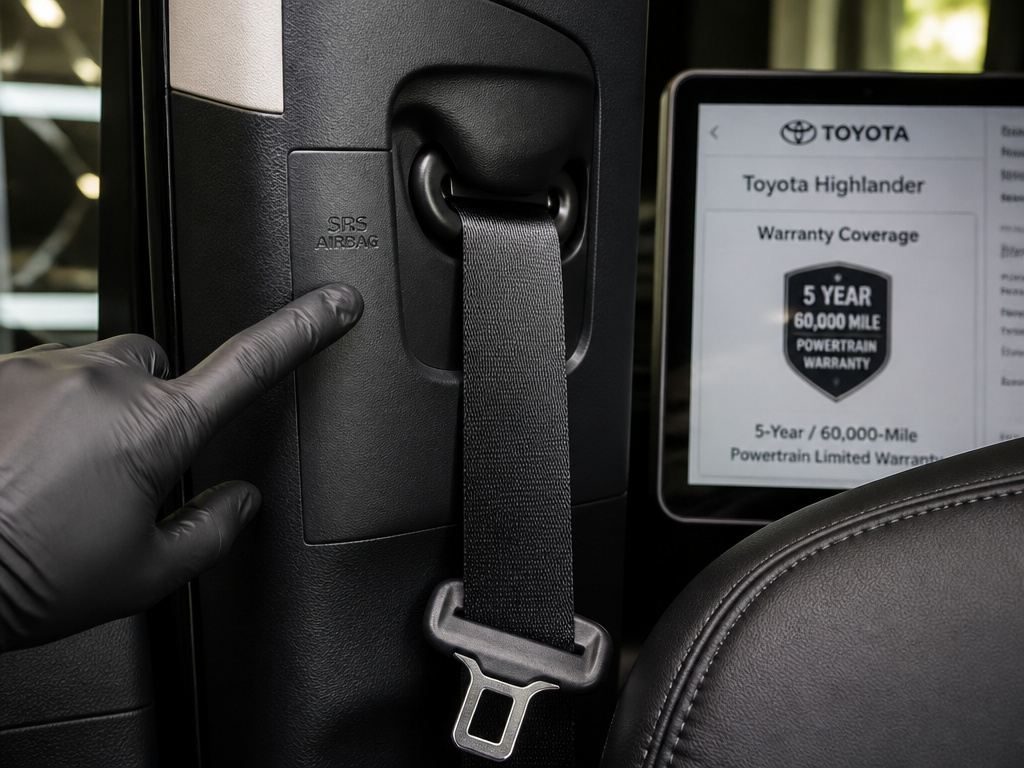
The factory warranty is your first line of defense against defects. The Highlander’s standard New Vehicle Limited Warranty is 36 months or 36,000 miles, whichever comes first, for defects in materials or workmanship. This covers most things, but there are key exceptions and longer terms you should note.
The Restraint Systems Warranty covers seatbelts and airbag systems for 60 months or 60,000 miles. This is critical because these are safety-critical components with a longer expected life.
There’s also an Emission Performance Warranty. If your vehicle fails an official EPA-approved emissions test within 2 years or 24,000 miles, and that failure causes you a penalty (like a fine), Toyota will repair it. Certain major emissions components have an even longer 8-year/80,000-mile warranty.
| Warranty Component | Coverage Period | What It Means For You |
|---|---|---|
| Basic New Vehicle | 3 years / 36,000 miles | Covers almost all repairs for factory defects. |
| Restraint System | 5 years / 60,000 miles | Specifically covers seatbelts and airbag components. |
| Emissions (Performance) | 2 years / 24,000 miles | Covers repairs if you fail an official emissions test. |
| Emissions (Designated Parts) | 8 years / 80,000 miles | Covers major components like the ECU and catalytic converter. |
What about maintenance? Toyota recommends scheduled service every 5,000 miles or six months. This includes the basics: oil and filter change, tire rotation, and inspections. If you drive under “special operating conditions” like frequent towing, dusty roads, or extensive idling in heavy traffic, the maintenance schedule becomes more rigorous, calling for more frequent changes of fluids like rear differential oil.
Practical Advice for Highlander Owners
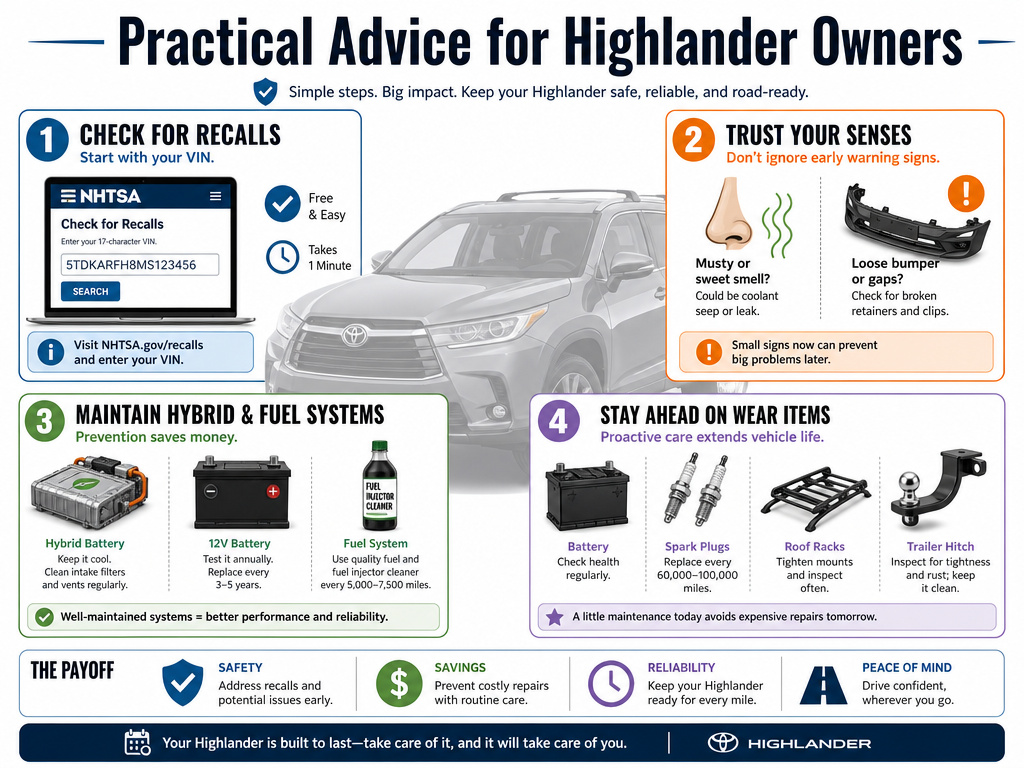
Knowing the problems is one thing. Dealing with them is another. Here’s the action plan.
Step 1: Immediately Check for Open Recalls.
Go to the NHTSA recall website and enter your 17-digit VIN. It will show all unrepaired recalls for your specific vehicle. Do this today. If a recall is listed, call your local Toyota dealer to schedule the free repair.
Step 2: Listen to Your Senses.
Be alert for the specific symptoms described: * A faint, greasy smell when the A/C is on? Think of TSB MC-10238131-9999. * Notice any looseness or unusual flex in the front bumper? Don’t wait—check for Recall 23V-720. * Driving a base model with big wheels in the Southeast? Verify your tires via Recall 24V-452.
Step 3: Maintain the Hybrid System (If You Have One).
There’s no special maintenance for the HV battery, but you must maintain the 12-volt auxiliary battery like any other car. A weak 12-volt battery can cause all sorts of confusing electronic glitches in a hybrid. Also, use a fuel injector cleaner periodically, as a clean-running engine keeps the entire hybrid system in its optimal efficiency range. For general engine health, stick with a high-quality synthetic motor oil for Toyotas that meets the specification in your manual.
Step 4: Plan for Wear Items.
The Highlander is reliable, but parts wear out. When it’s time, don’t just buy the cheapest option. For critical components like a replacement battery or spark plugs, OEM-spec or high-quality aftermarket is the way to go. If you need more cargo space, a well-chosen set of roof racks is a better investment than overloading the cabin. And if you tow, ensure your trailer hitch is installed and rated correctly for your load.
Frequently Asked Questions
Are Toyota Highlanders reliable cars?
Yes, the Toyota Highlander has a strong reputation for reliability. Its weakness isn’t random breakdowns but specific, known issues like the bumper recall and HVAC TSB. Addressing those proactively avoids most major problems, making it a dependable long-term vehicle.
What is the most common problem with the Toyota Highlander?
The most common documented issues are the front bumper cover detachment (Recall 23V-720) and the HVAC system water leak/grease odor (TSB MC-10238131-9999). The bumper issue is a safety recall affecting over 750,000 vehicles. The HVAC problem is a widespread nuisance that requires a significant repair.
How long will a Toyota Highlander last?
With proper maintenance and timely repair of known issues, a Toyota Highlander can easily last 200,000 miles or more. The hybrid system is particularly robust, with many examples exceeding high mileage with minimal battery degradation. Adherence to the severe service maintenance schedule is key if you drive in harsh conditions.
Is the Toyota Highlander hybrid battery covered by warranty?
The hybrid system components, including the high-voltage battery, are covered by Toyota’s 8-year/100,000-mile warranty in most states (10 years/150,000 miles in some states with stricter emissions standards). This is separate from the basic 3-year/36,000-mile new vehicle warranty.
What does it mean when my Highlander says “ready”?
When the instrument cluster shows “READY,” it means the hybrid system is powered on and the vehicle is operational. The gasoline engine may be off, so the car will be silent. You can now shift into gear and drive. It does not mean the engine is running.
The Bottom Line
The Toyota Highlander automobile’s story isn’t just about comfort and resale value. It’s about a vehicle with a few very specific, well-mapped flaws. The bumper recall and the tire load recall are not optional—they are safety fixes you must address. The HVAC TSB is a quality-of-life repair that, while annoying, has a known solution.
Ownership success comes from moving past generic advice. Don’t just “get it serviced.” Check your VIN for NHTSA recall 23V-720. Don’t just “change the cabin filter.” Know the code TSB MC-10238131-9999 if you smell wax. This turns you from a passive owner into an informed one, capable of guiding any service visit to the right outcome. That’s how you get the reliable experience the Highlander is famous for.
