
Honda Ridgeline | The Known Issues & Why It Still Wins
This post contains affiliate links. As an Amazon Associate, we earn from qualifying purchases.
The 2024 Honda Ridgeline is a 3.5-liter V6-powered unibody pickup with 5,000 lbs of towing, an innovative lockable in-bed trunk, and Honda’s i-VTM4 torque-vectoring AWD. Its main known issue is NHTSA recall 24V-321 for a tailgate camera wire harness that can fail in cold, salty conditions, affecting 187,290 vehicles from the 2020-2024 model years.
That recall details the specific failure mode. The rest of the truck’s story is about balancing car-like comfort with legitimate utility. It doesn’t chase the half-ton segment on paper specs. It delivers a specific driving experience that either fits your life perfectly or misses it completely.
What follows is a breakdown of its dimensions, payload, and towing, the specifics of the active recalls, and the one drivetrain feature that makes it unique in its class.
Key Takeaways
- The Ridgeline’s 5,000 lb towing and ~1,500 lb payload are class-competitive, but its unibody construction and independent rear suspension prioritize on-road ride quality over heavy-duty truck work.
- NHTSA Recall 24V-321 is for a tailgate wire harness (part 32109-T6Z-A10) that can crack and break in freezing, salty conditions, leading to a blank rearview camera screen. The fix is a harness replacement, but parts were not available as of the May 2024 notice.
- A separate service bulletin (24-085) addresses a low-power mode and flashing MIL after long drives in cold weather, fixed by replacing the intake manifold kit.
- The i-VTM4 AWD system can send up to 70% of torque to the rear and vector it side-to-side, acting as a limited-slip differential for improved traction in corners and off-road.
- Payload varies by trim: the base Sport trim carries 1,583 lbs, while the loaded Black Edition manages 1,509 lbs. Always check your door jamb sticker for your specific truck’s rating.
Dimensions, Payload & Towing: The Utility Numbers
Forget the brochure comparisons to full-size trucks. The Ridgeline’s utility envelope is defined by its midsize, unibody architecture. The numbers are precise and they tell you exactly what jobs this truck is built for.
The bed is 64 inches long with the tailgate up, stretching to 83 inches with it down. The width between the wheel wells is a standard 50 inches, perfect for sliding in a sheet of plywood flat. The lockable, drainable In-Bed Trunk offers 7.3 cubic feet of dry storage—the party trick that still has no direct competitor. Its 350 lb-rated tie-down cleats are cast into the bed walls, not bolted on.
Payload is where you see the cost of options. The lightest truck, the Sport trim, can carry 1,583 lbs. Add the heavier wheels, sound deadening, and features of the Black Edition, and that drops to 1,509 lbs. That’s a 74-pound difference just in trim level.
Where this goes sideways: Loading the bed to its 1,500 lb limit without accounting for the weight of passengers and gear in the cab. You’ll hit the Gross Vehicle Weight Rating (GVWR) of 6,019 lbs faster than you think, overloading the suspension.
| Trim Level | Curb Weight | Max Payload | Key Differentiator |
|---|---|---|---|
| Sport | 4,420 lbs | 1,583 lbs | Lightest configuration, base features. |
| RTL | 4,480 lbs | 1,544 lbs | Adds leather, premium audio, and power amenities. |
| TrailSport | 4,495 lbs | 1,521 lbs | Off-road tuned suspension, all-terrain tires, unique styling. |
| Black Edition | 4,504 lbs | 1,509 lbs | Fully loaded with navigation, black accents, and advanced features. |
Towing is a flat 5,000 lbs across all trims when properly equipped. That requires the factory tow hitch and wiring harness. The truck includes a transmission cooler and a integrated trailer brake controller pre-wire. It’s enough for a decent-sized boat or a fully loaded cargo trailer, but it’s the ceiling. If your regular load is 4,500 lbs, you’re in the sweet spot. If you’re eyeing 5,000 lbs every weekend, you’re at the limit in a midsize truck.
The dimensions make it easy to live with. A 43.4-foot turning circle is tighter than many SUVs. The 7.64 inches of ground clearance is sufficient for forest service roads, not rock crawling. These are the specs of a vehicle designed to be used daily, not just on haul days.
The 2024 Ridgeline’s Engine & Drivetrain
Under the hood is Honda’s J35Y6 engine. It’s a 3.5-liter V6 making 280 horsepower at 6,000 rpm and 262 lb-ft of torque at 4,700 rpm. It uses direct injection, Variable Cylinder Management (which can deactivate three cylinders under light load), and is paired to a 9-speed automatic transmission.
The power delivery is smooth and linear. It doesn’t feel peaky or strained. The transmission shifts cleanly, though some drivers note a slight hunt for gears when towing on grades. The EPA rating is 18 city / 24 highway / 21 combined mpg for most trims, dipping by 1 mpg on the highway for the TrailSport due to its all-terrain tires.
The i-VTM4 system is a torque-vectoring all-wheel-drive setup. It uses a rear differential with twin electromagnetic clutches that can send up to 70% of the engine’s torque to the rear axle, and can then send nearly all of that torque to either the left or right rear wheel. This acts like a rear limited-slip differential, pulling the truck through corners and providing exceptional traction in slippery off-camber situations.
This isn’t a part-time system that waits for slip. It’s proactive. You feel it on wet pavement during hard acceleration from a stoplight—the truck just goes, with no wheelspin or drama. For off-pavement driving, the Intelligent Traction Management offers Snow, Sand, Mud, and Normal modes, adjusting throttle response and torque distribution.
The unibody construction and multi-link independent rear suspension are the final pieces. They give the Ridgeline its car-like ride quality. The trade-off is a lower payload and towing ceiling compared to body-on-frame rivals, and less wheel articulation for extreme off-roading. The TrailSport trim’s off-road tuned suspension helps, but it doesn’t change the fundamental architecture.
It’s a drivetrain built for confidence in bad weather and comfort on long highway slogs, not for winning drag races or conquering Moab.
Known Issues & Recalls
Two documents define the 2024 Ridgeline’s known problems: an NHTSA safety recall and a technical service bulletin. Both are specific and traceable.
NHTSA Recall 24V-321: The Tailgate Camera Harness
This is the big one. In May 2024, Honda filed NHTSA recall report 24V-321 covering 187,290 Ridgelines from the 2020-2024 model years. The issue is the rearview camera tailgate wire harness, part number 32109-T6Z-A10.
The cause is mechanical and environmental. The harness runs through a flexible conduit between the cab and the tailgate. In cold climates where road salt is used, salty water can penetrate the conduit. With repeated tailgate openings and closings, the wires inside can flex, develop fine cracks in their insulation, and eventually fatigue and break. Freezing and thawing accelerates the crack growth.
The consequence is a rearview camera that works intermittently or goes blank. In some cases, it can also affect the tailgate lock and security alarm. As the NHTSA recall campaign 24-084 notes, a blank backup camera increases the risk of a backing collision.
The timeline is critical: * First Warranty Claim: November 5, 2020. * NHTSA Investigation Opened: Prior to February 27, 2024. * Honda Stopped Shipments: April 25 – May 2, 2024. * Recall Filed: May 9, 2024. * Initial Customer Notification: Planned for mid-July 2024. * Critical Detail: As of the May 10, 2024 notice, repair parts were not available. Honda advised dealers only to fix vehicles if the camera was already inoperative.
If you own an affected Ridgeline, you must check your VIN at recalls.honda.com. The repair, when parts are available, is a full harness replacement at no cost.
Service Bulletin 24-085: Low Power Mode
Separate from the recall is NHTSA technical service bulletin MC-11005272-0001 (Honda bulletin 24-085). This affects some 2017-2024 Ridgelines.
The symptom is specific: after a long drive (around 2 hours) in cold weather (near or below freezing), the vehicle may enter a low-power mode with a flashing check engine light and will not accelerate. After turning the truck off and on, the symptom clears and no diagnostic trouble codes are stored.
Honda’s investigation pointed to moisture accumulation in the intake manifold during long drives. During cornering under acceleration, this moisture could be drawn into the cylinders, causing misfires that trigger the protective limp mode.
The fix is to replace the entire intake manifold kit (which includes a new PCV hose and insulator). This is a warranty repair if your vehicle exhibits the symptom. It’s not a recall because it’s not deemed a safety defect—just a frustrating drivability issue.
Interior, Tech & Daily Driving
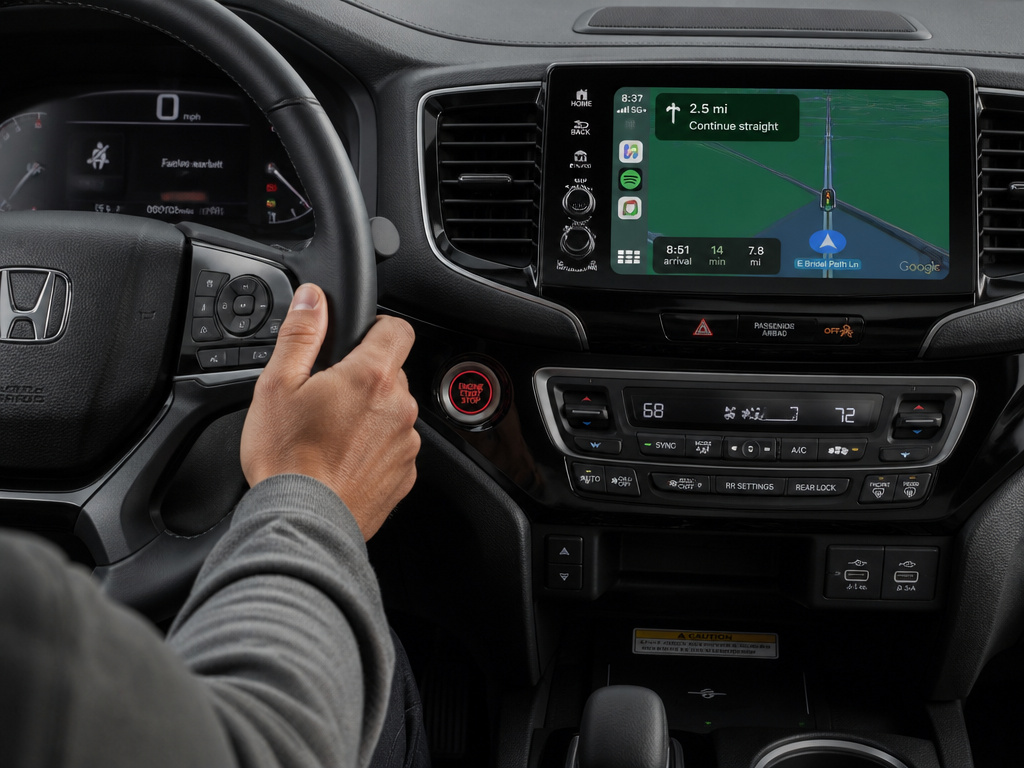
Step inside and the Ridgeline feels immediately familiar if you’ve been in a modern Honda Pilot or Passport. The dashboard layout is logical, materials are a mix of soft-touch plastics and, depending on trim, leather or durable fabric. The front seats are supportive for long drives.
The 8-inch touchscreen infotainment system (9-inch on Black Edition) is standard. It includes Apple CarPlay and Android Auto, both wired. The interface is straightforward, if not the fastest in the industry. Higher trims add a premium audio system, wireless phone charging, and a built-in Honda satellite-linked navigation system.
Where it shines as a daily driver is in the details. The second-row seats flip up, revealing a flat floor and 2.9 cubic feet of under-seat storage. The cab is quiet, with active noise cancellation standard. The driving position is commanding but not truck-tall, with excellent forward visibility.
Honda Sensing® suite of safety features is standard on every 2024 Ridgeline. This includes: * Collision Mitigation Braking System (CMBS) * Road Departure Mitigation (RDM) * Adaptive Cruise Control (ACC) with Low-Speed Follow * Lane Keeping Assist System (LKAS)
The systems are calibrated to be helpful without being intrusive—a hallmark of Honda’s approach. The multi-view rear camera system, when working, is excellent, providing standard, wide, and top-down views.
For adding personal utility, the aftermarket is strong. Owners often add tonneau covers for bed security, seat covers for durability, and use OBD2 scanners for basic diagnostics. Choosing the right motor oil and oil filters is crucial for maintaining the direct-injection V6.
Maintenance & Cost of Ownership
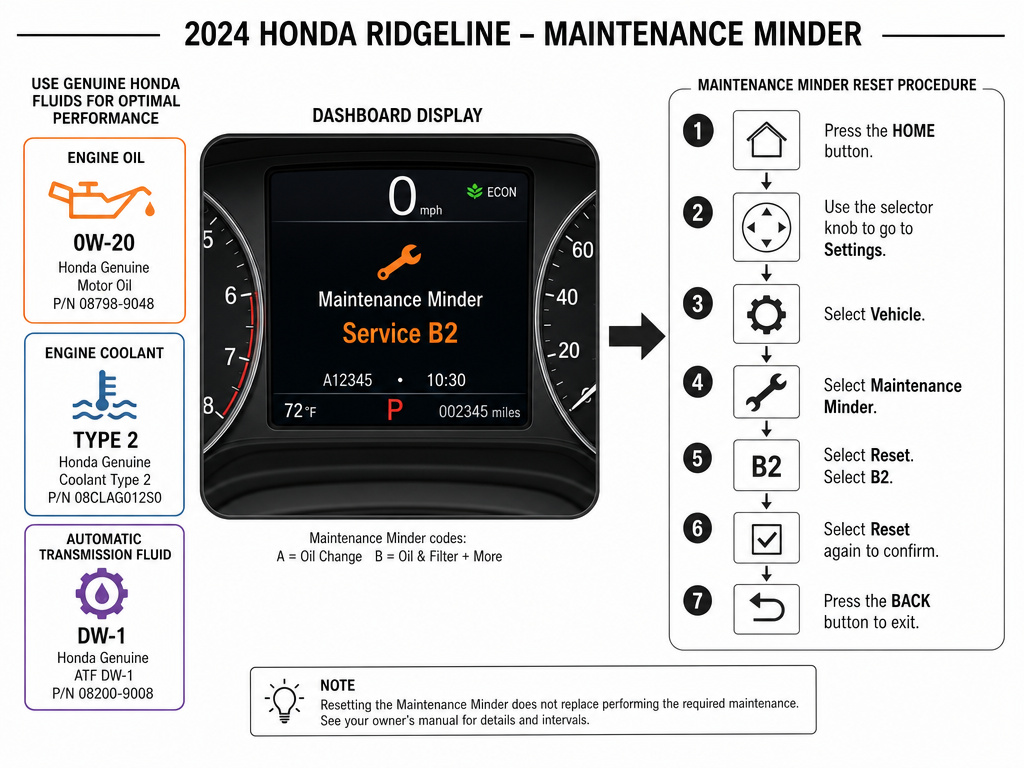
The Ridgeline uses Honda’s Maintenance Minder™ system. It doesn’t have a fixed mileage schedule. Instead, the truck’s computer monitors driving conditions and alerts you when service is due (e.g., “Service A1” or “B2”). This is efficient, but you must reset the system after each service or the intervals become inaccurate.
Critical factory specs include: * Engine Oil: 5.7 quarts of 0W-20 synthetic blend or full synthetic (API SP/SN Plus). * Transmission Fluid: Honda ATF DW-1. Drain and refill is around 3.5 quarts; a full fluid exchange takes more. * Coolant: Honda Long-Life Antifreeze/Coolant Type 2 (pre-diluted). * Spark Plugs: Iridium-tipped, with a replacement interval typically around 100,000 miles as indicated by the Maintenance Minder.
Common mistake: Using a generic OBD2 scanner to try and reset the Maintenance Minder. It often requires a specific sequence through the vehicle’s own display or a professional scan tool. Getting it wrong means the system won’t track correctly for the next service.
Reliability for the powertrain is generally considered strong, building on years of use in other Honda models. The main watch items are the recalls and service bulletins already discussed, and typical wear items like brakes and tires. The independent rear suspension is more complex than a solid axle but offers that superior ride; just know that a wheel alignment is a four-wheel job.
When considering Honda accessories or aftermarket wheels, ensure they are compatible with the Ridgeline’s specific load ratings and bolt pattern. This isn’t the platform for extreme modifications focused on peak power; it’s about enhancing utility and protection with items like bed protection accessories.
Frequently Asked Questions
What is the real-world fuel economy of the 2024 Ridgeline?
Expect 19-21 mpg in mixed driving. The EPA estimates are accurate. Highway cruising at 70 mph can yield 24-25 mpg. Heavy city traffic, towing, or aggressive driving will drop it into the high teens. The TrailSport trim’s all-terrain tires typically cost 1 mpg.
Can the Ridgeline handle moderate off-roading?
Yes, particularly the TrailSport trim. The i-VTM4 AWD provides excellent traction in mud, sand, and snow. The 7.64-inch ground clearance and available all-terrain tires are sufficient for forest trails, fire roads, and beach driving. It is not a rock crawler; its approach, breakover, and departure angles (around 20 degrees) limit extreme articulation.
How does the in-bed trunk work, and is it useful?
The trunk is a lockable, waterproof compartment at the front of the bed. It opens with a pull handle and has a drain plug. It’s incredibly useful for storing tools, recovery gear, or groceries out of sight and out of the weather. It fits a 72-quart cooler or several full-size backpacks with ease.
Is the 2024 Ridgeline good for towing a camper?
It can tow up to 5,000 lbs, which covers many small travel trailers, pop-up campers, and boat combinations. The key is managing weight distribution and ensuring your trailer’s loaded weight is well within the limit. The integrated trailer brake pre-wire is a major plus. For frequent towing near the max, a transmission temperature gauge (aftermarket) is a wise addition.
What is the difference between the RTL and Black Edition trims?
The RTL is the well-equipped mid-tier with leather, a power moonroof, and premium audio. The Black Edition adds the 9-inch nav system with voice recognition, a heated steering wheel, acoustic windshield glass, black exterior accents, and unique interior trim. It’s the luxury offering.
The Bottom Line
The 2024 Honda Ridgeline is a specialist. It trades raw, heavy-duty capability for refined on-road manners, clever storage, and all-weather confidence. The current tailgate camera recall is a significant mark against it, but the root cause—a specific wire harness in salty cold—is now known and being addressed.
For the right buyer, its compromises are strengths. If your truck duties involve more Home Depot runs than job site deliveries, more ski trips than dirt track racing, and you value a quiet, comfortable cabin every single day, the Ridgeline makes a compelling argument. Just check that VIN, understand the payload of your chosen trim, and know what you’re buying: the most car-like truck on the market. That’s either its greatest flaw or its winning feature.
