
What is Dry Camping? A Complete Guide to Preparing Your RV
This post contains affiliate links. As an Amazon Associate, we earn from qualifying purchases.
Dry camping is RV travel without external hookups for electricity, water, or sewer. To prepare, you must manage three onboard systems: power (battery/solar/generator), water (fresh tank conservation), and waste (holding tank capacity). A factory 100Ah lead-acid battery gives one night of modest use; stretching a 30-gallon fresh water tank to 4-7 days requires cutting consumption to 3-5 gallons per person daily.
That one-night battery life is the factory default, not a limit. It’s the starting line. The whole game is learning what your specific rig actually uses hour by hour, and what you’re willing to change to stay out longer.
What follows is the system-by-system breakdown: how to audit your power draw, how to stretch a water tank, and where the waste actually goes. Plus the non-negotiable step every first-timer should take before heading into the backcountry.
Key Takeaways
- Your RV’s factory 100Ah lead-acid battery supports about one night of basics; lithium batteries double usable capacity and handle cold weather far better.
- Calculate your fresh water needs at 3-5 gallons per person per day for drinking, cooking, and Navy showers. A 30-gallon tank lasts two people 3-4 days.
- Always do a “practice run” dry camp in your driveway or a local campground before attempting a remote trip. You’ll find the gaps in your setup and habits.
- Know the difference: “dry camping” is any hookup-free stay; “boondocking” is remote camping on public land; “dispersed camping” is the official Forest Service term.
- Generator etiquette is real. The unwritten rule in shared areas is 8 a.m. To 8 p.m. Running outside those hours is a quick way to annoy every camper within earshot.
Dry Camping Defined: More Than Just a Parking Lot
The terms get tossed around interchangeably, but they point to different places and expectations. Dry camping is the broad category, any night spent without a cord plugged into shore power, a hose connected to city water, or a sewer line. This includes a Walmart parking lot, a friend’s driveway (moochdocking), or a state park campsite that simply lacks utilities.
Boondocking is a subset of dry camping, typically meaning free, remote camping on public lands like Bureau of Land Management (BLM) or U.S. National Forest property. Dispersed camping is the specific term used by the Forest Service for camping outside of designated campgrounds. The common thread is self-reliance. Your RV’s onboard systems are the only utilities you have.
The part nobody mentions: Your RV’s monitor panel for tank levels is often imprecise. If the gauge shows one-third full, it might be half. Or nearly empty. When in doubt, do a manual check. Trusting a faulty gauge is how gray water ends up on the shower floor.
The Three Systems You Must Manage
Off-grid comfort comes down to balancing a simple equation: your consumption versus your capacity. Fail at this math, and your trip ends early. There are three variables in the equation.
1. Power: From a Single Night to a Week Off-Grid
The factory-installed single 100Ah lead-acid battery in most RVs is a placeholder. It’s enough to run the lights, water pump, and fan for an evening, maybe two if you’re careful. It is not designed for a long weekend.
A 100Ah lead-acid battery provides about 50Ah of usable power before damage occurs. A standard 12V RV ceiling fan draws 1-2 amps. Run it for 10 hours, and you’ve used 20Ah, nearly half your usable capacity for the night.
Here’s where trips extend. You need a way to replenish the power you use.
- Solar Panels: The gold standard for silent, sustainable power. A 200-watt solar system can often recharge a day’s usage in 4-6 hours of good sun. For extended boondocking, 400+ watts is a common target.
- Generator: The reliable backup. A 2000-watt inverter generator can recharge batteries and run high-draw appliances like a microwave or air conditioner for short periods. The fuel cost is noise and gasoline.
- Battery Upgrade: This changes everything. Lithium iron phosphate (LiFePO4) batteries, like those from Battle Born, provide nearly 100% of their rated capacity. Two 100Ah lithium batteries store the usable equivalent of four 100Ah lead-acid batteries. They also charge faster and perform better in cold weather.
| Power Source | Best For | The Catch |
|---|---|---|
| Factory Lead-Acid | A single overnight test. | 50% usable capacity; slow recharge; poor cold-weather performance. |
| Solar Panels (200W+) | Multi-day stays in sunny climates. | Zero output at night or in heavy shade; requires upfront investment. |
| Inverter Generator | Guaranteed power in any weather; running AC. | Noise, fuel, and maintenance; observe strict generator hours in public areas. |
| Lithium Battery Bank | Serious, week-long boondocking. | High initial cost; requires a compatible charger. |
Why the battery type matters in cold weather: A lead-acid battery can lose 50% of its capacity when temperatures drop below freezing. A lithium battery retains 80-90% of its capacity in the same cold. If you camp in the mountains, the chemistry under your floor is not an academic detail.
2. Water: Your Most Precious Cargo
A standard RV fresh water tank holds 25 to 50 gallons. At home, the average American uses 80-100 gallons per day. The boondocking target is 3-5 gallons per person, per day. This requires a conscious shift.
Start with the math. Two people, using 4 gallons each per day, will drain a 30-gallon tank in less than 4 days. This covers drinking, cooking, and a conservative cleaning routine. Stretching it further means adopting specific habits.
- Navy Showers: Wet down. Turn water off. Soap and shampoo. Rinse off. Total time: 90 seconds. Total water: under 1 gallon. A standard RV shower uses 3-5 gallons per minute.
- Dishwashing Strategy: Use a spray bottle with soapy water for scrubbing. Rinse dishes in a bin, not under a running tap. Dump the gray water later, away from camp.
- Drinking Water: Use a separate jug for drinking water. It keeps your main tank fresher and makes it easier to track drinking consumption.
Your gray water tank, which collects sink and shower drainage, will fill up faster than you think, often before your fresh water is gone. A typical 30-gallon gray tank fills in 3-4 days for a couple. Know where your next dump station is using apps like SaniDumps or RV Dump Stations.
3. Waste: Holding Tank Reality
You have two waste tanks: gray (sinks, shower) and black (toilet). The black tank is usually smaller and fills more slowly. The rule is absolute: black water must only be dumped at a designated facility with a sewer connection.
In true dispersed camping areas on public land, it is often permissible to carefully drain gray water on the ground, following Leave No Trace principles: at least 200 feet from any water source, and scatter it widely. Never do this with black water. Always check local regulations first.
Where this goes sideways: Assuming your black tank is fine because you’re “careful.” It fills slowly, but it does fill. The only thing worse than a full gray tank is a full black tank 40 miles from the nearest dump station.
Your First Dry Camp: A Practice Run
The most valuable night you can spend is in your own driveway, or at a nearby campground where you deliberately do not connect any hookups.
This is a systems test, not a vacation. Go through your entire routine. Cook dinner using your power. Run the water pump. Use the toilet. Monitor how quickly your battery voltage drops. How long does the fridge run on propane? This dry run reveals the gaps before you’re in a remote location with no cell service.
You’ll answer critical questions: Does my battery actually last through the night? How much water did that dinner really use? Is my generator loud enough to wake the neighbors? It’s cheap, controlled, and prevents the most common first-trip failures.
Finding Your Spot: From BLM Land to Retail Parking
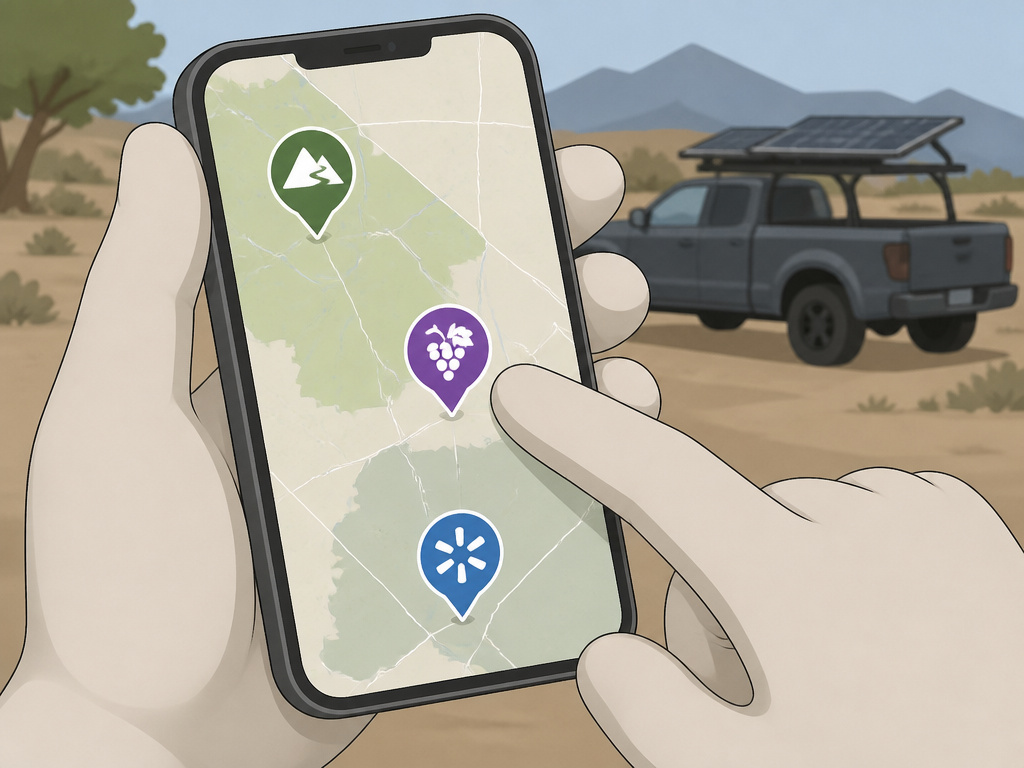
Your choice of location dictates the experience. The Bureau of Land Management (BLM) and U.S. National Forests manage millions of acres where dispersed camping is allowed, usually for up to 14 days in a single spot. These are the classic boondocking spots, remote, free, and scenic. Apps like FreeRoam and iOverlander are essential for finding legal boundaries and established spots.
Harvest Hosts provides a network of wineries, farms, and breweries that allow overnight stays for members, a unique form of dry camping. Retail parking lots (Walmart, Cabela’s) are a pragmatic option for a single overnight while traveling. The rule here is to be invisible: no awnings, no chairs, no external generators. You’re parking, not camping.
Before you invest in a major solar setup, ensure you have the right foundation. A good set of truck accessories can include a sturdy bed rack for mounting panels, while the right coolers will save you from running a power-hungry RV fridge constantly.
Cold Weather Dry Camping: The Rules Change
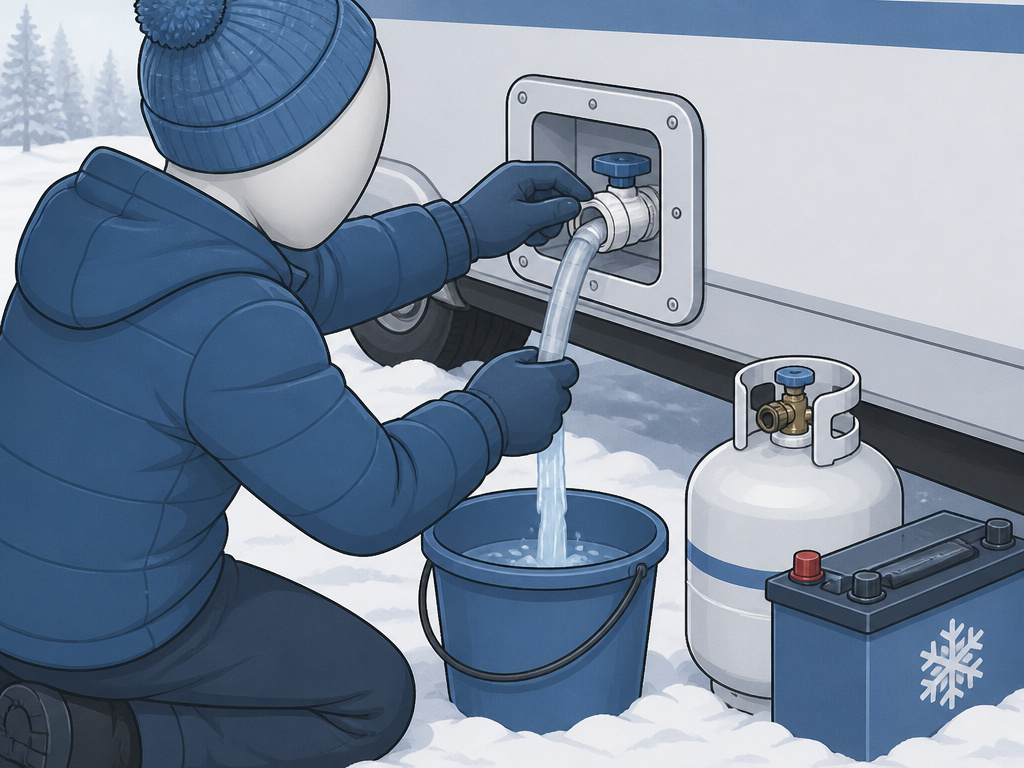
Boondocking below freezing introduces new stakes. Water lines freeze. Batteries underperform. Your margin for error shrinks.
- Water Systems: When temperatures are forecast to dip below 20°F for extended periods, most winter boondockers drain their fresh water system entirely. They bring water in jugs. It’s a hassle, but it’s cheaper than replacing burst plumbing.
- Battery Choice Revisited: This is where lithium batteries justify their cost. Their cold-weather performance is objectively superior. If you’re using lead-acid, expect to recharge more often and never let them sit discharged in the cold.
- Heating: Propane furnaces are effective but drain both your propane tank and your battery (to run the fan). Diesel heaters are more efficient but require installation. A good camping mattress with high R-value insulation is a passive, power-free way to stay warm.
Essential Gear for Extending Your Stay
You can go dry camping with a stock RV. To enjoy it for more than a night, a few pieces of gear move the needle from survival to comfort.
A portable solar panel kit (like those from Jackery or Renogy) is a flexible start. You can deploy it in the sun while your RV sits in the shade. A quiet inverter generator (Honda or Yamaha) is peace-of-mind insurance for cloudy weather. For water, collapsible water jugs let you transport extra fresh water without taking up permanent storage.
Your comfort outside the RV matters too. A reliable camping stove saves your RV’s propane for heating, and the right car camping gear list will include items like a folding table and chair that don’t rely on your RV’s power.
Easy to miss: A simple $20 battery monitor that shows voltage and amp-hours consumed is more accurate than your RV’s built-in gauge. It’s the single best tool for learning your real power habits.
Frequently Asked Questions
Is dry camping the same as boondocking?
Dry camping is the broader term for any camping without hookups. Boondocking specifically refers to free, remote camping, typically on public land. All boondocking is dry camping, but not all dry camping (like a Walmart overnight) is boondocking.
How long can you dry camp in an RV?
With a factory setup (100Ah battery, 30-gallon water tank), a couple can typically last 1-2 nights comfortably. With upgrades like solar panels, extra batteries, and water conservation, stays of 7-14 days are common on public lands where allowed.
Can you run air conditioning while dry camping?
Running a standard RV roof air conditioner on batteries alone is impractical; it would drain a 100Ah battery in under an hour. The two solutions are: running a generator to power the AC, or upgrading to a massive lithium battery bank (600Ah+) paired with a large inverter.
Where can I legally dry camp for free?
The primary sources are Bureau of Land Management (BLM) land and U.S. National Forests, which often allow free dispersed camping for up to 14 days. Always check the specific district’s rules online or at a ranger station, as some popular areas have restrictions.
What’s the most common mistake first-time dry campers make?
They overestimate their battery capacity and underestimate their water usage. They plug in every night at home and have no intuition for how fast a water pump drains a battery or how many gallons a “quick” shower uses. The practice run exists to correct this.
Do I need a special RV to go dry camping?
No. Any self-contained RV with a fresh water tank, a battery, and holding tanks can dry camp. Travel trailers, motorhomes, and even some equipped camper vans are all capable. The duration of your stay is determined by the size and efficiency of those systems.
The Bottom Line
Dry camping transforms an RV from a motel on wheels into a genuine vehicle for exploration. It’s about trading the convenience of a plug for the freedom of a mountain vista with no neighbors in sight. The preparation is straightforward: manage your power, husband your water, and respect your waste limits.
Start with the practice run. Let it show you where your real limits are, not the optimistic ones in the brochure. Then, whether you’re eyeing a weekend in a state park or a week on BLM land, you’ll know exactly what your rig can do. That knowledge is the difference between an anxious experiment and a confident adventure.
