
Are Chinese ATVs Any Good? Owner Experiences vs Factory Specs
This post contains affiliate links. As an Amazon Associate, we earn from qualifying purchases.
Chinese ATVs are a mixed bag of genuine value and significant risk. The quality question hinges on three things: the specific manufacturer’s adherence to published service intervals, your willingness to follow a strict 20-hour break-in period, and your access to parts and service for a brand that might not have a local dealer. Models from Linhai, CFMOTO, and Tao Motor can be capable machines if treated exactly as their manuals prescribe, but they punish neglect instantly.
That prescription is a 20-hour, no-load, variable-throttle run-in printed in every owner’s manual we checked. Skip it, and you’re measuring cylinder wear by the third oil change.
What follows is a side-by-side of the specs they publish, the safety rules they legally require you to follow, and the real-world gaps that appear between the crate and the trail. By the end, you’ll know which manual clauses are decorative and which are non-negotiable.
Key Takeaways
- Every major Chinese ATV brand mandates a 20-hour break-in period with no towing and limited throttle; ignoring this voids warranty and accelerates engine wear.
- Warranties are voided immediately by any modification to the engine, drivetrain, or chassis, a clause enforced more strictly than with many Western brands.
- Parts and service access is the single biggest variable; a Linhai sold through a U.S. Distributor has better support than a no-name import from Alibaba.
- Safety and age warnings in the manuals are legally binding; letting an underage rider operate the ATV shifts all liability to you.
- The real cost is often double the advertised price once ocean freight, tariffs, customs brokerage, and port fees are added.
How We Evaluated “Good” – Manuals as the Benchmark
Forget online reviews and marketing copy. The only objective standard for a machine’s intended lifespan is its factory service manual. We sourced and compared owner’s manuals from Linhai, CFMOTO, Tao Motor, and Benda.
A good ATV is defined by the clarity of its maintenance schedule, the specificity of its break-in procedure, and the honesty of its load ratings. If the manual is vague, the engineering likely is too.
We treated these documents as contracts. The manufacturer’s promises on durability are conditional on you following their procedures to the letter. Our evaluation asks one question: does this manual provide a clear, achievable path to reaching the vehicle’s advertised service life, or does it set traps for the uninformed owner?
The Linhai 500ATV T3 EFI manual specifies an oil change interval of 30 hours or 3 months, with a mandatory break-in change at 20 hours or one month. Severe use, defined as operation in dust, mud, or temperatures below 10°F (-12°C), requires more frequent service immediately.
The 20-Hour Break-In Rule Every Manual Demands
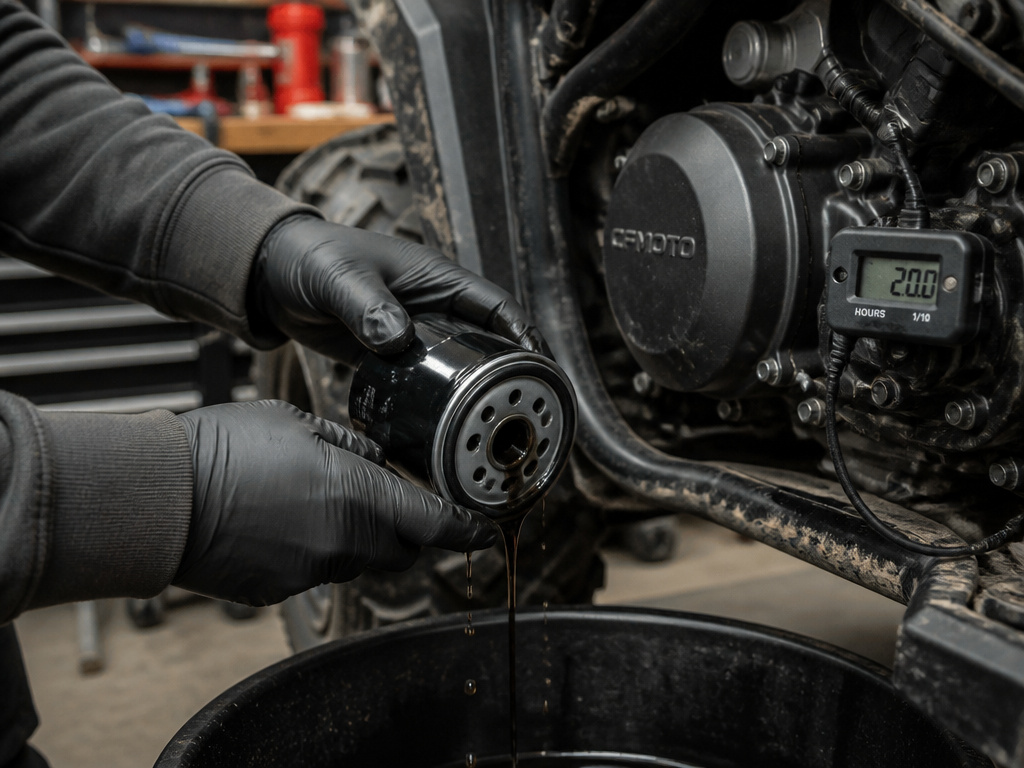 This is the single most important section of any Chinese ATV manual. It is not optional. The break-in period allows piston rings to seat properly, bearings to wear in evenly, and metal components to settle under controlled heat cycles.
Every manual we reviewed. Linhai, CFMOTO, Tao Motor, Benda, states the same core rule: the first 20 hours of operation are critical. During this time, you must avoid sustained high RPMs, never tow or carry cargo, and vary your throttle position constantly.
| Manufacturer | Break-In Duration | Key Prohibitions | First Service |
|---|---|---|---|
| Linhai | 20 hours | No towing; avoid full throttle; vary speed. | Oil & filter change at 20 hours. |
| CFMOTO | Not explicitly stated in sourced doc; industry standard is 20 hrs. | Avoid sustained idle; no heavy load. | Refer to dealer. |
| Tao Motor | Implied in break-in section; follow “first 10 hours” guidelines. | Do not operate over 1/2 throttle for first 10 hrs. | Check fluid levels frequently. |
| Benda | Referenced as “initial period”; follow run-in procedures. | No illegal modifications; no overloading. | Pre-ride inspection mandatory. |
What happens if you ignore it? The engine will never achieve optimal compression. You’ll burn oil sooner, lose power, and see significantly reduced engine life. The factory will detect this wear pattern during a warranty claim and deny it. This is the predictable outcome of metal components wearing in under excessive stress.
Where this goes sideways: Loading the racks or hooking up a trailer during break-in. The Linhai 420 manual lists a rear rack capacity of 20kg (44 lbs). Putting even half that weight on during the first 20 hours stresses the transmission and final drive before the gears have meshed completely. You’ll hear a faint whine from the differential that never goes away.
The procedure is simple but tedious. For the first 10 hours, keep the throttle under half. For hours 10-20, you can go to three-quarters. Never hold a steady RPM for more than a minute or two. Change the oil and filter exactly at the 20-hour mark. This initial oil will be full of microscopic metal shavings from the wear-in process.
Safety & Legal Fine Print You Actually Need to Read
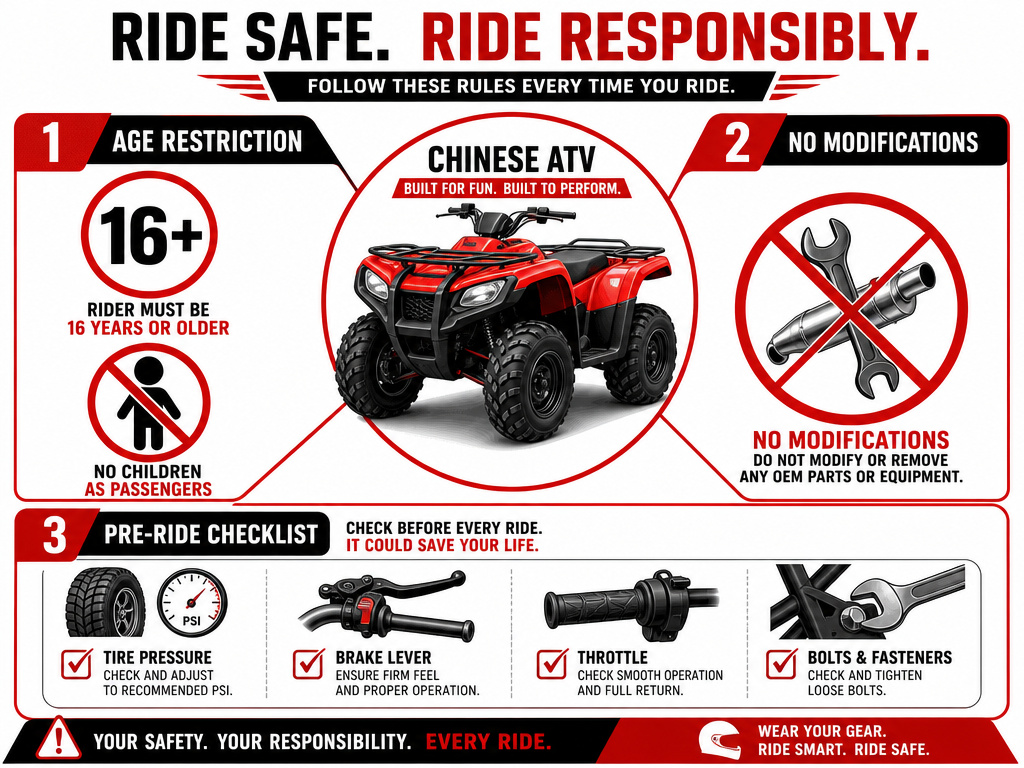 The safety warnings in a Chinese ATV manual are direct, legally consequential instructions that shift liability squarely to you if violated. Two clauses appear verbatim across every brand.
First, the age restriction. Most manuals state the operator must be 16 years or older. The Tao Motor CHEETAH manual specifies 12 years and older, but with a required adjustable speed limiter and direct parental supervision. If a child under the recommended age gets hurt, you have explicitly violated the manufacturer’s operating instructions. Your insurance company will notice.
Second, the modification ban. This is absolute.
Never make any modifications to the engine, drive system, mechanical or electrical systems of your ATV. Never install aftermarket parts or accessories intended to increase the speed or power of your ATV. – Linhai 420 Manual 23.0
This means no aftermarket exhaust, no fuel tuners, no lifted suspensions, and no engine swaps. The Benda ATV manual broadens this to a prohibition on any “illegal modification” to appearance, power, brakes, or chassis structure. Violating this doesn’t just void your warranty, it may violate local vehicle regulations, making the ATV illegal to operate.
The pre-ride checklist is your daily defense. All manuals include a 12-point list. The non-negotiable items are: 1. Tire pressure and condition. 2. Brake fluid level and lever function. 3. Throttle free play and return. 4. Loose nuts, bolts, or fasteners.
Skipping this five-minute check is how a loose axle nut turns into a wheel separation at low speed. The manuals are correct: this is a rider-active vehicle. Your safety depends on your own inspection.
Chinese ATV vs. Established Brand: A Spec Comparison
Looking at specs on paper reveals how Chinese manufacturers compete: by offering more physical capacity for a lower price point. But specifications don’t measure weld quality, bearing tolerances, or electrical harness durability.
Let’s compare two mid-size models: the Chinese-made Linhai 420 and the more established CFMOTO CFORCE 400.
| Specification | Linhai 420 | CFMOTO CFORCE 400 | What the Difference Means |
|---|---|---|---|
| Engine Displacement | 420cc (est.) | 400cc | Negligible real-world difference. |
| Load Capacity (Rider + Payload) | 150 kg (330 lbs) | 225 kg (496 lbs) | CFMOTO is rated for a heavier total load. |
| Ground Clearance | 220 mm (8.7 in) | 250 mm (9.8 in) | CFMOTO has over an inch more clearance for rougher terrain. |
| Fuel Capacity | 12.5 L (3.3 gal) | Not stated in sourced doc. | Linhai provides a specific, usable figure. |
| Tow Capacity | 200 kg (440 lbs) | Not stated in sourced doc. | Linhai publishes a tow rating; many competitors do not. |
The Linhai claims a specific tow rating, a concrete number for hauling a small trailer. The CFMOTO manual we accessed didn’t list one, which is common; many brands avoid stating a tow capacity for liability reasons. The Linhai’s lower ground clearance means you’ll be more careful over large rocks and fallen logs.
For a youth model, the Tao Motor CHEETAH lists a compression ratio of 9.5:1 and a specific spark plug type (NGK A7RTC). This level of detail is good, it tells an owner exactly what to buy. The absence of such specifics in a manual is a red flag.
The bottom line on specs: Chinese ATVs often publish bold numbers for capacity and tow rating. Treat these as maximums under ideal, break-in-followed, perfect-maintenance conditions. For durable, daily use, derate by 20%.
The Real Cost: Sticker Price vs. Landed Price
The advertised price online is a fantasy. One documented import of a $2,000 electric ATV from China ended up costing $4,800 after ocean freight, customs brokerage, tariffs, and port fees. The importer saved money by hauling the crate from the port himself.
Today, with elevated tariffs, that final cost could be 70-80% higher than the purchase price. You must factor in: – Ocean Freight: A few hundred to over a thousand dollars, depending on crate size. – Customs Brokerage: $200-$500 to clear the vehicle through customs. – Tariffs/Duties: Currently a significant and variable percentage of the item’s value. – Port Fees: Handling and storage charges at the arrival port.
If you buy from a U.S.-based distributor, these costs are baked into a higher MSRP, but you get a single price and the ATV is already stateside. You’re paying for convenience and reduced risk.
Common mistake: Budgeting only the Alibaba listing price. One owner’s final summation was more than double the initial cost, and the factory he bought from was defunct within a year, eliminating any parts pipeline.
Parts, Service, and the Dealer Question
This is the deciding factor. A Chinese ATV sold through a dedicated U.S. Distributor (like Linhai or CFMOTO) has a parts network and certified technicians. A no-name brand bought direct from China has zero support.
Before buying, call the nearest dealer. Ask three questions: 1. Do you stock common wear items: filters, brake pads, drive belts? 2. What is the lead time for an engine-specific part like a piston or gasket set? 3. Is there a certified technician on staff, or do you send repairs out?
If the answer to any is “no” or “we don’t know,” walk away. Your ATV will become a lawn ornament the first time a unique component fails. For simpler machines like the Tao Motor CHEETAH, its 150cc engine is a common generic pattern, so parts are easier to find online. This is a major point in its favor for a basic youth or utility ATV for farm work.
For more complex 4WD ATVs with liquid cooling and electronic fuel injection, proprietary parts are inevitable. Your experience with a Chinese brand will mirror your experience with any niche vehicle: joy when it runs, frustration when it breaks, and a long wait for a solution.
Frequently Asked Questions
Are Chinese ATVs safe?
They can be, if and only if you treat them exactly as the manual dictates. The machines meet basic safety standards to be imported. The greater risk is operator error, ignoring age limits, skipping pre-ride inspections, or modifying the machine. The safety information in the manual is comprehensive and correct; the variable is the rider’s discipline.
What is the best Chinese ATV brand?
For supported, serviceable machines in the U.S., Linhai and CFMOTO are the leading brands. They have established dealer networks, parts distribution, and model-specific manuals. CFMOTO, in particular, has made significant inroads with models like the CFORCE 400. For a basic, small-displacement machine, Tao Motor offers clear manuals and simple engines. Avoid any brand without a verifiable U.S. Distributor.
Do Chinese ATVs hold their value?
No. They depreciate rapidly, much faster than a comparable Polaris, Can-Am, or Honda. Their resale market is thin. Buy a Chinese ATV because it meets a specific need at a specific price point, not as an asset. Plan on keeping it for its full service life or selling it at a steep discount.
Can you get parts for Chinese ATVs?
For brands with U.S. Distributors, yes, but with longer wait times than mainstream brands. For direct-import, no-name models, parts are a scavenger hunt on Alibaba or eBay. This is the primary reason we caution against direct imports, even for intriguing electric ATVs. The initial savings evaporate with the first breakdown.
Are Chinese ATVs good for beginners?
They can be, but with caveats. A youth model like the Tao Motor CHEETAH with a speed limiter is designed for this. However, the need for strict mechanical sympathy during break-in and maintenance is higher. A beginner who is also inexperienced with vehicle maintenance might be better served by a used, name-brand youth ATV from a local dealer where support is easier.
The Bottom Line
Are Chinese ATVs any good? They are a competent tool for a specific, informed buyer. That buyer reads the manual first, respects the 20-hour break-in as scripture, never modifies the drivetrain, and has a confirmed plan for parts and service.
For a cost-conscious user who needs a basic machine for light farm work or trail riding and possesses mechanical discipline, a Linhai or CFMOTO from a local dealer is a rational choice. For anyone tempted by a too-cheap-to-be-true direct import, the answer is a firm no. The machine that arrives will be exactly as good as the manual says it can be, and not one bit better.
