
Answering How Long ATV Tires Last With Maintenance Advice
This post contains affiliate links. As an Amazon Associate, we earn from qualifying purchases.
ATV tires last between a few hundred and 5,000 miles, but the real answer is in the tread depth and the calendar. Most stock tires wear out between 1,200 and 4,000 miles of mixed use. Replace any tire when the tread depth reaches 3 mm (1/8 inch), or when sidewall cracks or dry rot appear, whichever comes first. Terrain is the dictator: asphalt can burn through a set in a single season, while sand might let them dry rot after five years.
That 3 mm rule is the manufacturer’s hard line for losing traction, especially on side slopes. The calendar matters just as much because the rubber compound breaks down from UV exposure and ozone, regardless of miles.
What follows is the breakdown of why your mileage will never match someone else’s, the specific failure modes for popular stock tires, and the maintenance schedule that actually works when you’re knee-deep in mud every weekend.
Key Takeaways
- The legal and safe minimum tread depth for ATV tires is 3 mm (1/8 inch), per Polaris and Can-Am manuals. Below that, hydroplaning and rollover risk spike.
- Stock tires like the Carlisle AT489 (Can-Am) may last 4,000 miles on pavement but will likely dry rot before the tread wears out on sand.
- “Severe Use”, defined by Polaris as frequent mud/water immersion or constant high RPM, cuts all maintenance intervals in half, including tire inspections.
- High-performance, soft-compound tires like the GBC Dirt Commander trade longevity for grip; some users report rear tires worn out in 500 miles.
- Tire pressure is not a set-and-forget spec. Running over or under the 7.0 psi cold pressure marked on your frame degrades handling and accelerates wear at the center or edges of the tread.
What Dictates ATV Tire Lifespan? It’s Not Just Miles
Your odometer is a liar when it comes to tire wear. Two riders can put 1,000 miles on identical machines and have tires in completely different conditions. The lifespan is a negotiation between three fixed parties: the rubber compound, the terrain under it, and the weight on top.
The rubber compound determines the tire’s inherent hardness. A harder compound resists abrasion but offers less grip, especially in mud or on rocks. Softer compounds, like those on dedicated mud tires, grip like glue but shear away quickly on hardpack. It’s a direct trade-off. You cannot have a tire that claws through clay and also lasts 5,000 miles on gravel roads.
The type of surface you ride on is the most critical factor for how long your ATV tires last. Tire wear increases with higher surface traction, asphalt wears tires fastest, loose sand the slowest.
Then there’s load. An ATV like a Polaris Sportsman XP1000 has a maximum weight capacity of 485 lbs. Exceed that with cargo, a passenger, and gear, and you’re overloading the tires. The sidewalls flex more, generating internal heat. The tread squirms under acceleration and braking, scrubbing off rubber faster. It also increases the risk of a puncture or sidewall tear on sharp obstacles.
The Surface You Ride On Is Everything
Think of your tire tread as a pencil eraser. Dragging it lightly across paper does little. Scrubbing it hard on concrete wears it down fast. Your riding surface is that paper or concrete.
Here’s how common terrains rank in terms of wear, from most abrasive to least: | Terrain Type | Wear Rate | Why It Wears Tires | |————————|————————|—————————————————————————————-| | Asphalt & Pavement | Very High | High friction and heat generation scrubs rubber off with every rotation. | | Hard-Packed Dirt/Gravel| High | Abrasive, mineral-based surface acts like sandpaper on the rubber lugs. | | Rocky Trails | Moderate to High | Sharp edges can cut and chunk lugs, especially with aggressive throttle. | | Grass & Fields | Moderate | Less abrasive than dirt, but hidden rocks or roots can cause impact damage. | | Mud & Deep Water | Low (for tread) | Lubricates the surface, but hides sharp objects and stresses sidewalls. | | Sand & Snow | Very Low | The tire floats on top; minimal abrasion occurs, so dry rot becomes the primary enemy. |
This table explains why forum reports vary so wildly. A rider logging miles on sandy trails might see 90% tread after 2,000 miles. Another rider commuting the same distance on county roads could be shopping for replacements.
How Do You Know When an ATV Tire Is Worn Out?
You need two measurements: a tread depth gauge and the date code on the sidewall. The 3 mm rule is your mechanical limit. The date is your chemical one.
The 3 mm (1/8 inch) tread depth is the universal replacement threshold from Polaris, Can-Am, and most other OEMs. Below this depth, the tire’s ability to evacuate water, grip on side slopes, and self-clean in mud plummets. You can measure it with a dedicated gauge or even a U.S. Quarter coin, if the tread is flush with Washington’s head, you’re at or below 3 mm.
Where this goes sideways: Ignoring tread depth on the front tires. Worn fronts lose steering precision and increase the risk of understeer, where the ATV plows straight ahead in a turn. On a side hill, that’s a rollover.
Beyond tread, inspect for these physical failures: – Dry Rot & Cracking: Look for a network of fine cracks in the sidewall or between tread blocks. This is the rubber oxidizing and losing its flexibility. A dry-rotted tire can blow out without warning, even with full tread. – Cuts, Gouges, and Bulges: A deep cut that exposes the cord layers (the crisscross fabric underneath) is a immediate failure. A bulge in the sidewall indicates internal ply separation, the tire is structurally compromised. – Uneven Wear Patterns: Cupping (scalloped dips around the tread) or feathering (sharp edges on one side of the tread blocks) points to suspension issues, misalignment, or chronic underinflation. It’s a sign something else is wrong.
If your tires are more than six years old, start inspecting the sidewalls for cracking every ride. Rubber deteriorates with age, heat, and UV exposure. This is why checking the safety of aging ATV tires is a non-negotiable part of long-term ownership.
Real-World Mileage: What Can You Actually Expect?
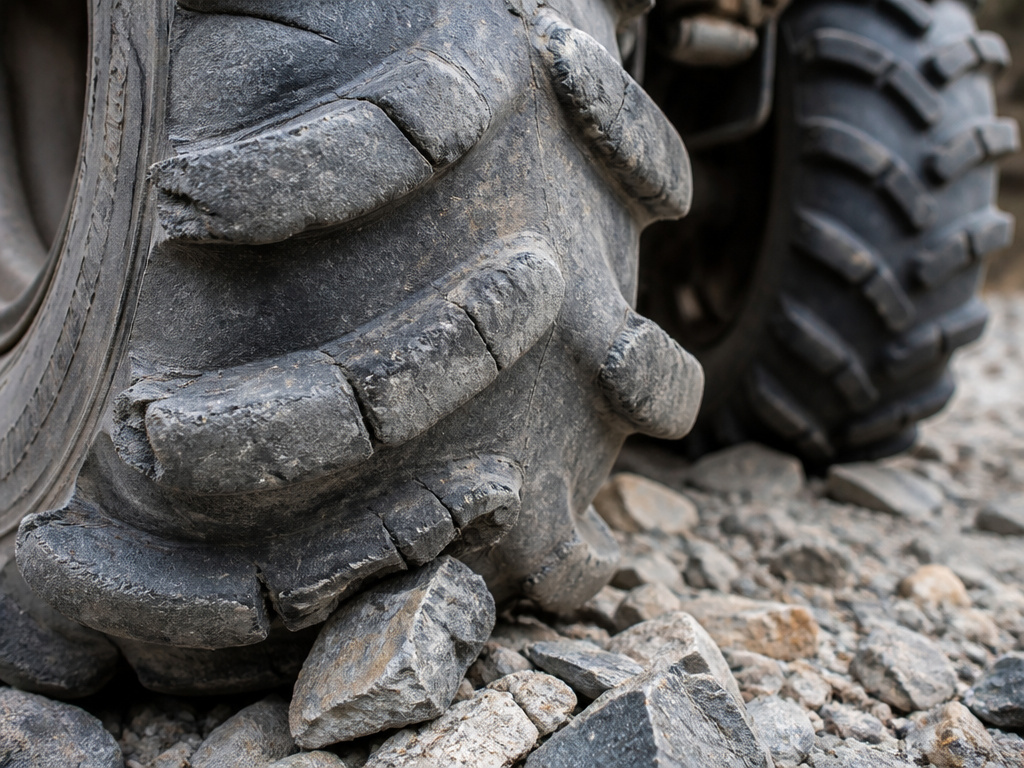 Forget the marketing. Real mileage comes from owner reports on forums and long-term tests. Here’s what the data shows for some common tires.
| Tire Model | Common Vehicle | Reported Mileage | Key Wear Note |
|---|---|---|---|
| Carlisle AT489 (Stock) | Can-Am XT models | 1,700–4,000 miles | Longevity on pavement; often dry rots before wearing out on soft terrain. |
| Carlisle PXT (Stock) | Polaris Sportsman XP1000 | 900–5,000 miles | Thin sidewalls are a vulnerability; tread can last if sidewalls survive. |
| GBC Dirt Commander | Aftermarket Mud Tire | 500 miles (rear) | Excellent grip traded for very fast wear, especially on hard surfaces. |
| STI Roctane XD | Aftermarket All-Terrain | 2+ seasons (trail use) | Cited by users as a long-lasting performer in mixed conditions. |
| ITP Terra Cross R/T | Aftermarket Radial | 3,000+ miles | 8-ply radial construction resists punctures and offers stable wear. |
These numbers are snapshots, not guarantees. A GBC Dirt Commander will die quickly on rocky trails but might last longer in pure, soft mud.The Carlisle AT489’s reported 4,000-mile life assumes mostly road use; in the rocks, it could be half that.
The takeaway is that stock tires are a compromise. Manufacturers choose a compound and tread pattern that is acceptable for everything but exceptional at nothing. That’s why so many owners immediately swap to aftermarket options. If you’re looking for an upgrade, our guide to the best ATV tires breaks down the top models for every purpose.
The Maintenance That Actually Extends Tire Life
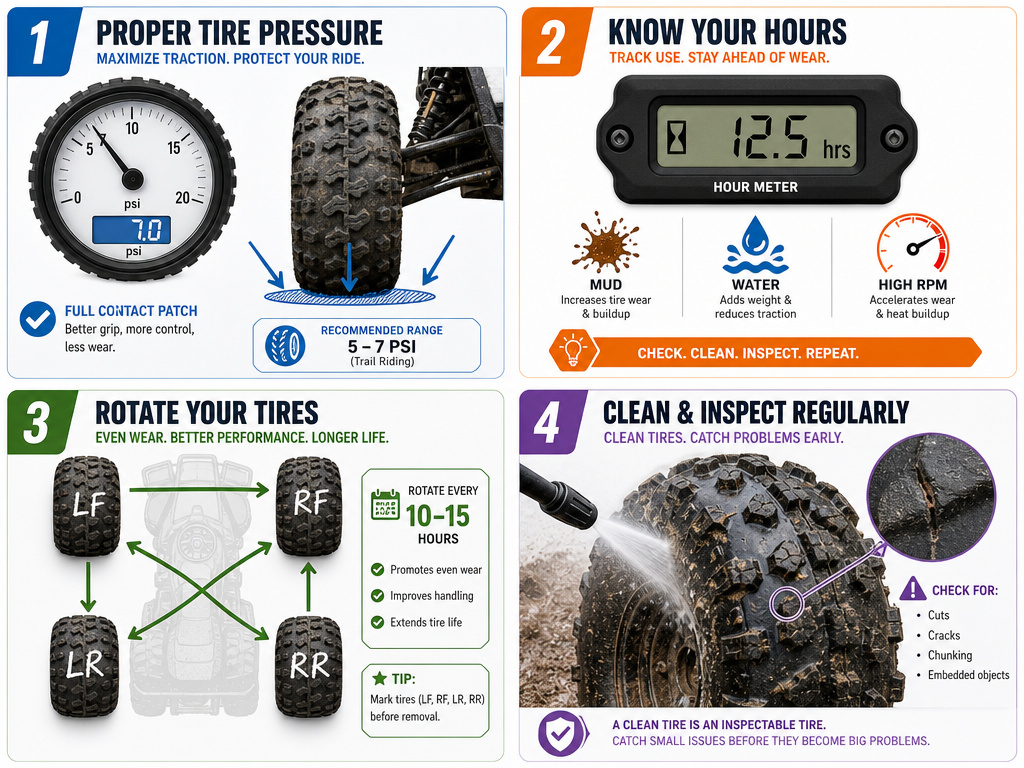 Maintenance is about preventing the accelerated wear that turns a 3,000-mile tire into a 1,500-mile tire.
1. Pressure Checks Are Non-Negotiable
Your ATV’s correct cold tire pressure is printed on the frame or in the manual, often 7.0 psi for many Polaris models. This low pressure is for a reason: it maximizes the contact patch for traction. Use a low-pressure gauge designed for ATVs (0-15 psi range). Check it monthly and before every long ride. – Underinflation: The tire’s shoulders wear faster, the sidewalls overflex and overheat, and the risk of pinch flats (snapping the inner tube or damaging the bead) goes up. – Overinflation: The center of the tread wears out prematurely, the ride becomes harsh, and traction drops because the tire can’t conform to the terrain.
2. The “Severe Use” Clause in Your Manual is Real
Polaris defines “Severe Use” with specific examples: frequent immersion in mud, water, or sand; constant high RPM use; prolonged low-speed heavy load operation. If your riding matches that description, the manual states you must service the vehicle, including tire inspection, at 50% of the normal interval.
That means if the schedule says “inspect tires every 25 hours,” you’re doing it every 12.5 hours. This advice recognizes that these conditions chew through components. Ignoring this clause is how you find a belt shredded or a tire with hidden damage at the worst possible moment.
3. Rotate to Manage Wear
ATV tires don’t wear evenly. The rear tires, especially on a 2WD machine, handle all the acceleration and most of the braking load. They wear faster. Rotating front to rear (if tire sizes are the same) helps equalize this. Do it every other oil change, or about every 50 operating hours. Mark the tires with chalk (LF for Left Front, etc.) so you can track the rotation pattern.
4. Clean and Inspect After Every Mud Ride
Mud hides damage. It also contains minerals and debris that can accelerate dry rot. Pressure-wash tires (avoiding direct, close-range blasts on the sidewall seals) after muddy rides. Once clean, you can actually see cuts, embedded rocks, or cracks you’d otherwise miss.
Bias-Ply vs. Radial: The Construction Choice That Changes Everything
This is the single biggest technical decision you make when buying tires. It dictates how the tire feels, wears, and resists damage.
Bias-Ply Tires have cords that run diagonally across the tire from bead to bead, with layers crisscrossing. This creates a stiff sidewall. – Pros: Strong, puncture-resistant sidewall. Often less expensive. Better for extreme rock crawling where sidewall bruising is a risk. – Cons: Stiffer ride, runs hotter at speed, and the tread can “wiggle” under load, leading to faster and sometimes uneven wear.
Radial Tires have cords that run perpendicularly from bead to bead, with a stabilizing belt under the tread. The sidewall is more flexible. – Pros: Soother ride, runs cooler, and the tread footprint remains more stable under load, promoting even wear and better high-speed handling. – Cons: The sidewall is more vulnerable to punctures and cuts from sharp rocks.
For most trail riders who value a comfortable ride and even wear, a modern 6 or 8-ply radial is the better choice. For hardcore rock bashers, the bias-ply’s brute-force sidewall strength still has a place. Understanding this difference is key when reading ATV tire reviews to find your match.
When To Replace: A Simple Decision Tree
Stop guessing. Follow this path.
- Check the date code. Is the tire over 6 years old? If yes, plan a replacement soon, regardless of tread.
- Measure the tread. Is it at or below 3 mm (1/8 inch)? If yes, replace immediately.
- Perform the visual inspection. Are there cracks, deep cuts, bulges, or exposed cords? If yes, replace immediately.
- Consider your usage. Are you about to enter a season of “Severe Use” as defined by your manual? If yes and the tires are even halfway worn, replace them proactively. Blowing a tire ten miles from the truck in a swamp is not an adventure.
If you’re replacing tires, it’s the perfect time to consider your wheel selection. A good, strong wheel is just as important as the tire mounted on it.
Frequently Asked Questions
Can I Just Replace Two ATV Tires?
You can, but you shouldn’t. Mismatched tread depths or patterns between the front and rear axles can upset the ATV’s handling, especially in slippery conditions. The different grip levels can cause unpredictable behavior in corners or during braking. For stability and safety, replace all four tires at once. If you must stagger, replace them in pairs (both fronts or both rears) with the same model.
Do ATV Tires Need To Be Balanced?
For typical trail speeds under 45 mph, balancing is not critical. The low tire pressure and flexible sidewall allow the tire to conform. If you do a lot of high-speed road running or feel a persistent vibration in the handlebars at speed, then balancing can help. Most ATV tire shops can perform static balancing, which is sufficient.
Why Do My New ATV Tires Wear So Fast at First?
Many aggressive tread patterns have sharp, tall lugs. The leading edges of these lugs bear the brunt of initial contact and can wear down noticeably in the first few hundred miles. This is often called the “break-in wear.” After these edges round off slightly, the wear rate usually stabilizes and becomes more gradual. It’s not a defect; it’s the tread settling into its working shape.
Are Non-Pneumatic (Airless) Tires Good for ATVs?
The technology exists, these tires use a flexible web structure instead of air. The main advantage is zero flats. The trade-offs are significant: a much harsher ride, increased weight (which affects suspension and performance), and currently, very limited tread pattern options for serious off-road use. For now, they remain a niche product best suited for commercial or utility applications where puncture risk is the primary concern.
What’s the Best All-Around Tire for Longevity?
If you ride a true mix of terrain, some hardpack, some mud, some rocks, a high-quality 6 or 8-ply radial all-terrain tire typically offers the best balance of wear and performance. Models like the ITP Terra Cross R/T or the STI Roctane XD consistently get praise for their durability in mixed conditions. For a dedicated deep-dive, see our picks for the best all-around ATV tires.
Before You Go
Your ATV’s tires are its only connection to the ground. Their condition dictates everything from fuel economy to whether you make it home. The number isn’t 10,000 miles. For most riders, it’s somewhere between the 1,200-mile burnout of a soft mud tire and the 4,000-mile slow fade of a stock all-terrain.
Watch the tread depth gauge. Respect the “Severe Use” calendar. And when the lugs get thin, don’t push it. The cost of a new set of versatile tires is always less than the cost of a recovery from a trail you couldn’t climb or a slide you couldn’t control.
